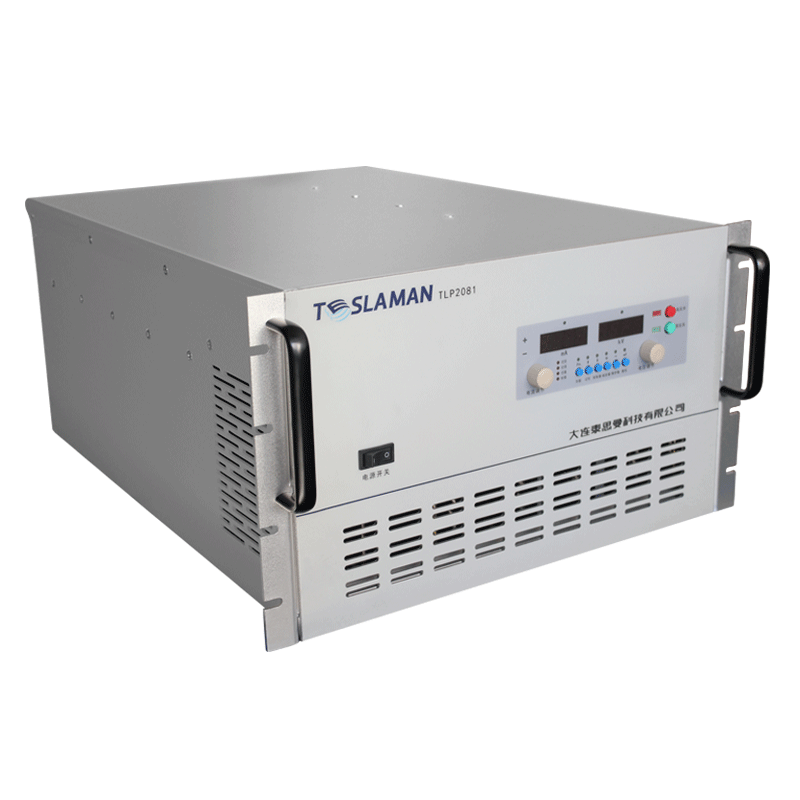
-800 V Pulsed Bias Power Supply for Magnetron Sputtering in Coating Systems
Reactive magnetron sputtering of high-quality optical filters and wear-resistant coatings increasingly relies on mid-frequency pulsed bias at –600 to –1000 V to suppress arcing on poisoned targets while maintaining ion energy sufficient for dense, low-stress films. Modern –800 V pulsed bias supplies therefore deliver asymmetric bipolar pulses at 40–250 kHz with reverse voltage amplitude 10–25 % of negative peak, rise/fall times under 280 ns, and arc energy limited to <0.6 mJ per event.
The topology uses a full H-bridge of 1.2 kV silicon carbide MOSFETs driving a 1:6 ferrite transformer followed by a passive voltage-doubling output stage that generates the positive reverse phase without additional active switches. Pulse width and reverse amplitude are independently programmable in 40 ns increments via a fiber-isolated gate driver board, enabling precise tailoring to target material and reactive gas partial pressure.
Arc management employs a multi-stage response: micro-arcs (<0.4 mJ) are extinguished by instantaneous bridge disable for 1.1–2.4 µs followed by soft restart at 65 % voltage; macro-arcs trigger full reverse-voltage override at +180 V for 5–9 µs to actively extract electrons from the cathode spot. Arc detection sensitivity reaches 28 A/µs via di/dt monitoring on the output cable, achieving total delivered energy per event below 0.52 mJ across Al, Ti, and Cr targets in oxygen-rich atmospheres.
Output filtering uses distributed L-C sections with vacuum-grade mica capacitors and air-core inductors to present high impedance at arc frequencies while maintaining flat pulse tops within ±2.8 % across 180 µs negative phase. Overshoot is actively damped by a small auxiliary MOSFET that injects counter-current during transitions, preventing voltage spikes that seed new arcs on partially poisoned targets.
Process synchronization supports HIPIMS superposition: the bias supply accepts an external trigger with <110 ns jitter and phase-locks its positive reverse pulse to the falling edge of the magnetron HIPIMS pulse, ensuring ion bombardment occurs exactly during the optimal afterglow phase for maximum film density without resputtering.
Thermal design uses immersion cooling in fluorinated fluid with redundant magnetically coupled pumps, maintaining junction temperatures below 72 °C at 40 kHz 75 % duty on 8 kW average output. These –800 V pulsed bias supplies routinely achieve defect densities below 0.08 cm⁻² on 200 mm optical stacks and hardness above 42 GPa on TiAlN tool coatings while extending target utilization by 38 % through reduced poisoning downtime.