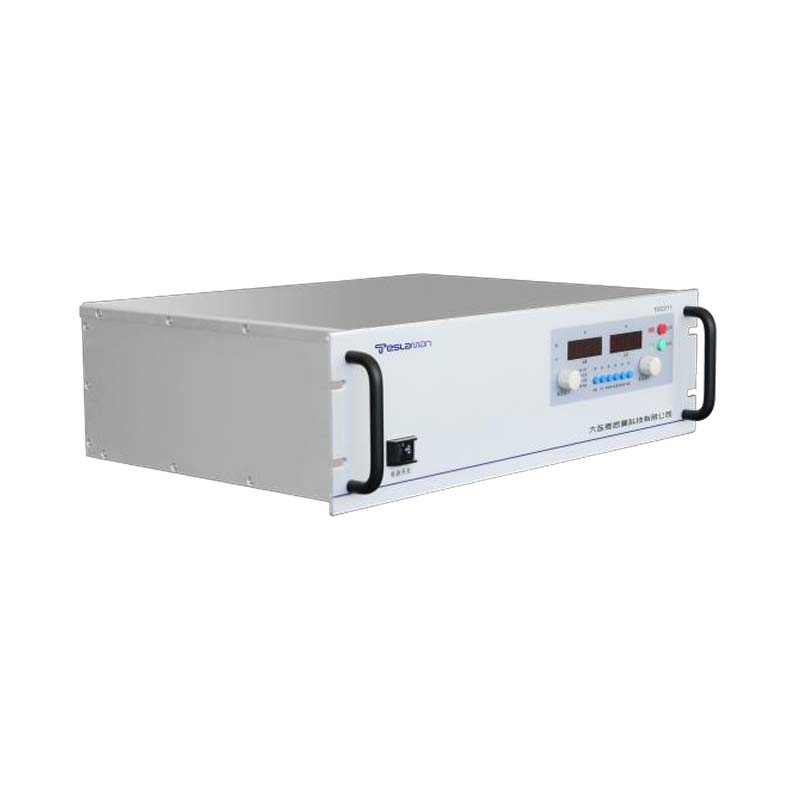
High Voltage Power Supply for Coating Arc Discharge Detection
Physical Vapor Deposition (PVD) coating processes, such as magnetron sputtering and cathodic arc deposition, rely on the establishment and maintenance of a stable plasma discharge. A common and significant challenge in these processes, particularly in reactive sputtering of insulating or compound layers, is the occurrence of arc discharges. Arcs are localized, high-current discharges that form on the target surface, causing ejection of macro-particles, degrading film quality, damaging the target, and potentially destabilizing the entire plasma. Consequently, the high-voltage power supply used to energize the cathode (target) is not only a source of power but also the first line of defense in arc management. Its ability to rapidly detect and quench arcs is paramount for achieving high-quality, defect-free coatings. This analysis explores the functional requirements and technological implementations for arc discharge detection and handling within high-voltage power supplies for coating applications.
Arc formation is an intrinsic risk in sputtering processes. In reactive sputtering of materials like aluminum oxide or silicon nitride, a reactive gas (oxygen, nitrogen) combines with the sputtered metal on the target surface to form an insulating compound layer. This layer charges up due to ion bombardment, leading to a drastic increase in local electric field strength until it breaks down in a violent arc discharge. Even in DC sputtering of metals, surface irregularities, impurities, or dielectric inclusions can initiate arcs. The arc is characterized by a near-instantaneous collapse of the cathode voltage and a very rapid rise in current, limited only by the circuit impedance. If allowed to persist for even milliseconds, it can cause significant damage.
Therefore, the primary requirement for the power supply is ultra-fast arc detection. Detection is typically based on monitoring the rate of change of voltage (dV/dt) and/or current (dI/dt), or by setting thresholds for absolute voltage drop. A genuine arc event causes the voltage to plummet and the current to surge with a characteristic speed that distinguishes it from normal noise or load variations. Modern power supplies implement detection algorithms in dedicated high-speed field-programmable gate arrays (FPGA) or digital signal processors (DSPs) that can identify an arc signature within 1 to 5 microseconds of its initiation. This processing speed is critical, as the goal is to interrupt the energy flow before the arc fully develops and causes damage.
Upon detection, the power supply must execute a quenching sequence. The simplest method is to simply shut off the output. However, a hard shut-off can induce high-voltage transients due to the inductive elements in the circuit and the plasma itself. More sophisticated strategies involve a multi-stage response. The first action is often to momentarily reverse the output polarity of the power supply. This "positive kick" actively pulls electrons away from the arcing site, helping to de-ionize the arc path and extinguish the discharge more effectively than just turning off the power. This reversal must be precisely controlled in magnitude and duration (typically tens of microseconds) to be effective without unnecessarily disturbing the entire plasma.
Following the quenching pulse, the power supply must manage the recovery of the process voltage. An immediate reapplication of full voltage to a still-ionized path can re-ignite the arc. Therefore, a gradual, controlled ramp-up of voltage is employed, often referred to as a "soft-start" recovery. The power supply's control logic monitors the load during this ramp; if the arc condition seems to persist (indicated by unstable voltage or current), it may abort the ramp and re-initiate the quenching cycle or enter a fault state. The speed and reliability of this recovery process directly impact the duty cycle of the sputtering process and the average deposition rate.
The architecture of the power supply heavily influences its arc handling capability. Switch-mode power supplies (SMPS), particularly those using insulated-gate bipolar transistors (IGBTs) or metal-oxide-semiconductor field-effect transistors (MOSFETs), offer distinct advantages for arc management. Their high switching frequency allows for extremely fast control loop responses. The output can be modulated or shut down within a single switching cycle (often a few microseconds). Furthermore, the energy stored in the output filter of an SMPS is relatively low compared to a traditional DC supply with large smoothing capacitors. This lower stored energy inherently limits the maximum energy that can be dumped into an arc before the supply can react, thereby reducing potential damage.
Advanced systems go beyond simple detection and quenching, incorporating arc prevention and process stabilization features. Some power supplies analyze the frequency and pattern of arc events to adjust their operating parameters preemptively. For instance, if micro-arcs (small, frequent discharges) are detected, the supply might temporarily reduce the power or introduce a low-frequency modulation to help dissipate charge build-up on the target before it reaches the critical breakdown point. This proactive approach enhances process stability, especially during reactive deposition of sensitive materials.
Integration with the coating plant's overall control system is also essential. The power supply must communicate arc event counts, energy per arc, and fault status to a supervisory controller. This data is valuable for process diagnostics, predicting target life, and optimizing run schedules. In summary, the high-voltage power supply in a coating application is a dynamic control system engineered for instability management. Its value is measured not just by its output power stability, but by its speed, intelligence, and effectiveness in detecting, quenching, and recovering from arc discharges. Through sophisticated real-time monitoring, ultra-fast switching, and adaptive control algorithms, these power supplies protect capital equipment, ensure consistent film quality, and enable the reliable production of advanced functional coatings used in optics, semiconductors, and tooling industries.