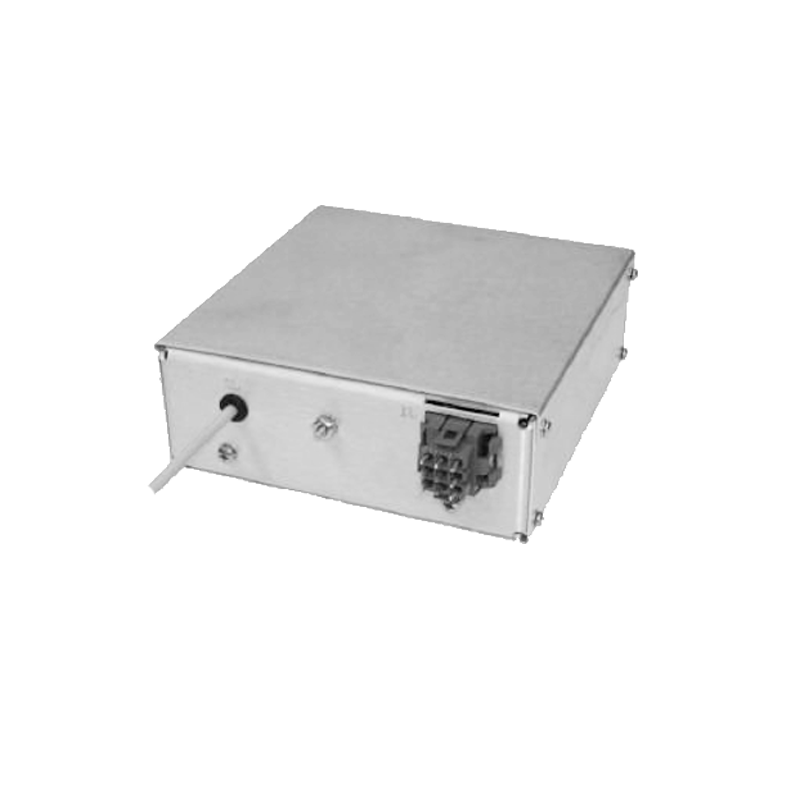
Blood Irradiation Uniform Dose Rotating Field Power Supply
The irradiation of blood products, primarily to prevent transfusion-associated graft-versus-host disease (TA-GVHD), is a critical medical procedure. It requires the delivery of a precisely controlled and uniformly distributed dose of ionizing radiation, typically gamma or X-rays, to blood bags. In X-ray based blood irradiators, a key technological challenge is overcoming the inherent dose non-uniformity caused by the geometry of the blood bag and the attenuation of radiation as it passes through the product. A highly effective solution employs a rotating irradiation field, where the X-ray source, the blood bag, or both, are moved in a complex pattern during exposure. The power supply system enabling this motion, particularly for systems that manipulate electromagnetic fields to "steer" an electron beam or control rotating anode targets, is a critical component for achieving the mandated dose uniformity specifications. This analysis focuses on the requirements for high-voltage and high-precision drive power supplies in such rotating field blood irradiation systems.
The fundamental goal is to ensure that every volume element within the blood bag receives a dose within a narrow tolerance band, often ±10% or better of the target dose. A static X-ray beam would produce a steep dose gradient, with areas proximal to the source receiving a much higher dose than distal areas. Rotation mitigates this by effectively averaging the exposure from multiple angles. In advanced systems, this is not simple rotation but often a complex, programmed orbital or helical motion. The mechanism for creating this moving field can vary. One design uses a stationary X-ray tube but physically rotates the blood bag container in multiple axes within the irradiation chamber. Another, more sophisticated approach maintains a stationary blood bag but uses electromagnetic deflection to cause the electron beam within an X-ray tube to scan in a programmed pattern across a stationary or semi-stationary target, creating a moving X-ray source point.
The latter method places the most direct demands on specialized power supplies. It requires a scanning electron beam system integrated into the X-ray tube. This involves two pairs of electromagnetic deflection coils (for X and Y axes) placed around the electron beam path. To create a smooth, precise scanning pattern—such as a circle, a spiral, or a Lissajous figure—the coils must be driven by precisely controlled, time-varying currents. The power supplies for these deflection coils are therefore bipolar, linear current amplifiers. Their performance dictates the accuracy and stability of the scan. Linearity is paramount: any non-linearity between the command voltage and the resulting coil current translates directly into a distortion of the scan pattern, leading to localized hotspots or coldspots in the dose distribution. The amplifiers must also have low offset drift and low noise; a DC offset would shift the entire scan pattern off-center, while noise would cause high-frequency jitter in the beam position, blurring the intended dose profile.
The scanning pattern itself is not arbitrary. It is calculated through detailed radiation transport simulations to optimize dose uniformity for a specific blood bag geometry and composition. The power supply system must be capable of reproducing this pre-computed pattern with high fidelity. This requires a digital control system where the desired current waveforms for the X and Y coils are stored in memory or generated algorithmically in real-time. The coil amplifiers must have sufficient bandwidth to reproduce the highest frequency components of these waveforms without phase lag or amplitude roll-off. If the pattern involves rapid directional changes (e.g., in a raster scan), the amplifiers must have a high slew rate to avoid rounding the corners of the pattern, which would lead to overdosing at the turning points. Synchronization with other systems is also critical. The timing of the scan must be synchronized with the pulse of the main high-voltage supply powering the X-ray tube (if pulsed), and the entire exposure sequence must be timed to deliver the exact prescribed dose.
The main high-voltage power supply for the X-ray tube itself also has specific requirements in this context. Dose uniformity is achieved through motion, but the absolute dose is controlled by the X-ray output, which is a function of the tube voltage (kV) and current (mA). This supply must be exceptionally stable. Any drift in tube voltage during the irradiation cycle would change the penetration depth (quality) of the X-rays, altering the dose distribution and potentially undermining the uniformity achieved by the scan. Thus, the high-voltage supply requires low ripple and excellent regulation. In systems using a rotating anode to dissipate heat, the anode drive motor also requires a stable power source, as variations in rotational speed could cause minute variations in the effective focal spot size or position.
For systems that physically rotate the blood bag, the power supply requirements shift to high-torque, precision motor drives. These motors must operate smoothly and reliably within a shielded irradiation chamber. Their drives must provide precise speed and position control, often incorporating feedback from encoders. The motion profile is likely not constant-speed rotation but a more complex sequence to present all parts of the bag equally to the radiation source. The motor drives must therefore be programmable and synchronized with the radiation output monitor to stop exposure when the integrated dose reaches the prescribed level.
Safety and reliability are paramount in medical equipment. All power supplies involved—the main high-voltage generator, the beam deflection amplifiers, and the motor drives—must be designed with redundant safety interlocks. The system must include continuous monitoring of scan amplitude and pattern. A failure of a deflection amplifier that causes the beam to become stationary would result in a severe overdose in one region and underdose elsewhere. Therefore, the control system must monitor the coil currents or a derived beam position signal and immediately inhibit the high voltage if the scanned pattern deviates beyond strict limits. This necessitates fast, reliable fault detection circuits within the power supply subsystems.
In summary, the power supplies for a rotating field blood irradiator are instruments of precision motion control and stable high-voltage generation. Their role is to translate a computationally optimized scan pattern into a perfectly reproduced physical motion of the radiation field. This demands linear, low-noise, wide-bandwidth amplifiers for beam steering; ultra-stable high-voltage outputs for consistent X-ray generation; and precise motor drives for mechanical manipulation. By ensuring the exact execution of these complex motions, the power supply system is a direct enabler of the uniform dose delivery that is essential for the safety and efficacy of blood product irradiation, a life-saving medical procedure.