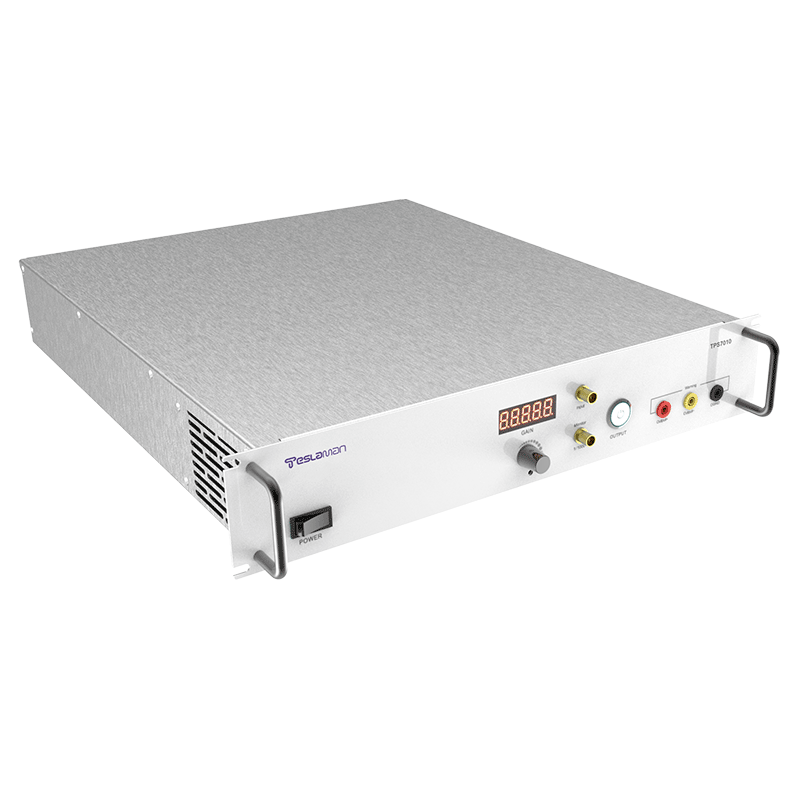
Non-Destru ctive Testing Phased Array High Voltage Excitation Power Supply
Phased arr ay ultrasonic testing (PAUT) has revolutionized non-destructive evaluation (NDE) by enabling electronic beam steering, focusing, and scanning without moving the probe. This is achieved by using an array of piezoelectric transducer elements, each of which must be excited by a high-voltage, short-duration electrical pulse to generate an ultrasonic wave. The performance of the entire PAUT system—its resolution, penetration depth, signal-to-noise ratio, and imaging fidelity—is fundamentally determined by the characteristics of the excitation pulses and the ability to control their timing with nanosecond precision across dozens or hundreds of channels. The high-voltage excitation power supply system is therefore a complex, multi-channel pulse generator that must balance high power, fast switching, precise timing, and channel-to-channel consistency.
The core r equirement is to generate a unipolar or bipolar high-voltage pulse, typically in the range of 50V to 400V, with a very fast rise time (often less than 10 nanoseconds) and a controlled pulse width (tens to hundreds of nanoseconds). The fast rise time is essential for generating a broadband ultrasonic pulse, which improves axial resolution (the ability to distinguish between closely spaced reflectors). The high voltage is necessary to deliver sufficient electrical energy to the transducer element to produce an ultrasonic wave with enough amplitude to penetrate thick or attenuative materials and return a detectable echo. The traditional solution for each channel is a simple MOSFET-based pull-down circuit charged by a central high-voltage DC supply. However, for a phased array system, this simple model must be expanded and refined dramatically.
The first major challenge is multi-channel synchronization and timing. Beam steering is accomplished by applying sequential delays to the excitation pulses of each element in the array. A delay miscalibration of just 1-2 nanoseconds can cause significant beam squint or side lobe generation, degrading image quality. Therefore, the excitation pulser for each channel must be triggered by a digital delay line with sub-nanosecond jitter. This is often implemented using field-programmable gate arrays (FPGAs) with high-speed serial outputs driving the gate of the high-voltage switch. The propagation delays of the trigger signals to each channel must be matched through careful PCB layout. Furthermore, the high-voltage switching devices themselves (MOSFETs or GaN HEMTs) have characteristic turn-on delays that vary with temperature and voltage. Advanced designs incorporate calibration routines that measure and compensate for these variations, ensuring the acoustic delay from the electronic trigger is identical for all channels.
The second challenge is channel-to-channel amplitude uniformity and pulse shape consistency. Variations in the amplitude or waveform of the excitation pulse directly translate into variations in the acoustic output of each transducer element. This causes grating lobes (unwanted beams at angles other than the intended steering angle) and reduces beamforming gain. To achieve uniformity, the high-voltage DC rail feeding each pulser must be exceptionally stable and free of droop during simultaneous firing of multiple channels. This often requires a distributed power architecture with local energy storage capacitors at each channel. The pulser circuit itself must be designed for low jitter and consistent output impedance. The characteristic impedance of the pulser should match that of the coaxial cable and transducer element to prevent reflections that distort the pulse shape. Active feedback circuits can be used to monitor the actual voltage pulse applied to each transducer and make minor adjustments to the gate drive to correct for deviations.
The third consideration is flexibility and programmability. Different inspection tasks require different excitation waveforms. A long, tone-burst pulse might be used for improved sensitivity in a low-noise environment, while a short, spike excitation is used for high resolution. Some advanced techniques use coded excitations (like chirps) to improve signal-to-noise ratio. The excitation power supply system must therefore be capable of generating a variety of programmable waveforms, not just simple square pulses. This points towards the use of high-speed, high-voltage arbitrary waveform generator (AWG) channels or, more commonly, pulsers with programmable pulse width, voltage level, and polarity (bipolar switching using an H-bridge topology).
Finally, r eliability and density are practical concerns. A 128-channel PAUT probe requires 128 high-voltage pulsers to be packaged into a portable or robot-mounted unit. This demands miniaturized components, efficient heat dissipation, and robust protection against faults (like a shorted transducer element). The use of wide-bandgap semiconductors (GaN) is particularly advantageous here due to their faster switching speeds, lower gate drive requirements, and smaller size compared to traditional MOSFETs. In essence, the phased array high-voltage excitation system is a synchronized array of precision radar transmitters in the ultrasonic domain. Its design dictates the system's ability to electronically "sweep" a focused beam through a component, constructing a high-resolution internal image from the returning echoes, and is thus the cornerstone of modern automated, high-speed volumetric inspection in aerospace, energy, and heavy manufacturing.