Microchannel Plate Dynamic Range Extension High Voltage Modulation
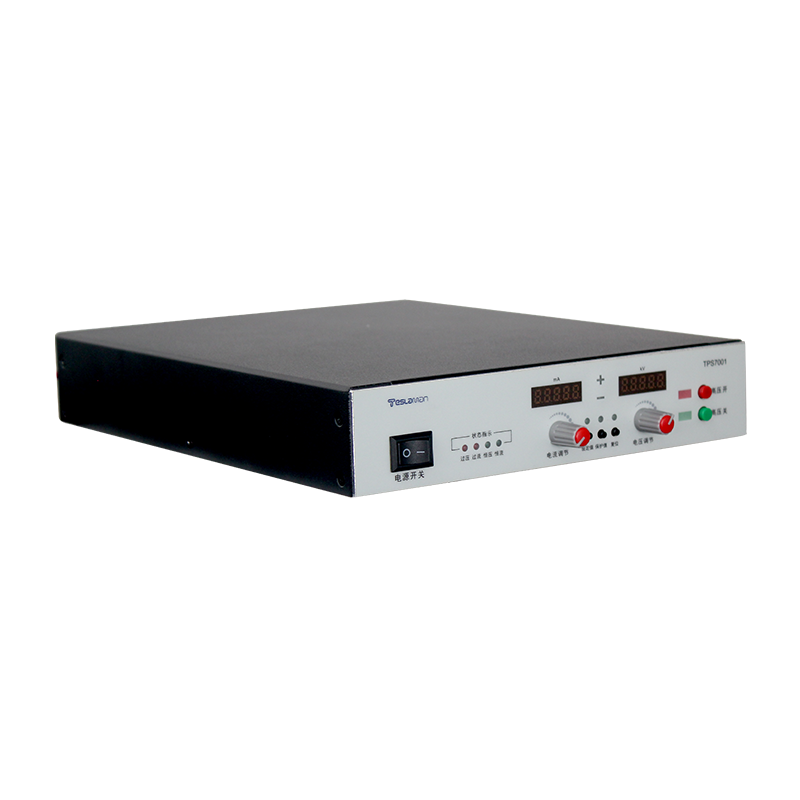
Microchannel Plates (MCPs) are unparalleled for low-light-level detection and fast timing, but their utility in applications encountering highly variable signal intensity—such as lidar, adaptive optics wavefront sensing, or certain mass spectrometry modes—is limited by a finite dynamic range. The core limitation is gain saturation at high input fluxes, where the electron multiplication process depletes the channel walls of charge, causing a non-linear and eventually flat response. To extend the usable dynamic range, active modulation of the MCP's high-voltage bias during operation has emerged as a powerful technique. This approach dynamically adjusts the MCP's gain in response to the incident signal level, preventing saturation at high flux while maintaining high sensitivity for weak signals. The high-voltage power supply enabling this modulation must therefore combine ultra-stable bias capability with high-speed, low-noise modulation characteristics.
The traditional MCP power supply provides a fixed high voltage (e.g., 1000 V) across the plate. The gain is an exponential function of this voltage. In a modulation scheme, this voltage is varied. The simplest form is automatic gain control (AGC), where the MCP voltage is adjusted based on the measured output signal or count rate. For instance, in a pulse-counting system, if the output pulse rate exceeds a predefined threshold (indicating high flux), a feedback loop commands the HV supply to reduce its output voltage by a small amount, thereby lowering the gain and moving the operating point away from saturation. Conversely, when the count rate drops, the voltage is increased to restore high single-pulse gain. This requires a power supply with a voltage control input that can be driven by an analog error signal or a digital command from a rate monitor circuit.
The performance requirements for such a supply are stringent. Firstly, the modulation must be free of introduced noise. Any ripple or step artifacts on the high-voltage output during adjustment will directly modulate the gain, creating intensity artifacts in the output signal. Therefore, the transition between voltage levels must be smooth, controlled, and exceptionally clean. A linear, non-switching output stage is often preferred for this reason, despite lower efficiency. Secondly, the speed of the modulation loop must be matched to the dynamics of the signal. For lidar sensing atmospheric returns, the signal intensity can change over microseconds as the laser pulse interacts with different layers. The HV supply's slew rate (volts per microsecond) and its control loop bandwidth must be sufficient to track these changes. A slow response would mean the MCP is in saturation for part of the return signal, distorting the measured profile.
More advanced techniques involve predictive or feedforward modulation, rather than feedback. In a mass spectrometer using an MCP detector, the intensity of ion packets arriving at the detector can be predicted from the known abundance and focusing conditions. A control signal synchronized to the mass scan can proactively modulate the MCP voltage, lowering it just before a high-abundance ion peak arrives and raising it for trace peaks. This demands a power supply that can follow a pre-programmed, high-speed voltage waveform with precise timing synchronization to the instrument's master clock. The ability to store and execute arbitrary waveforms becomes a key feature.
For imaging applications, such as in adaptive optics, the challenge is spatial non-uniformity. A bright guide star or laser beacon can saturate the corresponding region of the MCP-based detector while other regions see faint light. A global voltage adjustment would compromise sensitivity in the faint regions. The ultimate solution is pixelated or spatially structured high-voltage control, where the MCP is segmented into independently biased zones. This is a significant technical challenge, as it requires multiple high-voltage channels with isolation and the ability to fabricate MCPs with isolated electrode sectors. The power supply for such a system would be a multi-channel, synchronized array of modular high-voltage amplifiers, each capable of independent dynamic modulation based on the light intensity in its corresponding field of view.
Throughout all modulation schemes, the stability of the MCP's operating point at any given voltage setting is paramount. If the supply exhibits drift, the carefully calibrated relationship between control signal and gain is lost. Thus, even during dynamic operation, the supply must provide a stable, low-noise output at each quasi-static level it is commanded to hold. Furthermore, the modulation circuitry must be designed to avoid introducing transients into the sensitive charge-sensitive amplifiers or counting electronics connected to the MCP's anode.
In essence, a dynamic range extension high-voltage modulation supply transforms the MCP from a static-gain component into an adaptive sensor. By enabling real-time, signal-dependent gain control, it allows a single MCP detector to accurately measure light levels spanning many orders of magnitude without manual intervention or the risk of saturation-induced damage. This expands the applicability of MCP technology to demanding fields like direct-detection lidar, high-dynamic-range astronomical imaging, and quantitative mass spectrometry, where signal intensities are unpredictable and span an extreme range.