Plasma Emission Spectroscopy Monitoring for Coating High-Voltage Power Supplies
In advanced physical vapor deposition processes, such as magnetron sputtering or cathodic arc deposition, the plasma state is the direct precursor to the forming film. Real-time, non-invasive monitoring of this plasma provides invaluable feedback for process control and quality assurance. Optical Emission Spectroscopy (OES) is a premier technique for this purpose, analyzing the light emitted by excited species in the plasma. The stability and characteristics of the high-voltage power supply driving the deposition process have a profound and direct impact on the OES signal. Therefore, integrating OES monitoring with the power supply's control system creates a powerful closed-loop capability for depositing complex stoichiometric coatings, such as nitrides, oxides, or multi-element alloys.
The light emitted from a plasma originates from the decay of atoms and ions that have been excited by electron collisions. The intensity of specific spectral lines corresponds to the concentration and excitation state of particular elements. In reactive sputtering, for instance, where a metal target is sputtered in an atmosphere containing a reactive gas like nitrogen or oxygen, the plasma contains spectral lines from both the metal and the reactive gas. The intensity ratio of these lines is highly sensitive to the partial pressure of the reactive gas at the target surface, which in turn is controlled by the sputtering rate, itself a function of the applied power. A conventional process runs the risk of transitioning from the desired metallic sputtering mode into a poisoned mode, where the target surface forms a compound, drastically reducing the deposition rate and altering film properties.
Here, the OES signal becomes the control variable. A dedicated spectrometer, often with a fast CCD detector, is focused on a representative region of the plasma, typically near the target race track. Key emission lines are identified and monitored in real-time. For example, when reactively sputtering titanium nitride, the intensity of a titanium line (e.g., Ti I at 498.17 nm) and a nitrogen line (e.g., N2 band head) are tracked. Their ratio is calculated continuously. This ratio is fed into a process controller that governs the high-voltage power supply.
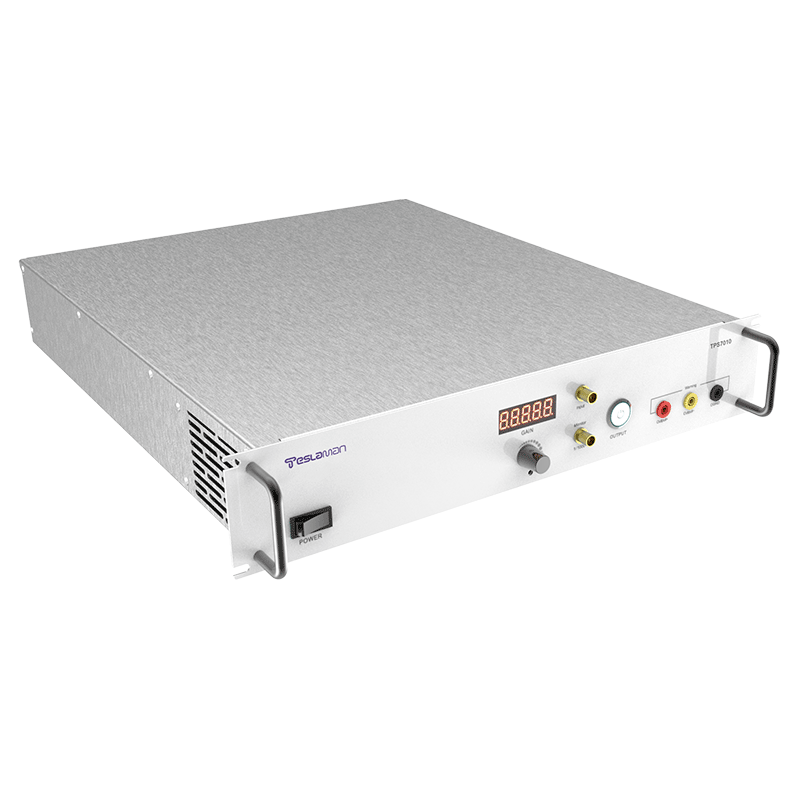
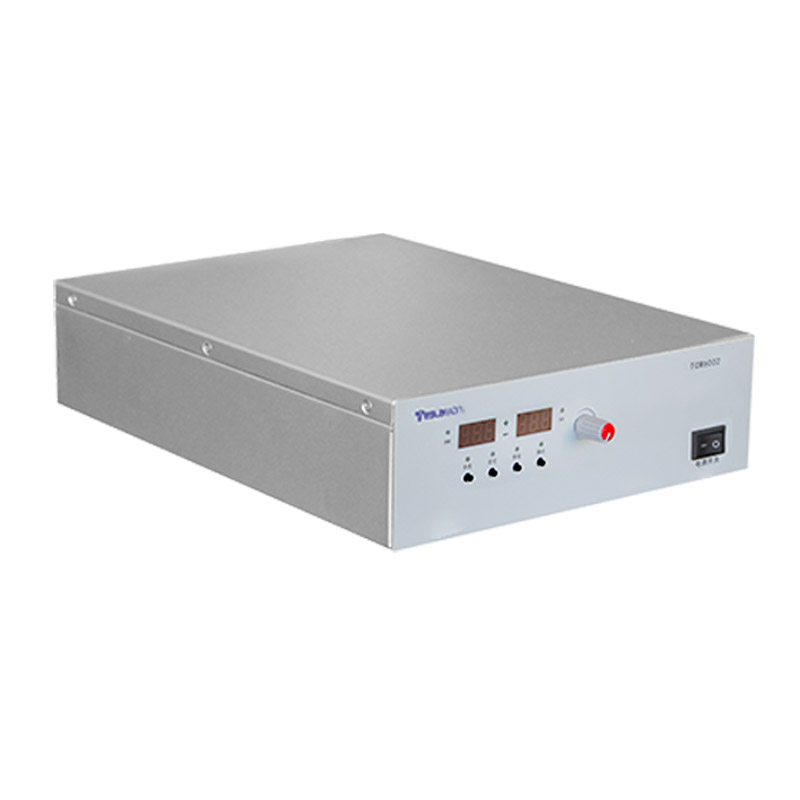
The power supply for such an application must be capable of rapid and precise adjustment of its output power, typically in a pulsed-DC or mid-frequency AC mode for reactive processes. Upon detecting a drift in the OES ratio indicating the beginning of target poisoning, the control algorithm does not simply adjust gas flow. Instead, it commands the power supply to increase its output power or to alter its pulse parameters. This increased power delivers more energetic bombardment to the target, momentarily cleaning the compound layer from its surface and restoring the metallic sputtering condition. This adjustment happens in seconds, maintaining the process in a stable, metastable zone where the desired compound forms on the substrate but not on the target.
The high-voltage supply's own characteristics must be stable to avoid introducing noise into the OES signal. Fluctuations in discharge voltage or current, caused by poor regulation or excessive ripple, will cause corresponding fluctuations in plasma density and electron temperature. This manifests as flicker or drift in the OES line intensities, which can be mistaken for process drift. Therefore, the power supply must exhibit excellent stability. Furthermore, in pulsed systems, the OES acquisition can be gated synchronously with the pulse period, allowing for time-resolved spectroscopy. This can reveal details about the temporal evolution of species within a single pulse, providing even deeper insight for optimizing pulse shape and frequency to control film properties like stress or crystal orientation.
Integrating OES with power supply control enables the deposition of films with precise and reproducible stoichiometry, critical for optical coatings with specific refractive indices or hard coatings with defined phase composition. It allows for automated endpoint detection when depositing multilayers. Most importantly, it moves the process control from indirect parameters like pressure and power to a direct measurement of the plasma chemistry, creating a robust, self-correcting deposition system that can compensate for long-term drifts in target condition, gas purity, or pump speed, thereby guaranteeing consistent film quality over the entire lifecycle of a target.