High-Speed Visual Positioning and High-Voltage Triggering for Ampoule Filling
In high-speed pharmaceutical filling lines for injectable medications, glass ampoules are filled and hermetically sealed at rates of several hundred per minute. The final sealing step is achieved by applying an intense, localized heat source to the neck of the ampoule, melting the glass and pulling it to form a sealed tip. While flames were historically used, modern aseptic lines employ a non-contact, cleaner method: high-voltage electric arc melting. This process demands precise spatial and temporal coordination between a machine vision system and a pulsed high-voltage power supply to ensure consistent, reliable seals without damaging the product.
The ampoules, transported on a rotating or linear carousel, must be positioned with their thin glass necks accurately located within the gap of two electrodes. A deviation of even a fraction of a millimeter can cause the arc to strike the body of the ampoule, shattering it, or result in a weak, off-center seal prone to leakage. A high-speed vision system, typically comprising a strobe-lit CCD or CMOS camera and dedicated processing hardware, is tasked with this positioning. As each ampoule enters the sealing station, the camera captures an image. Sophisticated algorithms analyze the image in milliseconds, identifying the edges of the ampoule neck and calculating any offset from the ideal centerline between the electrodes.
This offset data is sent to a high-speed motion correction system. This may involve precisely timed adjustments to the carousel position, or more commonly, the micro-positioning of the electrode assembly itself using piezoelectric or servo-driven actuators. The system dynamically compensates for any mechanical tolerance stack-up or vibration in the transport system, ensuring that at the moment of firing, the ampoule neck is perfectly centered.
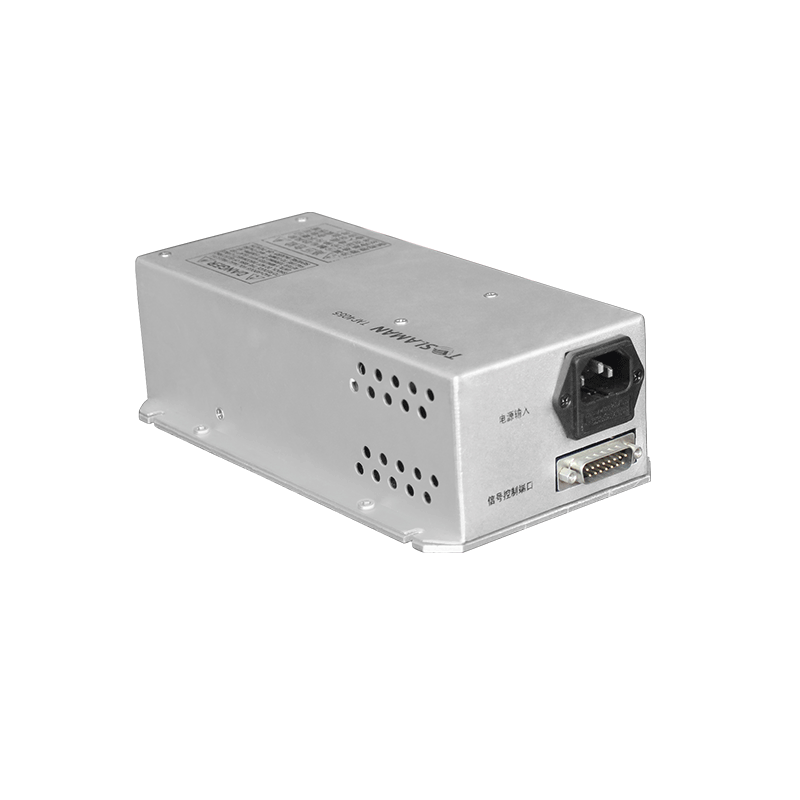
The triggering of the high-voltage arc is the critical next step. The power supply for this application is a specialized pulsed unit, generating a short-duration, high-current arc. Operating parameters are typically in the range of 10-20 kV, with discharge durations of a few milliseconds. The timing of this pulse is exquisitely precise. It must occur during the brief window when the ampoule is stationary and correctly aligned. The trigger command originates from the master line controller, synchronized with the vision system's ready signal.
However, the electrical characteristics of the arc are highly dependent on the exact gap distance and the condition of the glass surface. A simple timed pulse is insufficient. Advanced systems incorporate real-time electrical feedback. As the high-voltage pulse is initiated and an arc forms, the power supply monitors the current and voltage waveforms. Using this feedback, it can modulate the pulse energy in real-time, employing a technique like adaptive pulse-width modulation. If the arc initiates weakly, the controller can extend the pulse duration slightly to ensure complete melting. Conversely, if the glass melts rapidly, it can truncate the pulse to avoid overheating, which can cause boiling of the liquid medication inside or create stress points in the glass.
The integration of vision and high-voltage control also enables sophisticated quality assurance. The vision system can capture a post-seal image to inspect the shape and quality of the formed glass tip, rejecting any ampoule with a defective seal. Data from each sealing event—position offset, arc voltage, current integral, and seal image analysis—is logged, providing full traceability for each batch. This closed-loop, sensor-rich approach ensures the highest levels of sterility assurance and product integrity, meeting the stringent requirements of the pharmaceutical industry while maximizing production line throughput and yield.