High-Voltage Optimization for Triboelectric Series Sorting of Plastics
The separation of mixed plastic waste based on the triboelectric effect leverages the inherent propensity of different polymers to acquire positive or negative charges when contacted and separated from another material. This contact charging places materials into a triboelectric series, a qualitative ranking. In an industrial separator, plastic particles are charged through repeated contact with a chosen charging material (like copper or nylon) in a rotating drum or fluidized bed. The charged particles are then introduced into a high-voltage electrostatic field, where their trajectories diverge based on the polarity and magnitude of their charge, enabling collection into distinct bins. The optimization of the high-voltage system that creates this deflection field is paramount for achieving high purity and yield, especially for polymers with closely spaced positions in the triboelectric series.
The separation chamber typically consists of two parallel plate electrodes, one at ground and the other at a high potential, creating a uniform electric field. The charged particles, entrained in an air stream, enter this field. The electric force, Fel = q * E, deflects them from their initial path. The challenge lies in the fact that the acquired charge (q) is not a fixed material property. It depends on numerous factors: the nature of the contact material, the contact area, the force and frequency of contact, particle size and shape, surface contamination, and ambient humidity. This results in a distribution of charges for each polymer type, with significant overlap between types that are neighbors in the triboelectric series.
High-voltage optimization aims to maximize the separation distance between the average trajectories of the target polymer distributions within the physical constraints of the separator chamber. The primary variable is the electric field strength (E), which is determined by the applied voltage and the plate separation. Simply increasing the voltage to create a stronger field is not always the answer. An excessively high field can lead to corona discharge from the electrode edges, which injects ions of the opposite polarity into the chamber. These ions can neutralize the carefully imparted tribo-charge on the particles, scrambling the separation. It can also cause particles to adhere to the electrodes via image forces, causing fouling.
Therefore, the optimization process involves a detailed characterization of the charging distributions for the specific plastic mix under realistic industrial conditions. This data is used to model particle trajectories. The optimal voltage is then determined as the highest value that can be applied without inducing significant corona or sparking. This is often found empirically by monitoring the chamber current; a sudden increase in current at a certain voltage threshold indicates the onset of corona.
Beyond simple DC fields, pulsed or alternating fields offer advanced control. A pulsed high-voltage field can be synchronized with the injection of particle batches. A strong initial pulse can provide a large initial deflection, after which the field is reduced or reversed to fine-tune the trajectory or to help clear the electrode surfaces. The shape and timing of these pulses become critical optimization parameters, allowing for the manipulation of particles based on both their charge and mass.
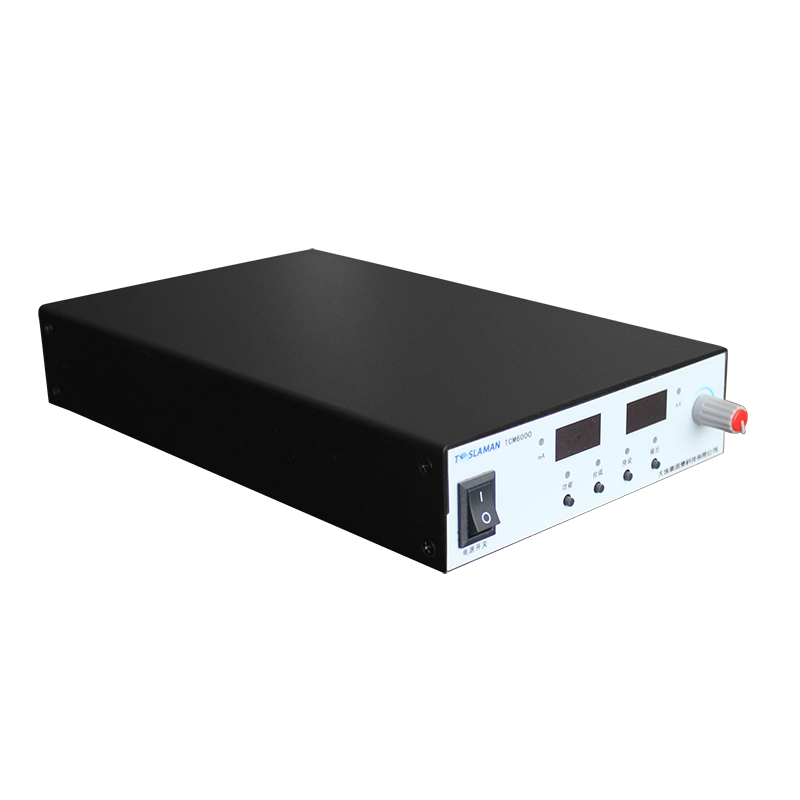
The high-voltage power supply for this application must be robust, capable of operating in an industrial environment with potential dust ingress, and must have excellent stability. Fluctuations in the output voltage directly translate to fluctuations in the electric field, causing the collection bins to receive an inconsistent mix of particles. Furthermore, the supply must incorporate robust spark-gap protection, as the introduction of a mis-sorted, conductive metal fragment into the separation zone is inevitable and will cause a direct short-circuit. The supply must quench this arc and recover automatically to maintain continuous operation.
Advanced systems integrate real-time monitoring of the separated product streams using near-infrared spectroscopy or other sensors. This quality data can be fed back to a controller that dynamically adjusts the high-voltage setpoint to compensate for drift in the upstream tribo-charging efficiency. This closed-loop control transforms the separator from a static machine into an adaptive system, maintaining optimal performance even as the composition of the input waste stream varies. This high-voltage optimization is therefore the key to making triboelectric separation a commercially viable, high-purity solution for closing the loop on complex plastic waste streams, a critical challenge in the circular economy.