High-Voltage Compensation for Gain Drift in Channel Electron Multipliers
Channel Electron Multipliers (CEMs) are ubiquitous detectors in mass spectrometry and surface analysis, prized for their high gain and fast response. However, their gain is not immutable. It drifts over time due to a combination of factors: aging of the active lead-silicate glass surface from accumulated charge extraction, changes in temperature affecting the resistivity of the glass, and variations in the local vacuum environment. This gain drift directly compromises the accuracy of quantitative measurements, as a change in detector response is indistinguishable from a change in analyte concentration. A closed-loop, high-voltage compensation system that actively counteracts this drift is essential for maintaining long-term analytical stability.
The traditional approach to managing gain drift is to perform periodic calibration using a standard reference material and manually adjust the CEM's bias voltage. This is time-consuming, interrupts measurements, and cannot correct for fast, temperature-induced fluctuations. An active compensation system automates this process, continuously monitoring the detector's gain and adjusting the high-voltage bias in real-time to maintain a constant response.
The core of the system is a stable, built-in reference source. This can be a very faint, pulsed light-emitting diode (LED) shining onto the CEM's input, or a small, sealed radioactive source (e.g., a nickel-63 foil) that emits a constant flux of beta particles. The key is that the source must be stable over long periods and its output must be well-characterized. The CEM detects this reference signal, producing a pulse count rate or an average current. This measured rate is compared to a stored setpoint value, which corresponds to the desired gain.
The error signal between the measured and setpoint rates is fed to a digital controller. The controller's output is a correction voltage applied to the high-voltage power supply's reference input. If the measured rate drops (indicating gain loss), the controller increases the CEM bias voltage slightly. If the rate increases (e.g., due to cooling), the voltage is reduced. This forms a classic negative feedback loop that locks the detector's response to the stable reference.
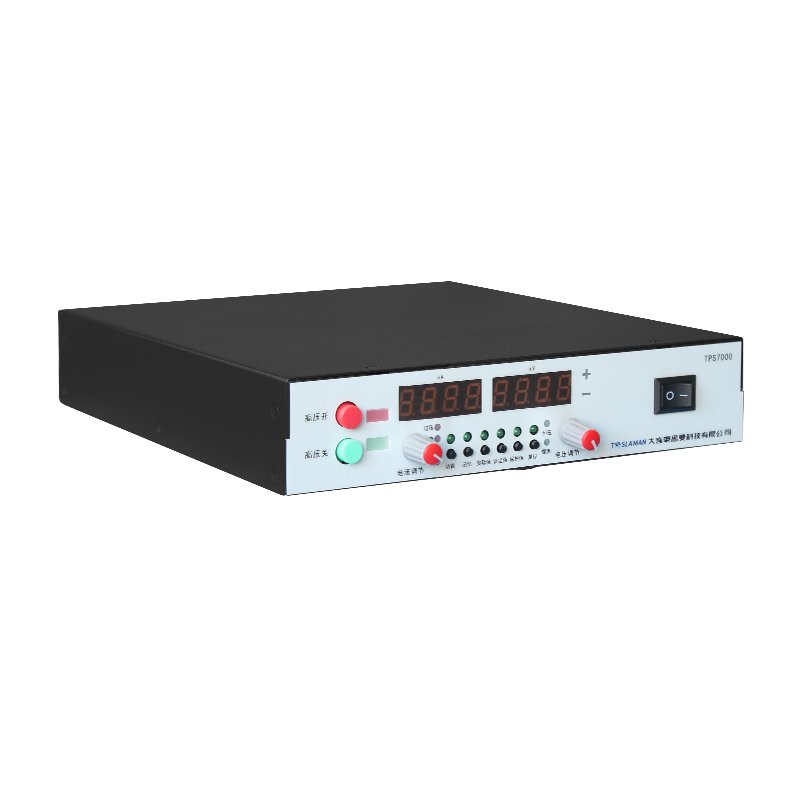
Implementing this feedback requires a high-voltage supply with specific characteristics. It must have a fine adjustment resolution, typically on the order of 0.1 V or better, to make the minute corrections necessary for gain stabilization without introducing step changes. The supply must also have very low noise and ripple, as any noise on the bias translates directly into noise in the gain, which is then interpreted as signal. The response time of the supply to a control command must be fast enough to track temperature-induced drifts, which can occur on a timescale of seconds to minutes, but not so fast that it attempts to correct for the statistical shot noise of the reference signal itself. The control algorithm therefore includes filtering to average out the statistical fluctuations.
For advanced applications, the compensation system can be more sophisticated. Instead of a simple feedback loop, it can use a model of the CEM's gain-voltage-temperature relationship. By measuring the temperature of the CEM (via an embedded thermocouple) and the current bias voltage, the controller can predict the gain and apply a feed-forward correction, which is then fine-tuned by the feedback from the reference source. This hybrid approach provides faster response to temperature changes.
The integration of this compensation system with the main instrument's data system is crucial. The fact that the gain is being actively stabilized should be transparent to the user, but the system should log all adjustments and the status of the reference source. If the reference source itself begins to fail (e.g., the LED output degrades), the system should detect this and alert the user.
The benefits of active high-voltage gain stabilization are profound. It enables quantitative analysis over extended periods without re-calibration, improving laboratory productivity. It eliminates a major source of uncertainty in trace-level measurements, where a small gain drift can be the difference between detection and non-detection. For long-duration experiments, such as in space missions or environmental monitoring, it ensures data consistency over months or years. The high-voltage supply, in this context, is not just a power source; it is the active agent that locks the detector's sensitivity to an internal, immutable standard, ensuring that the numbers reported by the instrument are a true reflection of the sample, not of the detector's changing state.