Adaptive High-Voltage Following for Electrostatic Spraying on Complex Curved Surfaces
Electrostatic spraying has revolutionized industrial coating, agricultural application, and even medical device functionalization by using high-voltage fields to charge droplets and direct them toward a grounded target. The primary advantage is a dramatic increase in transfer efficiency and wrap-around effect, coating surfaces not in the direct line of sight. However, the physics of electrostatic deposition becomes significantly more complex when the target is not a simple flat plate but a three-dimensional object with intricate curves, recesses, and varying radii of curvature. The local electric field, which governs droplet trajectory and deposition, is a function of both the applied voltage and the local geometry of the target. To achieve a uniform coating on a complex curved surface, a static high voltage is fundamentally inadequate. The solution lies in an adaptive high-voltage following system, where the applied voltage is dynamically modulated in real-time based on the changing distance and geometry between the spray gun and the target surface.
The core principle is that the electric field strength at the point of droplet formation and along its flight path determines the charge imparted to the droplet and the force attracting it to the target. If the gun-to-target distance decreases, as it must when navigating a concave feature, the field strength increases, potentially leading to electrostatic breakdown, back-ionization, and a phenomenon known as Faraday cage effect where coating fails to enter deep recesses. Conversely, as distance increases over a convex bulge, the field weakens, and transfer efficiency plummets. An adaptive system must counteract these geometric effects.
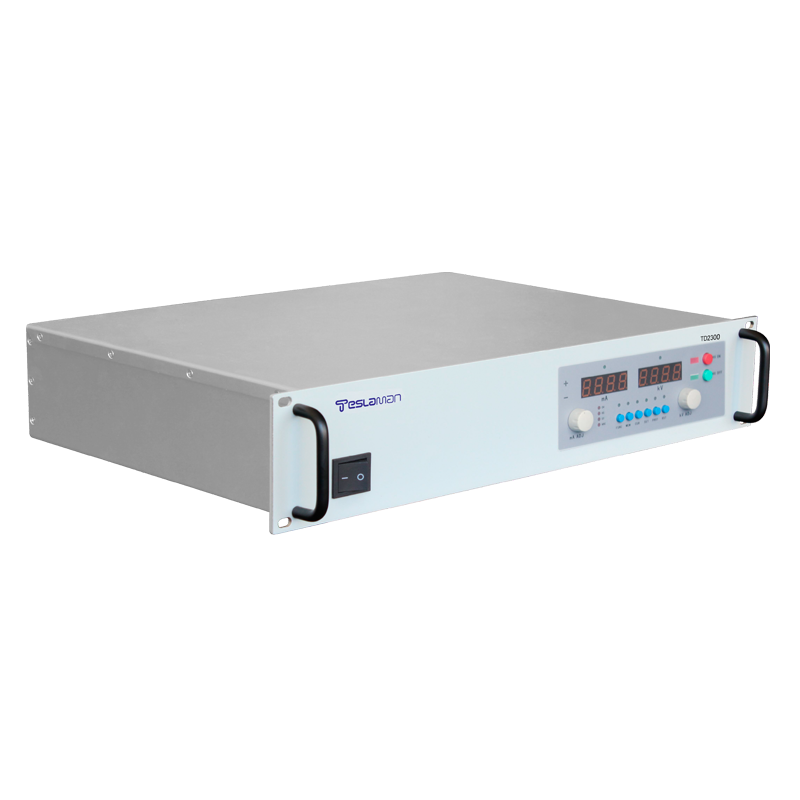
The enabling technology is a high-voltage power supply with an exceptionally wide bandwidth control input. It must act as a high-voltage amplifier, capable of receiving a low-voltage command signal from a distance sensor or a pre-programmed robot path and translating it into a proportional change in output voltage, from perhaps 30 kilovolts down to 60 kilovolts, within milliseconds. This is not a simple on/off switch; it requires a linear, low-distortion response across the entire operating range. The supply must have a control loop fast enough to track the robot's motion without lag, yet stable enough to prevent oscillations that would manifest as periodic thickness variations in the coating.
The distance sensing itself is a challenge. Optical or ultrasonic sensors must operate in the harsh environment of an electrostatic spray booth, with atomized paint particles and high electric fields. Capacitive sensing, which measures the change in capacitance between the gun and the target, offers a robust alternative, but its output is highly non-linear with distance and must be linearized by the control system. Some advanced systems use a model-based approach: the robot's controller knows its exact position relative to a 3D model of the part, and it commands the high-voltage supply to follow a pre-computed voltage map. This feed-forward approach eliminates sensor lag but requires perfect calibration and part registration.
Another layer of complexity arises from the fact that the target is not at a uniform potential. The deposited paint layer itself is an insulator and builds up charge. This accumulated charge repels incoming charged droplets, a phenomenon known as space charge limitation. An adaptive high-voltage system can compensate for this by gradually reducing the voltage as the coating builds up, maintaining a constant effective field. This requires a feedback loop based on the measured current flowing to the part. As the insulating layer thickens, the current for a given voltage decreases. The controller interprets this as a signal to lower the voltage, preventing back-ionization and maintaining a consistent deposition rate.
Safety is paramount in such a system. The rapid voltage changes must never cause arcing. The power supply must include fast arc detection and suppression, and the control algorithm must be constrained to prevent commanding a voltage that would exceed the breakdown threshold for the current gun-to-target distance. This threshold is itself a complex function of humidity, paint conductivity, and air pressure, and may need to be modeled or learned by the system.
The practical outcome of adaptive high-voltage following is transformative. It allows robotic spray painters to treat complex parts like car bodies, furniture, or aerospace components with a single pass, without the need for multiple guns or complicated masking. It drastically reduces overspray, saving material and reducing environmental cleanup. It ensures that recessed areas receive adequate coverage, improving corrosion protection and product quality. The high-voltage supply, in this context, evolves from a simple bias source into a dynamic, intelligent actuator that works in concert with the robot's motion to achieve a level of coating uniformity that was previously only possible with manual, skilled labor. It is a prime example of how advanced power electronics can solve a fundamental problem in applied physics and manufacturing.