High-Voltage Programming for Gradient Density Patterns in Electrostatic Flocking
Electrostatic flocking is a fascinating and highly versatile process that transforms millions of short fibers, known as flock, into a functional or decorative surface. By applying a high-voltage electric field, these fibers are aligned, accelerated, and implanted into an adhesive-coated substrate. The result is a velvety, textured surface that can provide anything from aesthetic appeal to sound damping or friction control. After fifty years in the high-voltage field, I continue to be intrigued by the subtle physics of this process and how the manipulation of the electric field, through what we might call high-voltage programming, allows for the creation of gradient density patterns with remarkable precision.
The conventional view of electrostatic flocking is a binary one: the field is on, and the fibers stand up and fly; the field is off, and they do not. However, to create a gradient in the density of the flock, or to produce distinct patterns of varying texture, we must move beyond this simple on/off paradigm. The density of flock on a given area is a function of the number of fibers that land there, which in turn is governed by the local electric field strength. By carefully controlling the spatial and temporal distribution of the high voltage, we can steer the fibers. This is the essence of high-voltage programming. It involves designing electrodes not as simple flat plates, but as complex structures, or even arrays of individually addressable elements, that can shape the field. For instance, a backing electrode behind the substrate can be segmented, and by applying different voltages to each segment, we create a non-uniform field. The flock fibers, which become dipoles or charged bodies in the field, will experience a force proportional to the field gradient, congregating in areas of higher field strength.
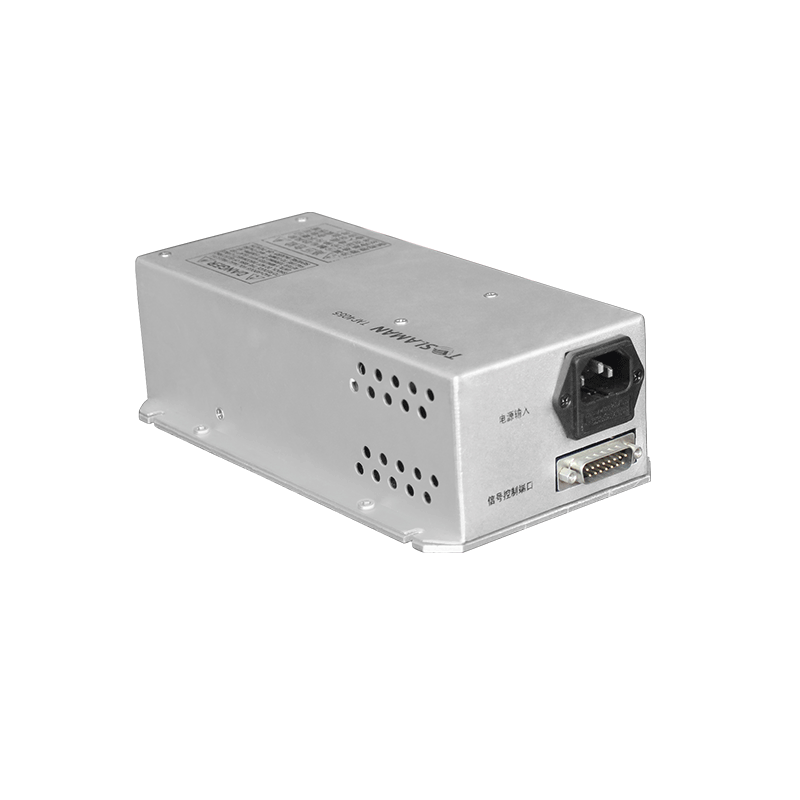
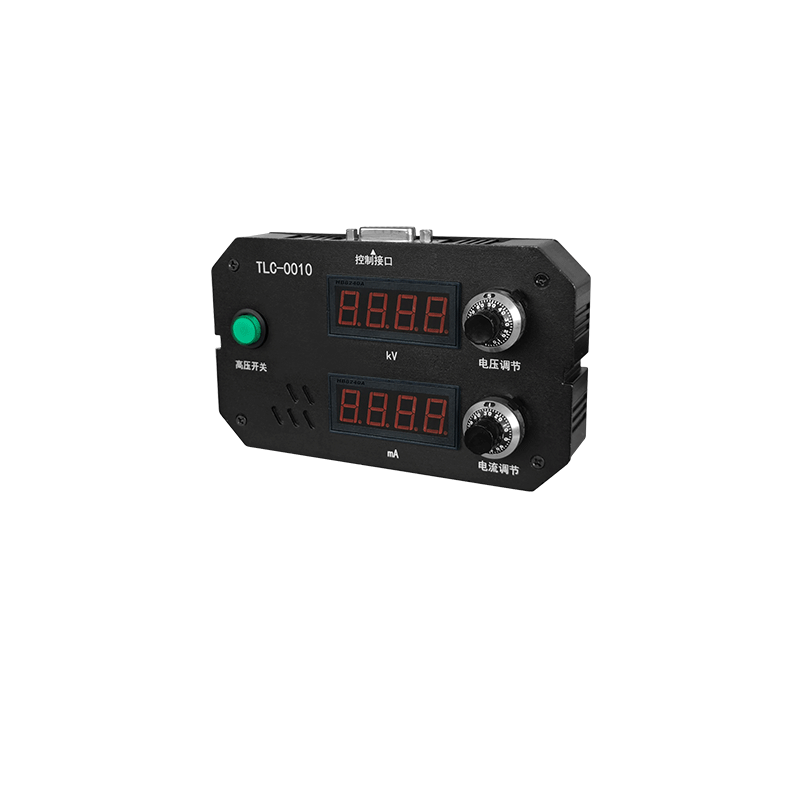
The power supply requirements for such a sophisticated system are significantly more demanding than those for a simple, uniform-coverage flocker. We need high-voltage amplifiers, not just static supplies. These amplifiers must be capable of producing precise, programmable output voltages, often in the range of 20 kV to 100 kV or more, with the ability to modulate these voltages at frequencies from DC up to several kilohertz. The bandwidth is crucial because we might want to rapidly switch the field pattern to create a time-averaged density gradient, or to synchronize the field variation with the movement of a continuous substrate. This pushes the technology into the realm of high-voltage, high-speed operational amplifiers, which must be carefully protected from arcing and flashovers that are common in the dusty, fibrous environment of a flocking plant.
Another critical aspect is the management of the charge on the fibers themselves. In a DC field, fibers will typically gain charge upon contact with the application electrode. This charge then causes them to accelerate toward the grounded or oppositely charged substrate. For gradient patterning, we can manipulate this charging process. By using an AC field with a programmable DC bias, we can cause the fibers to oscillate and migrate toward regions of highest field intensity, creating a more controlled deposition. The frequency and waveform of the AC component become additional programming parameters. A sine wave might produce a different flock behavior compared to a square wave or a pulsed DC signal. The power supply, therefore, must be a versatile waveform generator capable of delivering high peak currents to charge the capacitive load presented by the electrode system, which can be substantial, especially for large-area applications.
The practical implementation of high-voltage programming also requires a deep understanding of the dielectric properties of the substrate and the adhesive. These materials act as insulators and will themselves become charged and polarized in the intense field. This can lead to a phenomenon known as back-ionization, where the accumulated charge on the adhesive surface breaks down, causing a micro-spark that can disturb the flock and create a defect in the pattern. A well-designed high-voltage program will anticipate this, perhaps by modulating the voltage to allow for charge dissipation, or by using a sequence of voltage pulses that implant the fibers before the surface charge builds to a critical level. The interplay between the applied voltage waveform, the substrate materials, and the flock fiber properties is a complex dance. Mastering it requires not only a powerful and flexible high-voltage source but also the empirical knowledge gained from years of observation and experimentation. When done correctly, the results are stunning: precise textures, variable softness, and functional gradients that are impossible to achieve with any other manufacturing technique, all orchestrated by the invisible hand of a carefully programmed electric field.