Pulse Pile-Up Avoidance in Channel Electron Multipliers via High-Voltage Control
Channel electron multipliers and the more advanced microchannel plates are the eyes and ears of countless scientific instruments, from mass spectrometers and electron spectrometers to space plasma analyzers and photon detectors. Their ability to detect single particles or photons with high efficiency and fast timing makes them indispensable. However, like all detectors, they have limitations. One of the most significant is the phenomenon of pulse pile-up, where the arrival rate of events becomes so high that individual pulses begin to overlap, leading to counting errors, spectral distortion, and a loss of quantitative accuracy. In my decades of work with these devices, I have explored a novel approach to mitigating pulse pile-up: the dynamic, intelligent control of the high-voltage bias applied to the multiplier. This technique uses the high-voltage supply not just as a static bias source, but as an active element in the detector's signal processing chain, adapting the detector's gain in real-time to the incoming flux.
The physics of a channel electron multiplier is based on secondary electron emission. A high voltage, typically between 1 and 3 kilovolts, is applied along the length of a semiconducting glass channel. When an incident particle or photon strikes the channel wall, it liberates a few secondary electrons. These electrons are accelerated by the electric field, strike the wall further down, and liberate more electrons. This cascading process results in a cloud of 10^6 to 10^8 electrons at the output, a pulse that is easily detectable. The gain of the multiplier is an exponential function of the applied voltage. A small change in voltage results in a large change in gain.
Pulse pile-up occurs when the time between successive events is less than the width of the output pulse. The output pulse from a channel electron multiplier has a finite duration, typically a few nanoseconds to tens of nanoseconds, depending on the device and the electronics. If two events occur within this time window, their pulses overlap, and the counting electronics may register them as a single, larger pulse, or may miss them entirely if the discriminator level is set too high. This results in a non-linear count rate response and, in a spectrometer, a distortion of the measured spectrum.
The traditional approach to mitigating pile-up is to use faster electronics, with shorter pulse shaping times, or to simply attenuate the incoming flux, which defeats the purpose of having a sensitive detector. The approach I have been exploring is to dynamically adjust the gain of the multiplier itself. At high count rates, we reduce the gain by lowering the high-voltage bias. This reduces the amplitude of each individual pulse, but it also, more importantly, reduces the pulse width. The charge cloud at the output is smaller and, due to space charge effects within the channel, is also more compact in time. This shorter pulse width reduces the probability of pile-up. At low count rates, we increase the gain back to its maximum to maintain single-particle sensitivity.
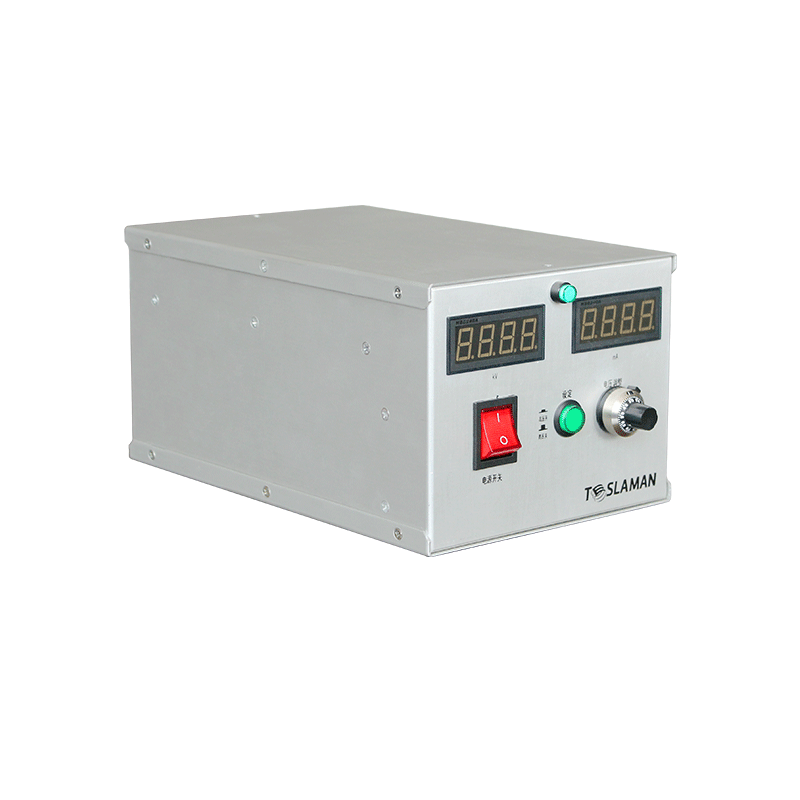
The implementation of this dynamic gain control requires a high-voltage power supply with an exceptionally fast response time. The bias voltage must be changed in response to the instantaneous count rate, which can vary on millisecond timescales. A simple, manually adjustable supply is inadequate. We need a supply that can be modulated by a control signal from the detector's counting electronics. This control loop must be carefully designed. If the gain is reduced too slowly, pile-up will occur before the correction is applied. If it is reduced too quickly, or too much, we may lose sensitivity to legitimate events.
The control algorithm itself is a subject of ongoing research. A simple approach is to use the measured count rate as the input to a feedback loop. The output of a fast discriminator and counter provides a real-time estimate of the event rate. This estimate is compared to a setpoint, and the difference is used to adjust the high-voltage bias. If the rate exceeds the setpoint, the voltage is reduced. This is a classic feedback control problem, but with the added complexity that the relationship between voltage and gain, and between gain and count rate, is nonlinear and device-dependent.
A more sophisticated approach uses the pulse height distribution itself as the feedback signal. In a properly functioning multiplier, the output pulses have a characteristic height distribution, often a negative exponential or a peaked distribution. As pile-up begins to occur, this distribution distorts, developing a high-energy tail due to the overlapping pulses. By monitoring the shape of the pulse height distribution, we can detect the onset of pile-up before it significantly affects the count rate. The control algorithm can then adjust the voltage to maintain the desired distribution shape. This requires a multi-channel analyzer or a fast digitizer in the feedback loop, adding complexity but providing a more direct measure of the phenomenon we are trying to control.
In my laboratory, we have implemented a prototype system on a mass spectrometer detector. The system uses a fast digitizer to capture each pulse from the channel electron multiplier. A field-programmable gate array analyzes the pulse stream in real-time, calculating both the count rate and the pulse height distribution. Based on these metrics, it generates a control signal that is fed to a fast, programmable high-voltage power supply. The supply can change the bias voltage by hundreds of volts in microseconds. We have demonstrated that this system can maintain linear count rate response up to fluxes that would cause severe pile-up in a fixed-gain configuration. The spectral distortion is also significantly reduced.
This approach to pile-up avoidance represents a paradigm shift in detector operation. The high-voltage supply is no longer a static, passive component. It is an active, intelligent part of the detection system, adapting the detector's behavior to the signal in real-time. This opens up new possibilities for extending the dynamic range of these already remarkable devices, allowing them to be used in applications with widely varying signal levels, from the detection of single photons in a dark environment to the measurement of intense ion beams, all without sacrificing quantitative accuracy.