Film Deposition Rate Control of High Voltage Power Supply for Organic Light Emitting Diode Evaporation Preparation
Organic light emitting diode manufacturing relies critically on precise thin film deposition processes where high voltage power supply systems play a fundamental role in determining the quality and uniformity of the deposited layers. The evaporation preparation technique requires extremely stable and controllable power delivery to the evaporation sources, as even minor fluctuations in the applied voltage can result in significant variations in the deposition rate and film thickness uniformity across the substrate surface. Understanding the relationship between high voltage power supply characteristics and film deposition parameters becomes essential for achieving the high quality standards demanded by modern display and lighting applications.
The evaporation process in organic light emitting diode fabrication involves heating organic materials in vacuum chambers until they sublime and condense on substrate surfaces to form thin functional layers. High voltage power supplies drive the electron beam or resistive heating elements that provide the thermal energy necessary for material evaporation. The deposition rate depends directly on the evaporation source temperature, which in turn depends on the power delivered by the high voltage supply. Precise control of this power delivery enables manufacturers to maintain consistent deposition rates throughout the coating process, ensuring uniform film thickness and optimal device performance.
High voltage power supplies designed for evaporation applications must exhibit exceptional stability characteristics, typically maintaining output voltage fluctuations below 0.1 percent of the set value under steady state conditions. This stability requirement arises from the exponential relationship between evaporation source temperature and material vapor pressure. Small temperature variations caused by voltage fluctuations can produce disproportionately large changes in evaporation rate, leading to film thickness nonuniformities that degrade device performance. Advanced power supply designs incorporate multiple feedback control loops and precision voltage reference circuits to achieve the necessary stability levels.
The transient response characteristics of high voltage power supplies significantly impact the ability to control deposition rates during process transitions. When process requirements demand changes in deposition rate, such as during graded layer deposition or when switching between different organic materials, the power supply must respond quickly and accurately to the new setpoint without overshoot or oscillation. Power supplies with slow response characteristics may require extended stabilization periods after setpoint changes, reducing process throughput and potentially creating interface layers with undesirable composition gradients.
Arc suppression capabilities represent another critical aspect of high voltage power supplies used in evaporation systems. The vacuum environment and presence of evaporated organic vapors can create conditions favorable for electrical discharge events. These arcs can cause sudden changes in evaporation source temperature, creating film defects and potentially damaging sensitive organic materials. Modern high voltage supplies incorporate sophisticated arc detection and suppression circuits that can identify incipient discharge events and rapidly reduce output voltage to prevent sustained arcing, then smoothly restore normal operation.
The deposition rate control system typically combines the high voltage power supply with process monitoring instrumentation and closed loop control algorithms. Quartz crystal microbalances positioned within the deposition chamber provide real time measurements of deposition rate and accumulated film thickness. These measurements feed back to the power supply control system, which adjusts the output voltage to maintain the desired deposition rate despite disturbances such as source material depletion or thermal drift. The integration of measurement and control systems enables the precise rate control necessary for advanced organic light emitting diode structures.
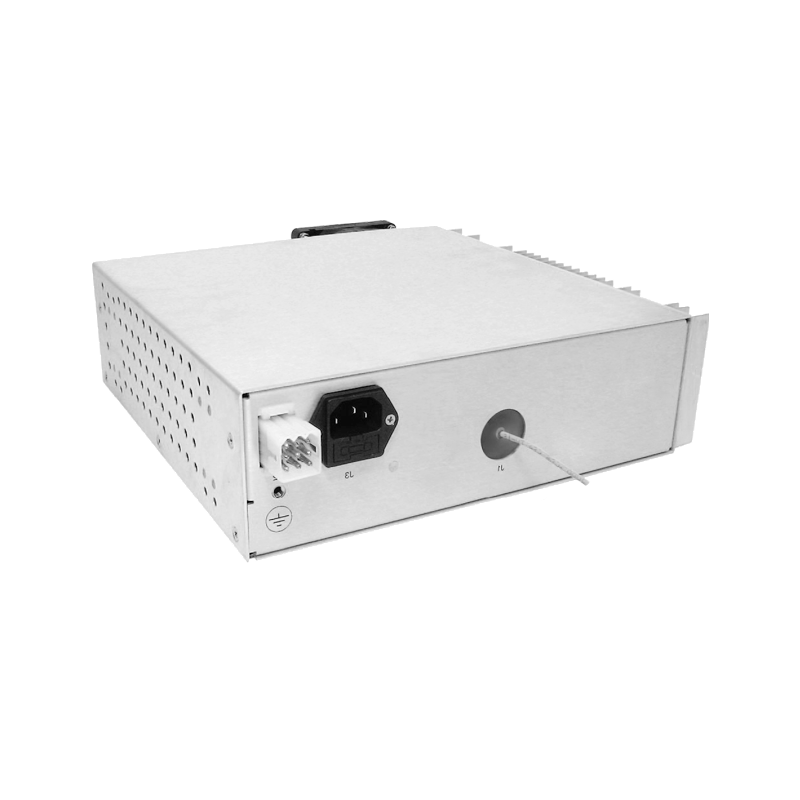
Thermal management considerations influence both the design and operation of high voltage power supplies for evaporation applications. The power supplies themselves generate significant heat during operation, particularly when delivering high power levels to evaporation sources. Effective cooling systems, whether based on forced air circulation or liquid cooling circuits, maintain the power supply components within acceptable temperature ranges to ensure reliable operation and long term stability. Temperature induced drift in control circuit components can degrade voltage stability, making thermal management essential for maintaining deposition rate control accuracy.
The electrical isolation requirements in evaporation systems present additional design challenges for high voltage power supplies. The evaporation sources often operate at elevated temperatures and may be mounted on electrically isolated platforms to enable individual control of multiple sources in co deposition processes. The power supplies must provide galvanic isolation between input power circuits and output circuits, with sufficient dielectric strength to withstand the operating voltages and any transient overvoltages that may occur during operation. Isolation transformers and optically coupled control interfaces provide the necessary electrical separation.
Calibration and verification procedures ensure that high voltage power supplies maintain their specified performance characteristics throughout their operational lifetime. Regular calibration checks using traceable voltage measurement standards verify that the actual output voltage corresponds accurately to the programmed setpoint. Stability measurements over extended periods characterize any drift in output characteristics, enabling corrective adjustments or maintenance interventions before process quality is affected. Documentation of calibration results supports quality management system requirements and provides data for predictive maintenance programs.
The economic implications of deposition rate control extend beyond immediate product quality considerations to affect overall manufacturing efficiency and material utilization. Precise rate control enables manufacturers to deposit films to exact thickness specifications without overcoating to compensate for rate uncertainties. This precision reduces material consumption, particularly important for expensive organic compounds used in light emitting layers. Improved deposition accuracy also reduces the frequency of reject parts and rework operations, contributing to higher overall fab productivity and lower unit manufacturing costs.