Embedded System Implementation of Complex Load Adaptive Matching Function for High Voltage Power Supply
High voltage power supplies encounter diverse load conditions in applications ranging from plasma processing to electrostatic precipitation, where the load impedance may vary significantly during operation. Traditional power supply designs with fixed output characteristics may perform suboptimally under varying loads, leading to reduced efficiency, increased stress on components, or degraded process performance. Embedded control systems enable adaptive matching to complex loads by continuously adjusting the power supply parameters in response to measured load conditions.
The concept of load matching in power supplies refers to optimizing the power transfer from the supply to the load by appropriate selection of output characteristics. For resistive loads, matching involves providing the appropriate voltage and current for the desired power delivery. For reactive loads with capacitive or inductive components, matching must account for the phase relationship between voltage and current. For nonlinear loads with voltage dependent characteristics, matching must track the operating point on the load characteristic.
Complex loads in high voltage applications exhibit various behaviors that challenge simple control approaches. Plasma loads have negative differential resistance regions where the current decreases with increasing voltage, potentially causing instability. Corona loads in electrostatic applications have highly nonlinear voltage current characteristics with threshold behavior. Capacitive loads such as electrode structures require high current during charging but minimal current at steady state. Each load type requires specific matching strategies.
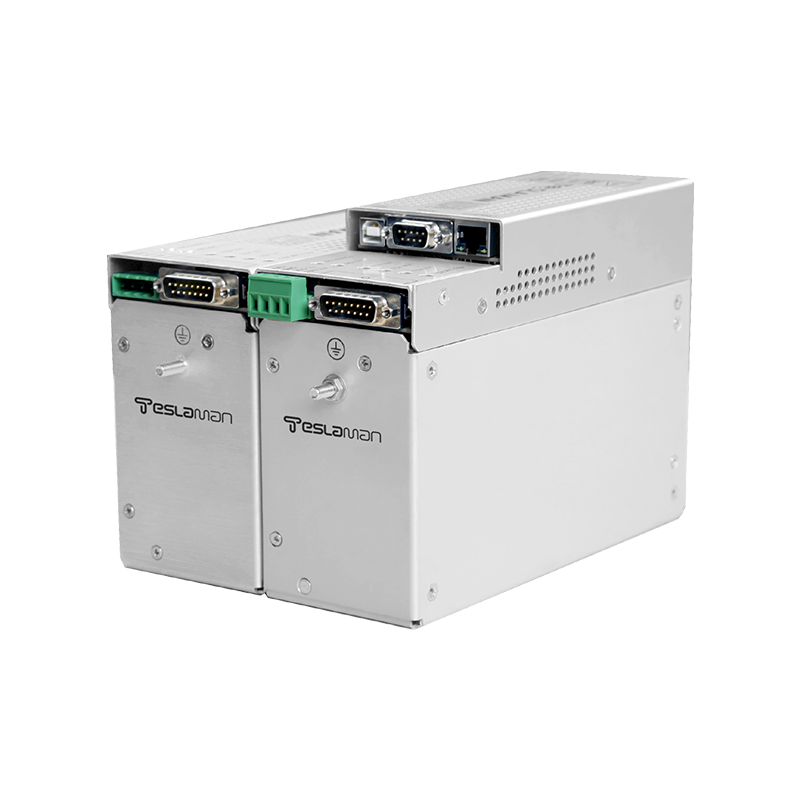
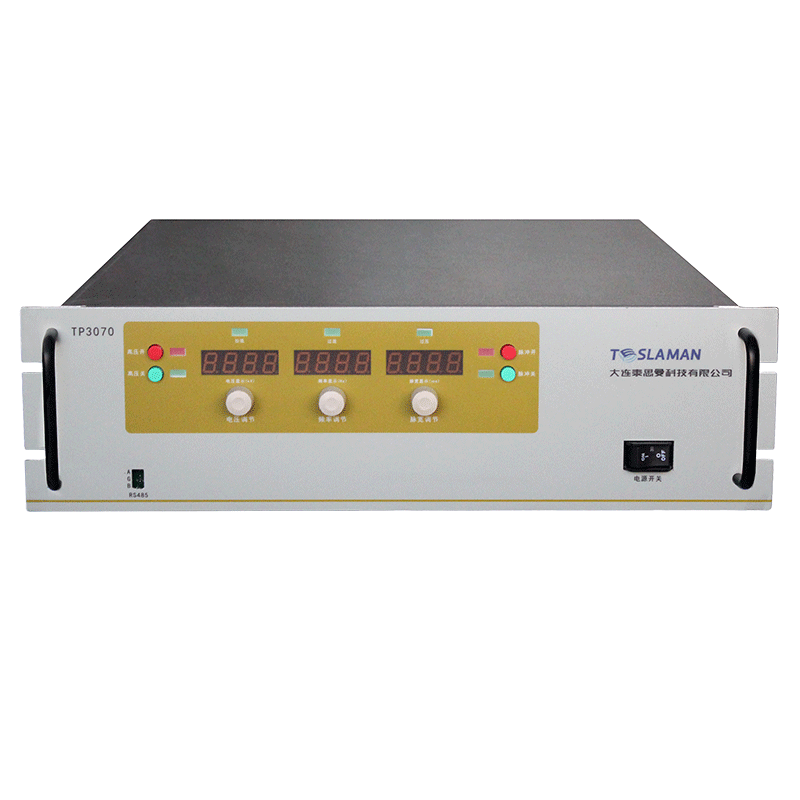
Embedded systems for adaptive matching combine sensing, processing, and control capabilities in an integrated platform. Microcontrollers or digital signal processors execute the control algorithms that determine the appropriate power supply parameters. Analog to digital converters measure the output voltage, output current, and other relevant quantities. Pulse width modulation or other digital to analog conversion techniques implement the control actions. Communication interfaces enable parameter adjustment and monitoring by external systems.
Sensing requirements for adaptive matching include accurate measurement of the output electrical quantities and potentially the load state. Voltage measurement at the output terminals determines the actual output level. Current measurement provides information about the load conductance. Power calculation from voltage and current indicates the energy delivery rate. Additional sensors may measure load specific quantities such as plasma optical emission or precipitator spark rate that indicate the load condition.
Control algorithms for adaptive matching range from simple feedback loops to sophisticated model based approaches. Proportional integral derivative control can regulate the output voltage or current to target values, adjusting for load variations. Gain scheduling can modify the controller parameters based on the operating region to maintain performance across the load range. Model predictive control can anticipate load changes and optimize the control trajectory over a future horizon.
Load identification algorithms estimate the load characteristics from the measured voltage and current data. For static loads, the conductance or resistance is simply the ratio of current to voltage. For dynamic loads, the relationship between voltage and current changes with frequency, requiring impedance measurement at multiple frequencies. The identified load model informs the matching strategy, enabling optimization of the power supply operating point.
Implementation challenges for embedded adaptive matching include the real time constraints, the limited computational resources, and the need for robustness to measurement noise and disturbances. The control loop must execute fast enough to track the load dynamics, with sampling rates appropriate for the bandwidth of interest. The computational complexity of the algorithms must fit within the processor capability. Filtering and signal processing techniques improve the signal quality for reliable control.
Communication interfaces enable integration of the adaptive matching system with higher level process control. Digital communication protocols transmit measurement data, control parameters, and status information between the embedded system and external controllers. Remote adjustment of control parameters enables tuning for specific applications without modifying the embedded software. Data logging capabilities record the operating history for analysis and optimization.
Reliability considerations for embedded control systems include protection against software faults, hardware failures, and environmental stresses. Watchdog timers detect and recover from software hangs or infinite loops. Redundant sensing can maintain operation despite sensor failures. Self test routines verify the system functionality during startup and periodically during operation. Environmental design considerations include temperature range, electromagnetic interference, and vibration that may affect the embedded electronics in high voltage environments.