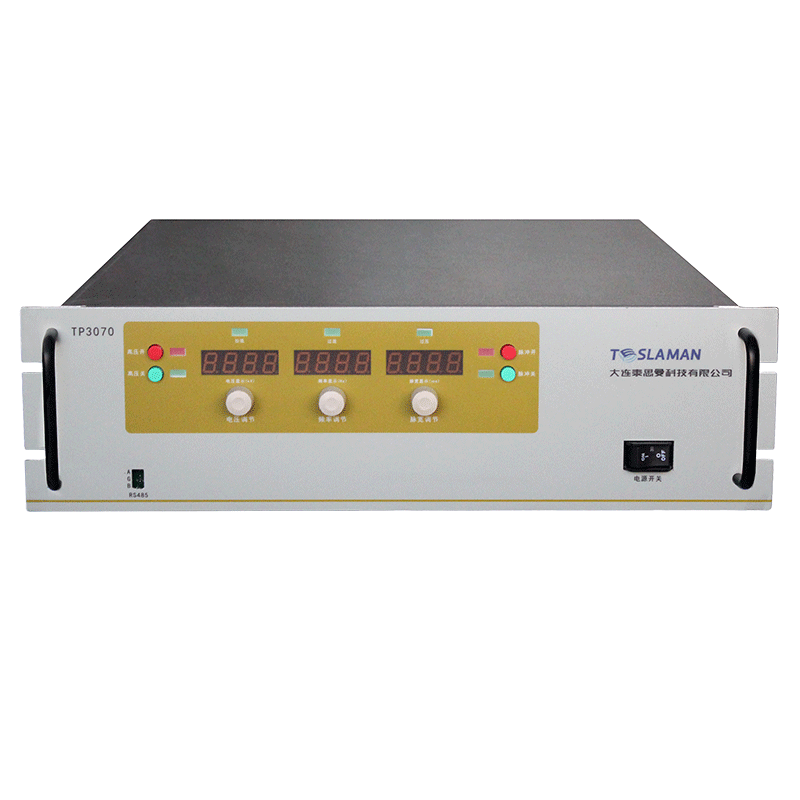
Beam Current Density Uniformity Calibration Method of High Voltage Power Supply for Ion Beam System
Ion beam systems deliver focused beams of ions for applications including ion implantation, ion milling, and ion beam analysis. The beam current density distribution across the target affects the uniformity of the process, whether doping in implantation, etching in milling, or signal in analysis. Calibration of the beam current density uniformity enables correction of nonuniformities through scanning patterns, beam shaping, or process parameter adjustment. The high voltage power supply that accelerates and focuses the beam influences the current density distribution and must be characterized as part of the calibration.
The ion beam current density distribution describes how the ion current varies across the beam cross section. An ideal beam would have uniform current density within a defined boundary and zero outside, but real beams have distributions that vary from this ideal. Gaussian distributions are common for focused beams, with the current density highest at the center and decreasing toward the edges. Nonuniform distributions may have hot spots, asymmetries, or other features that affect the process uniformity.
Sources of current density nonuniformity include the ion source extraction geometry, the beam transport optics, and space charge effects. The ion source extracts ions from a plasma through an aperture, with the extraction geometry affecting the initial beam profile. Aberrations in the focusing optics distort the beam profile as it propagates. Space charge, the mutual repulsion of ions in the beam, causes the beam to expand and can create nonuniform expansion depending on the initial distribution.
The high voltage power supply affects the current density distribution through the beam energy and the lens settings. The accelerating voltage determines the ion energy and velocity, affecting the space charge expansion and the lens focusing. Variations in the accelerating voltage cause changes in the beam profile. The lens voltages control the beam focusing and can be adjusted to optimize the current density uniformity for specific applications.
Calibration methods for current density uniformity measure the beam profile at the target position. Faraday cup arrays measure the current at multiple positions simultaneously, providing a direct map of the current density distribution. Scanning a single Faraday cup through the beam builds up the profile with higher spatial resolution but requires more time. Wire scanners measure the current intercepted by a wire moving through the beam, providing profile information in one dimension that can be combined for two dimensional profiles.
Beam profile monitors using scintillators and cameras provide a fast, nondestructive method for visualizing the beam profile. The ions strike a scintillator material that emits light proportional to the ion flux. A camera records the light pattern, which represents the beam current density distribution. This method is useful for setup and tuning but may not have the quantitative accuracy of Faraday cup measurements.
The calibration procedure typically involves measuring the beam profile at representative operating conditions including different beam energies, currents, and lens settings. The measurements characterize how the profile varies with these parameters, enabling prediction of the profile for any operating point within the characterized range. Interpolation between measured points provides profile estimates for intermediate conditions.
Uniformity metrics quantify the profile quality for comparison and specification. The uniformity percentage is typically defined as the maximum deviation from the average current density divided by the average, expressed as a percentage. The full width at half maximum describes the beam size for Gaussian like profiles. The profile shape parameters such as kurtosis and skewness characterize deviations from ideal shapes.
Correction of nonuniformity uses several approaches depending on the application. Scanning pattern optimization adjusts the relative dwell times at different positions to compensate for the beam profile nonuniformity, achieving uniform integrated dose. Beam shaping using apertures or lenses modifies the beam profile toward a more uniform distribution. Multi beam approaches combine multiple beams with different profiles to achieve better uniformity than individual beams.
The high voltage power supply settings for optimal uniformity may differ from settings for other beam parameters such as minimum spot size or maximum current. The calibration should identify the settings that achieve the required uniformity while meeting other performance requirements. Tradeoffs between uniformity, current, and spot size inform the selection of operating parameters.
Documentation of the calibration results includes the measured profiles, the uniformity metrics, the recommended operating parameters, and the uncertainty of the calibration. The documentation supports process development and quality control by providing the information needed to predict and control the beam uniformity. Traceability to measurement standards ensures the calibration accuracy and enables comparison between different systems or different calibration times.