Vacuum Coating High Voltage Power Supply Uniformity in Flexible OLED Substrate Coating
Flexible organic light-emitting diode substrates require uniform thin film deposition to ensure consistent performance across large area panels. Vacuum coating processes, particularly magnetron sputtering and plasma-enhanced chemical vapor deposition, rely on high voltage power supplies to generate and sustain the plasma that drives the deposition reaction. The uniformity of the deposited film is directly influenced by the voltage distribution across the deposition zone, making the power supply a critical component in achieving high quality coatings. The power supply delivers a negative voltage to the target cathode, typically ranging from 200 to 1000 volts, which accelerates ions from the plasma toward the target surface. The ion bombardment not only sputters material from the target but also influences the energy and directionality of the depositing atoms on the substrate.
The challenge of maintaining coating uniformity on flexible OLED substrates is compounded by the large substrate sizes used in modern manufacturing, which can exceed one square meter. The power supply must deliver voltage with high spatial uniformity across the entire target assembly, as any non-uniformity in the plasma density will create corresponding thickness variations in the deposited film. Advanced power supplies address this through multi-zone output designs where the target is divided into several independently powered sections, each with its own voltage regulation. This allows fine adjustment of the voltage distribution to compensate for edge effects and ensure consistent deposition across the full substrate area. The voltage regulation accuracy for each zone is maintained better than 0.5 percent to achieve thickness uniformity within three percent across the entire panel. Inline thickness monitoring sensors provide real-time feedback to the power supply control system, enabling dynamic adjustment of zone voltages to maintain deposition uniformity as the target material depletes during extended coating runs.
The interaction between the high voltage power supply and the plasma discharge creates a complex feedback system. The plasma impedance varies with operating conditions such as gas pressure, target material, and accumulated coating thickness on the target surface. The power supply must adapt its output to maintain stable discharge conditions throughout the coating run. Modern systems employ constant power control modes where the voltage is continuously adjusted to maintain a target power level rather than a fixed voltage or current. This approach provides more stable plasma conditions as the target surface properties evolve during deposition. The power control loop typically operates with a bandwidth of several hundred hertz to respond to the gradual changes in plasma impedance. For reactive sputtering processes, where the target surface undergoes chemical changes during deposition, the power supply must handle more rapid impedance variations and may employ faster control loops with bandwidths approaching one kilohertz.
Substrate biasing represents an additional application of high voltage power supplies in flexible OLED coating systems. By applying a DC or pulsed bias voltage to the substrate, the energy of depositing ions and atoms can be controlled, influencing film density, stress, and adhesion. The substrate bias power supply must operate independently from the target power supply and often employs a floating output configuration to accommodate the substrate stage movement. Bias voltages typically range from 50 to 300 volts, with the ability to switch between positive and negative polarities as required by the specific coating process. Pulsed bias modes are commonly used to reduce charge accumulation on insulating substrate surfaces, with pulse frequencies ranging from 10 to 100 kilohertz and duty cycles adjustable from 10 to 90 percent. The bias power supply must maintain precise voltage control even under pulsed operation, with voltage settling times between pulses kept below one microsecond to ensure effective charge dissipation.
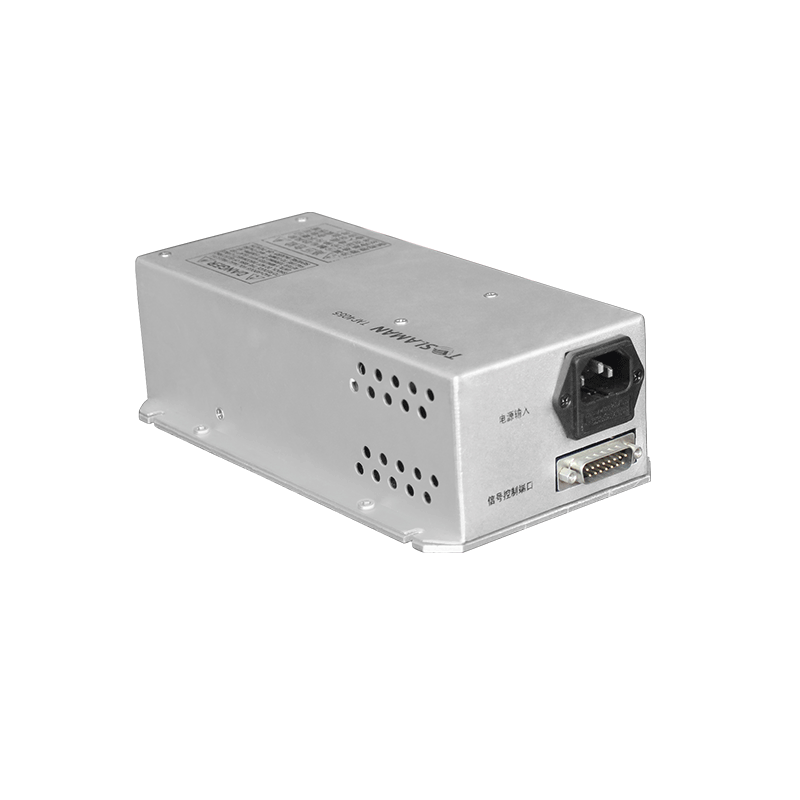
The design of high voltage power supplies for flexible OLED coating must also account for the unique requirements of roll-to-roll processing environments. The continuous movement of flexible substrates through the deposition chamber creates dynamic load conditions that the power supply must accommodate. Wire feeding mechanisms for power delivery to moving electrodes require specialized high voltage slip rings or capacitive coupling designs that maintain reliable electrical contact without excessive wear or contamination generation. The power supply housing incorporates multiple sealing stages to prevent process gases from penetrating into the electronics enclosure, while maintaining adequate cooling airflow through filtered vents. These design considerations ensure long-term reliability in the demanding continuous production environment of flexible OLED manufacturing. The power supply also integrates with the web tension and speed control systems, adjusting its output in real time to compensate for variations in substrate transport that can affect coating uniformity.
The plasma ignition and stabilization sequence represents a critical phase of the coating process that places stringent demands on the high voltage power supply. During ignition, the power supply must deliver a rapidly increasing voltage to establish the initial plasma discharge without causing arcing or damage to the target assembly. Once ignited, the power supply transitions to a stable operating mode while maintaining the discharge within a narrow voltage and current window. Advanced power supplies incorporate programmable ignition sequences with controlled voltage ramping and gas flow coordination, optimizing the ignition process for different target materials and gas mixtures. The plasma stability during the initial minutes of operation is particularly critical for the first layers of deposition, which must adhere uniformly to the substrate surface to provide a foundation for subsequent layers.
Environmental control within the power supply enclosure is essential for maintaining consistent performance in the OLED manufacturing facility. The cleanroom environment requires that the power supply does not generate particulate contamination, which means all internal components must be enclosed within sealed housings with filtered air intake for cooling. The power supply design also addresses vibration isolation to prevent mechanical resonances from affecting the precision of the deposition process. Integration with the facility building management system allows the power supply to report operating parameters and receive commands for scheduled maintenance operations. These comprehensive design considerations ensure that the high voltage power supply functions as a reliable and precise component within the complex ecosystem of flexible OLED manufacturing equipment. The power supply also interacts with the process gas delivery system, coordinating gas flow rates and compositions with the power supply output to maintain stable plasma conditions. The power supply control system provides real-time data on plasma impedance to the gas delivery controller, allowing automatic adjustment of gas flow to compensate for changes in plasma chemistry. This coordinated control is particularly important for reactive deposition processes where the plasma composition evolves during coating, requiring continuous adjustment of both electrical and gaseous parameters to maintain film quality.