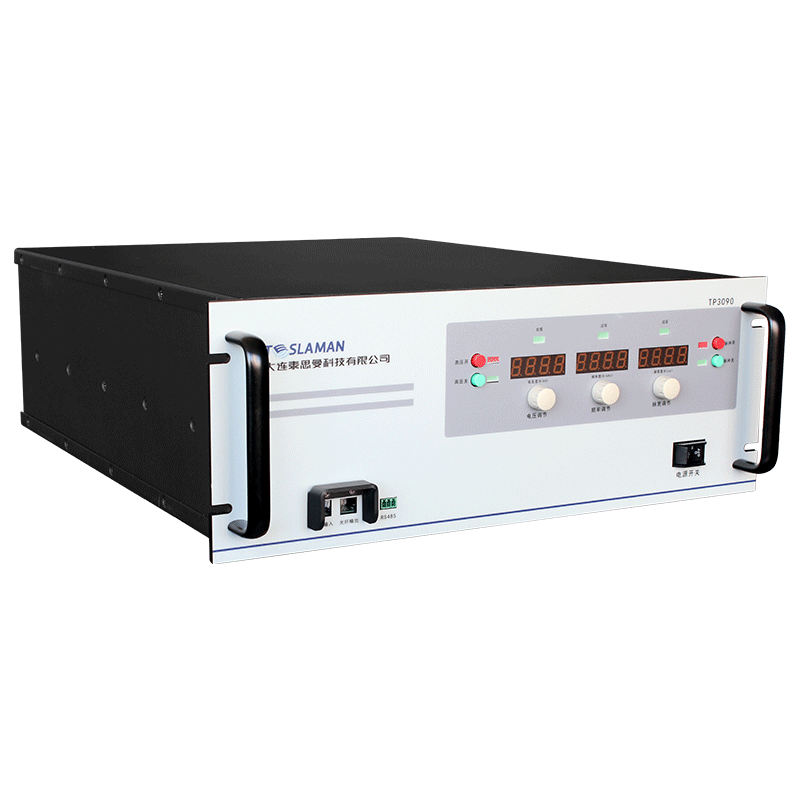
ppm Level High Voltage Power Supply Micro Voltage in Atomic Clock Auxiliary Instruments
Atomic clocks require extremely precise voltage control for various auxiliary instruments that support clock operation. Many of these applications require micro voltage control at the parts per million level to maintain frequency stability. High voltage power supplies must provide extremely high resolution and stability to achieve ppm level voltage control. The performance of the power supply directly influences the frequency stability of the atomic clock, which is the primary performance metric for these precision instruments.
Atomic clocks operate based on the hyperfine transition frequency of atoms such as cesium, rubidium, or hydrogen. The transition frequency is extremely stable when environmental conditions are properly controlled. Various auxiliary instruments including ion pumps, vacuum gauges, temperature controllers, and magnetic field coils require high voltage with extremely precise control. Even small variations in voltage can cause changes in temperature or magnetic fields that shift the transition frequency, reducing clock stability. ppm level voltage control is required to ensure that frequency variations remain within acceptable tolerances.
ppm level voltage control requires that voltage adjustments can be made in steps of one part per million of full scale output. For a 1000 volt output, this means adjustment steps of 1 millivolt. For a 10 kilovolt output, this means steps of 10 millivolts. High resolution digital-to-analog converters are required to achieve this level of resolution. 16-bit DACs provide 1 part in 65536 resolution, which is approximately 15 ppm. 20-bit DACs provide approximately 1 ppm resolution. Therefore, high resolution DACs are essential for achieving ppm level micro voltage adjustment.
Voltage stability must be maintained at the ppm level over extended periods. Long term stability of one ppm per month or better is required for atomic clock applications. This level of stability requires extremely high quality components with low drift characteristics. Voltage references must have extremely low temperature coefficients and low long term drift. Precision wirewound resistors with low temperature coefficients are used for voltage sampling to ensure that the feedback voltage accurately represents the output voltage. Any drift in component values directly causes drift in output voltage, so component selection is critical.
Temperature effects are the primary cause of voltage drift in high voltage power supplies. Changes in ambient temperature cause changes in component values including resistance, capacitance, and reference voltage. Temperature-induced drift must be compensated through careful design. Active temperature control of the voltage reference and critical components maintains constant temperature, which eliminates temperature-induced drift. Temperature-stabilized ovens for critical components maintain temperature within tenths of a degree, which keeps drift within ppm levels.
Thermal expansion of circuit board materials can cause changes in component position that affect high voltage insulation and stray capacitance. Stray capacitance changes can affect voltage division in the feedback network, resulting in output voltage changes. Low thermal expansion coefficient materials such as ceramic or composite circuit boards minimize thermal movement. Stable stray capacitance maintains voltage division accuracy, which maintains output voltage stability at ppm levels.
Micro voltage adjustments are required during frequency tuning and calibration of atomic clocks. When calibrating the clock frequency, small adjustments to voltages in auxiliary circuits fine tune the magnetic field or temperature to bring the frequency to the correct value. The ability to make precise micro voltage adjustments is essential for achieving the ultimate frequency accuracy. The adjustment must be repeatable so that the same setpoint produces the same output voltage every time. Repeatable adjustment ensures consistent frequency calibration results.
Voltage ripple at ppm level must be achieved to prevent frequency modulation from voltage fluctuations. Even small amplitude ripple at low frequencies can modulate the atomic transition frequency through temperature or magnetic field effects, resulting in increased phase noise and reduced frequency stability. Extensive filtering with multiple stages reduces voltage ripple to ppm levels. Low ripple ensures that the output voltage does not contribute to phase noise, allowing the atomic clock to achieve its ultimate frequency stability.
High voltage ion pumps maintain the high vacuum required for atomic clock operation. Ion pumps require high voltage DC to operate, and the pumping speed depends on the applied voltage. Stable voltage maintains constant pumping speed, which maintains constant vacuum pressure. Variations in voltage cause variations in pumping speed, which cause variations in vacuum pressure. Pressure variations cause changes in the dielectric constant of the residual gas and can cause changes in electric fields that affect frequency stability. ppm level voltage control maintains constant pumping speed and constant vacuum pressure, contributing to overall frequency stability.
Magnetic field coils used for Zeeman splitting require stable current to maintain the desired magnetic field. Stable current requires stable voltage across the coil because resistance is constant at constant temperature. Micro voltage variations cause micro current variations, which cause magnetic field variations. Magnetic field variations cause changes in the atomic transition frequency through the Zeeman effect. Therefore, ppm level voltage control is required to maintain magnetic field stability, which maintains frequency stability. The requirement is particularly stringent for atomic clocks that rely on precise magnetic field control for operation.
Temperature control for the atomic beam source uses proportional control that requires precise voltage adjustments to the heater. The temperature of the atomic beam source must be maintained within very tight tolerances because temperature affects the velocity distribution of the atoms, which affects frequency selection and ultimately frequency stability. ppm level voltage adjustments to the heater allow precise temperature control, maintaining the optimal temperature distribution and velocity distribution. Precise temperature control contributes to overall frequency stability.
Stray magnetic fields from the high voltage power supply can affect the atomic magnetic moments and cause frequency shifts. The power supply design must minimize stray magnetic fields through careful component placement and shielding. High permeability magnetic shielding contains stray fields within the power supply enclosure, preventing them from affecting the atomic clock physics. Shielding effectiveness must be sufficient to ensure that stray fields do not cause frequency shifts exceeding ppm levels.
Digital communication interfaces allow remote control of micro voltage adjustments from the clock control system. The clock control system can request precise voltage changes and monitor the actual output voltage to close the control loop. Digital communication with high resolution voltage readback provides accurate information about the actual output voltage. High resolution readback is required to verify that the output voltage matches the requested setpoint within ppm tolerances.
Long term aging of components causes gradual voltage drift that must be minimized. Component aging changes resistance values, reference voltage, and other parameters that affect output voltage. The aging rate of selected components is specified by manufacturers, and components with low aging rates are selected for critical applications. Aging compensation algorithms based on calibration history can correct for gradual drift, maintaining output voltage within ppm tolerances over many years of operation.
Vacuum conditions inside the atomic clock enclosure can affect insulation resistance and leakage currents. Leakage currents from high voltage circuits can cause small changes in output voltage that affect performance. High voltage insulation must be designed to minimize leakage currents in vacuum. High purity insulating materials with very high resistance minimize leakage, maintaining output voltage stability. Leakage current monitoring can detect any changes in insulation resistance that could indicate degradation over time.
Calibration at ppm level requires traceable reference standards for accurate voltage measurement. The output voltage must be calibrated against a reference standard that has traceability to national metrology standards. Calibration adjusts the digital-to-analog converter settings to correct for any deviations between requested and actual output voltage. Regular calibration intervals maintain accuracy over the lifetime of the instrument. Calibration records provide documentation of performance for quality assurance.
Noise performance at low frequencies is critical because low frequency voltage noise causes low frequency frequency noise, which degrades clock stability. 1/f noise, which has higher power at low frequencies, must be minimized through careful component selection and circuit design. Low noise components and filtered bias reduces 1/f noise, maintaining low noise performance at all frequencies. Low noise design ensures that voltage noise does not degrade the frequency stability of the atomic clock.
Packaging and thermal isolation prevent temperature changes from the surrounding environment from affecting internal components. Thermal insulation with low thermal conductivity minimizes temperature changes inside the power supply caused by changes in ambient temperature. Isothermal design maintains all critical components at the same temperature, preventing temperature gradients that can cause additional drift. Stable internal temperature maintains stable output voltage at ppm levels regardless of changes in ambient temperature outside the package.
The performance requirements for ppm level micro voltage control in atomic clock auxiliary instruments represent one of the most demanding challenges for high voltage power supply design. Every aspect of design from component selection through circuit topology, thermal management, shielding, and packaging must be optimized to achieve ppm level performance. The frequency stability of the entire atomic clock depends on achieving this level of performance. As atomic clock performance continues to improve for applications including precision navigation, timekeeping, and fundamental physics research, the requirements for voltage control continue to become more stringent. Continued improvement in high voltage power supply technology enables continued improvement in atomic clock performance, benefiting all applications that depend on ultra-stable frequency references.