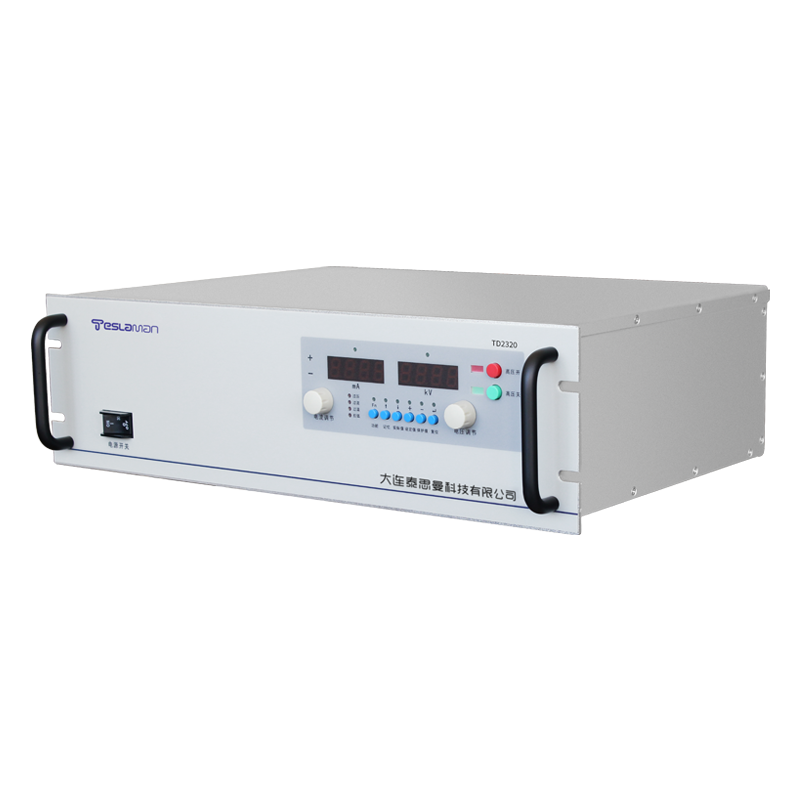
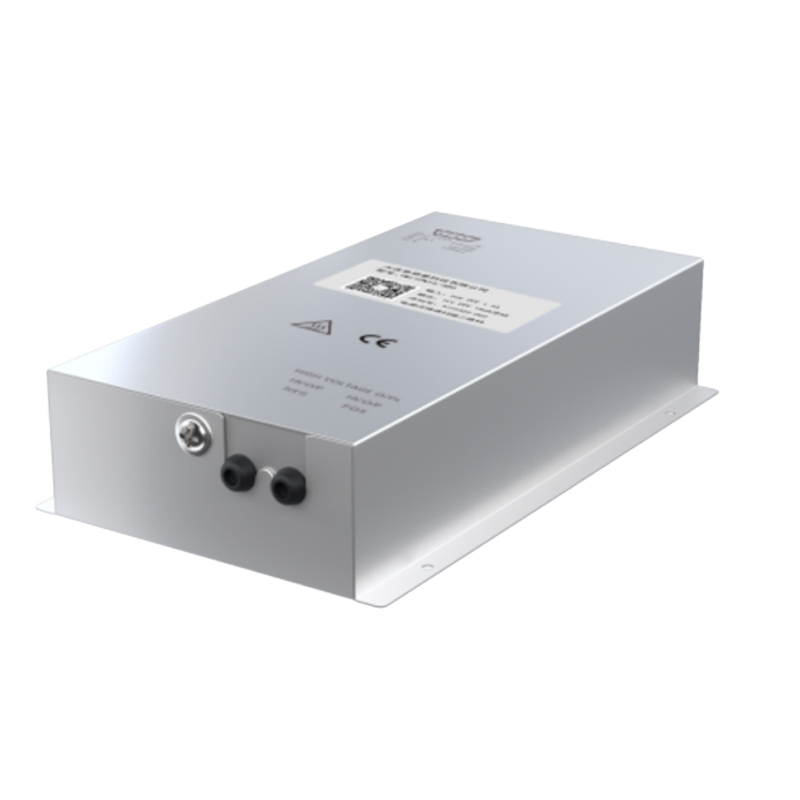
Accelerator High-Voltage Supply for Safe High Voltage in Medical Heavy-Ion Therapy
Medical heavy-ion therapy places exceptional demands on the accelerator high-voltage supply that feeds the ion source, the injector, and the successive accelerating stages of the treatment synchrotron or cyclotron. The supply must maintain a precisely controlled high voltage over long treatment sessions while guaranteeing the safety of patients, operators, and sensitive hospital infrastructure. Safety and stability are not separate requirements in this environment; the two requirements are two faces of the same engineering problem, because a momentary voltage excursion can alter the beam energy, and an energy error directly affects the dose deposited in the target volume.
The beam energy in heavy-ion treatment is set by the accelerating voltage and the field configuration of the ring. A deviation of only a few tenths of a percent in the final energy shifts the Bragg peak position by several millimeters in tissue. For this reason, the accelerator supply is designed around a high-precision voltage reference and a low-drift regulation chain. Temperature-controlled reference elements, precision resistive dividers with low temperature coefficients, and guarded feedback paths keep the output stable from the first patient of the day to the last. The regulation loop is intentionally slow for absolute accuracy yet equipped with a fast inner loop that absorbs load transients during injection and extraction.
Safety architecture follows a layered philosophy. The first layer is passive: creepage distances, shielding partitions, and interlock contacts that physically prevent access to energized areas. The second layer is active protection, with overvoltage clamps, overcurrent trip circuits, and crowbar elements that discharge stored energy within milliseconds when an abnormal condition is detected. The third layer is supervisory, where the supply continuously compares measured parameters against a safety envelope and requests beam termination when the envelope is violated. Every layer is independently testable, so routine maintenance can verify each function without de-energizing the entire facility.
The high-voltage section is contained in a sealed tank filled with insulating gas or dielectric fluid. The tank design balances dielectric strength against thermal performance, because the charging power of a treatment accelerator can reach hundreds of kilowatts during ramp-up. Cooling channels are arranged to keep the hottest components away from the insulating medium and to avoid creating hot spots that could accelerate insulation aging. Partial discharge monitoring is installed on the tank and on the high-voltage feedthroughs, providing continuous evidence of insulation health during clinical operation.
Control of the supply is fully digital, with a dedicated fast control loop implemented in firmware and a slower supervisory loop executed on the system controller. The fast loop regulates the accelerating voltage with a bandwidth high enough to reject power-line harmonics and the periodic load variations caused by the radio-frequency cavities. The supervisory loop handles parameter updates, ramp profiles, and fault handling, and communicates with the therapy control system through a deterministic interface. All setpoints and measured values are time-stamped so that an offline analysis can reconstruct the exact voltage history around any beam delivery event.
Ramp control deserves particular attention in a medical accelerator. The supply must bring the voltage from zero to the operating level with a controlled slope, because a rapid change can induce oscillations in the magnet power supplies and disturb the closed orbit of the beam. The ramp profile is therefore designed as a smooth function, and the supply verifies that the voltage has settled within tolerance before the beam is permitted to enter the ring. The same discipline applies during extraction, when the voltage is stepped to match the slow extraction resonance.
Reliability engineering is driven by the clinical schedule. Treatment slots are booked far in advance, and an unexpected supply failure disrupts patient care. Redundant power modules, hot-swappable control boards, and a comprehensive built-in test suite allow the maintenance team to replace a suspect module without interrupting treatment. Failure modes are analyzed with fault-tree methods, and the most critical single points are duplicated. Mean time between failures is tracked as a key performance indicator, and the data feed back into component selection for the next design revision.
Electromagnetic compatibility receives the same level of attention as electrical safety. The therapy room contains imaging equipment, beam monitors, and patient monitoring systems that must not be disturbed by the accelerator supply. The supply therefore meets stringent emission limits, and the immunity of the supply is verified against the disturbances generated by the magnets and the radio-frequency system. Cabling is routed with separation between power and signal paths, and grounding follows a star topology that prevents circulating currents from coupling noise into the measurement chain.
Validation before clinical use follows a structured protocol. The supply undergoes type tests for dielectric withstand, partial discharge, temperature rise, and electromagnetic compatibility. This is followed by endurance tests that simulate the duty cycle of a full treatment day. Acceptance tests at the hospital verify the interface with the therapy control system, the interlock chain, and the dose monitoring equipment. Calibration of the voltage measurement chain is traced to a national standard, and the calibration interval is chosen so that drift remains well below the clinical tolerance.
The supply also participates in the broader safety concept of the treatment room. A manual emergency stop cuts the high voltage and discharges the stored energy, an automatic interlock follows the status of the beam line, and a software interlock monitors the consistency of the measured parameters. The design principle is that no single failure, and no combination of two independent failures, can lead to an unsafe delivery of high voltage. This principle is verified by fault injection tests during commissioning and repeated at defined intervals during the life of the equipment.
Condition monitoring extends the safety and reliability envelope. Sensors for temperature, pressure, humidity, and partial discharge are integrated into the supply, and the readings are stored in a historian database. Trend analysis detects insulation degradation and cooling deterioration before such degradation affects performance. The monitoring system issues graded alarms, from advisory messages to immediate shutdown requests, so the clinical team can plan maintenance at a convenient time rather than reacting to a failure.
Documentation is part of the safety chain. Every protection function is described in the operating manual with the activation threshold, the response time, and the verification procedure. Maintenance records are linked to the individual serial numbers of the modules, creating a complete life-cycle history. This documentation supports the periodic safety reviews required by hospital accreditation bodies and provides the evidence base for continuous improvement of the design.
In summary, the accelerator high-voltage supply for medical heavy-ion therapy is a safety-critical subsystem whose design integrates precision regulation, layered protection, redundant architecture, continuous monitoring, and rigorous validation. The result is a supply that maintains the demanding voltage stability required for accurate dose delivery while providing the safety margins that clinical environments demand. Each improvement in stability, each reduction in failure rate, and each enhancement of the monitoring capability contributes directly to safer and more effective treatment of patients. The engineering effort continues, because the requirements of clinical practice grow with every new treatment protocol and every advance in beam delivery technology. The supply will keep evolving toward higher precision, greater reliability, and deeper integration with the therapy system.