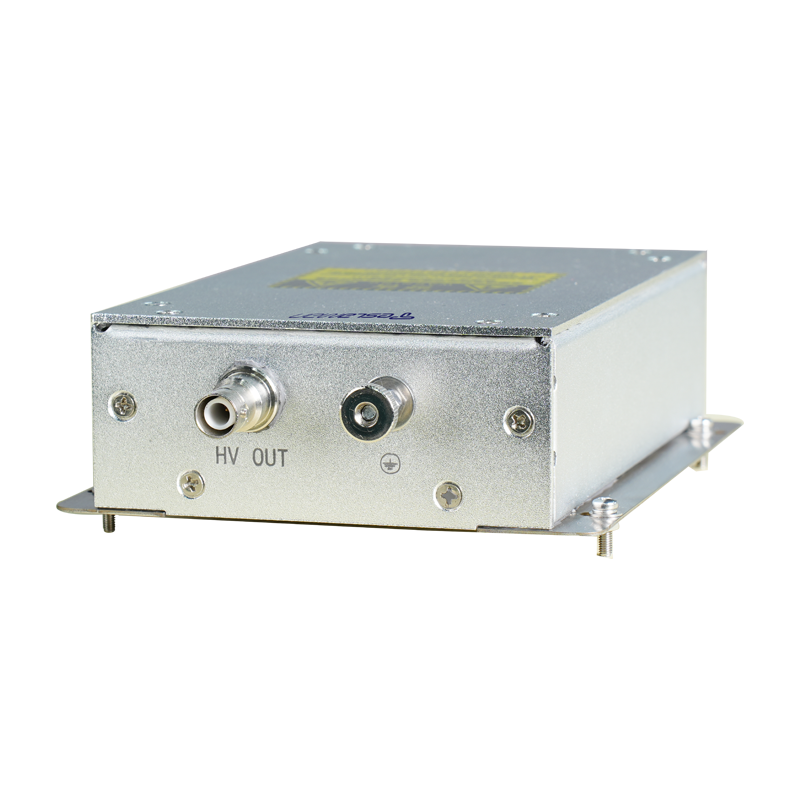
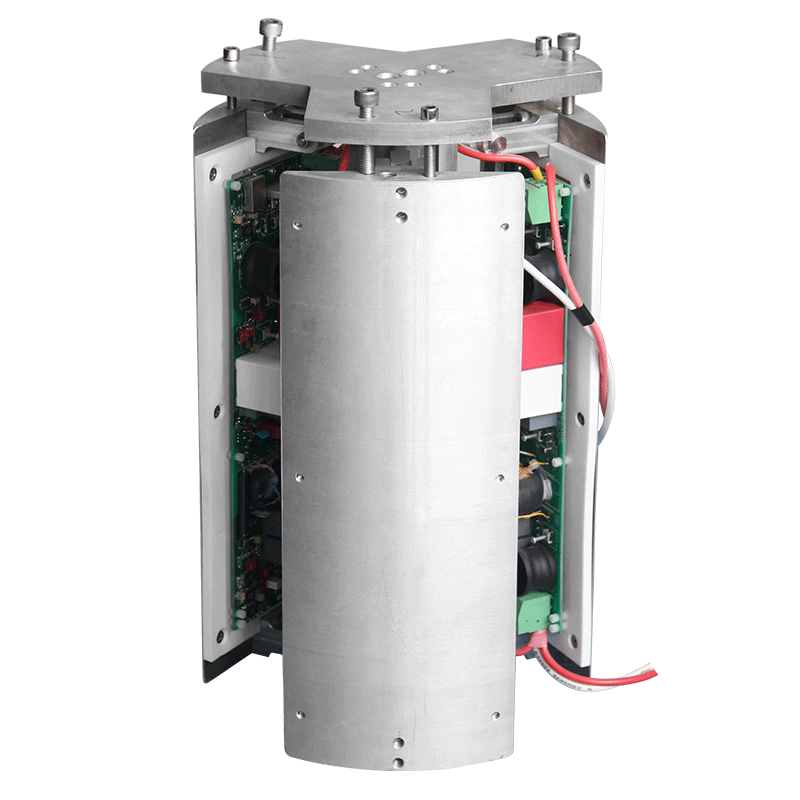
225 kV Floating High-Voltage Solution for Vacuum Coating Electron Guns
Large-area precision optical coating and high-rate metallization of architectural glass require electron guns operating at 180–225 kV acceleration voltage while the entire gun and filament assembly floats on a dynamically regulated bias platform of –8 kV to +4 kV for beam steering and emission control. Floating high-voltage architectures must therefore deliver the full 225 kV relative to chamber ground while simultaneously superimposing a fast, independently regulated bias voltage with microsecond response and noise below 12 V p-p.
The solution uses a dual-deck topology: a primary 225 kV deck built as an air-insulated, parallel-fed Cockcroft-Walton multiplier driven by a 28 kHz resonant inverter, and a secondary ±12 kV bias deck physically mounted inside the primary deck’s oil-filled tank and galvanically isolated by a 1:1 high-frequency isolation transformer. The electron gun cathode is referenced to the bias deck output, so the total acceleration voltage seen by electrons is the algebraic sum of the two decks with opposite polarities.
Regulation of the 225 kV deck is performed by a high-bandwidth series linear MOSFET regulator located on the low-voltage side of the drive transformer, allowing 180 dB loop gain at DC and 42 dB at 10 kHz without stability issues common to direct high-side regulation. Ripple at the gun cathode remains below 8 V p-p across the full 2–25 mA beam current range.
The floating bias deck uses a compact sine-wave resonant converter operating at 120 kHz with gallium nitride primaries and synchronous rectification on the floating secondary. Slew rate exceeds 8 kV/µs, enabling real-time beam steering corrections from fast deflection plates or emission current feedback loops that suppress density variations caused by filament sag. Bias voltage noise is held below 4 V p-p through active filtering and local battery-backed decoupling capacitors that ride through primary-side interruptions.
Isolation between decks exceeds 350 kV DC and 500 kV BIL through the use of cast epoxy bushing and oil-paper insulation systems originally developed for medical linacs. Control signals cross the barrier via 50 kV-rated fiber-optic links with 180 dB common-mode rejection. A floating 28 V lithium-ion pack provides bias deck housekeeping power for up to 90 seconds during primary faults, preventing uncontrolled cathode potential drift that would otherwise damage coated optics.
Arc management is split: the primary 225 kV deck uses a fast crowbar and stored-energy limiting to 18 J, while the bias deck implements instantaneous current fold-back to 150 % of nominal within 1.2 µs. Coordinated recovery ensures the bias voltage is re-established first, preventing filament bombardment by a partially energized beam.
Thermal design employs forced-oil circulation for the primary deck and conduction cooling through the tank wall for the bias deck, maintaining filament temperature stability within ±1.8 °C despite beam power swings from 2 kW to 48 kW. These floating systems routinely deliver 400 mm wide beams with thickness uniformity below 0.8 % across 3.2 m substrates and beam current stability supporting deposition rate control better than ±0.4 % over 8-hour runs in high-volume architectural coating lines.