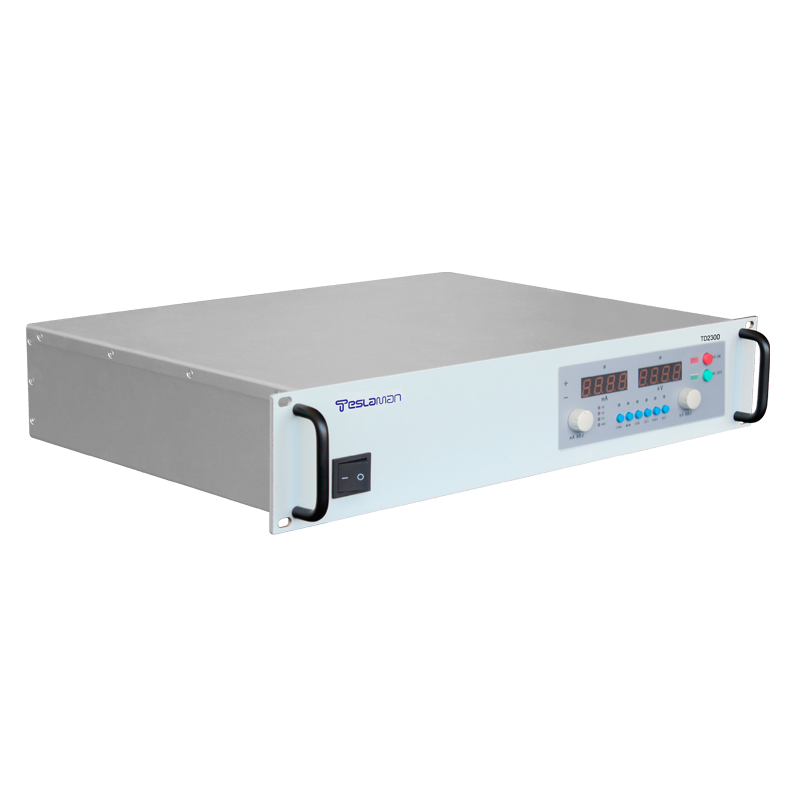
Zero-Arc High-Voltage Discharge for E-Chuck Wafer Transfer
Safe and particle-free wafer transfer from bipolar electrostatic chucks in EUV and high-NA lithography tracks requires complete neutralization of stored charge in <240 ms with zero detectable arcing and final surface potential <±0.6 V to prevent wafer pop-off or placement errors.
The zero-arc discharge circuit uses a resonant H-bridge of 1.7 kV silicon carbide MOSFETs driving a 1:1 air-core transformer directly coupled to the chuck electrodes through <12 nH vacuum feedthroughs. Discharge begins with a controlled constant-current sink at 140–180 A that collapses clamping voltage exponentially to <18 V in 92–138 µs, followed by a damped sinusoidal ringing phase that drives residual charge through zero and into slight opposite polarity.
Arc prevention is achieved by active voltage clamping during the entire discharge: a parallel linear sink absorbs any positive excursion above +28 V, while a negative clamp limits excursion below –22 V. Real-time electrode voltage is monitored via a 1:1000 capacitive divider with 180 V/µs bandwidth; any deviation >38 V triggers immediate bridge disable within 420 ns.
Charge recovery exceeds 97 % through synchronous rectification back to the 400 V rail. A learning algorithm refines the ringing amplitude and damping factor every wafer based on measured chuck capacitance and leakage, achieving final residual charge <2.6 nC (≈0.42 V surface potential) across chuck lifetime.
Multi-zone chucks with up to 32 electrodes are supported by stacking identical discharge modules with fiber-optic trigger distribution. Zone timing is staggered by 9 µs to prevent mutual coupling through the wafer bulk silicon.
Pre-transfer diagnostics execute a 180 V resistance test in 42 ms; if any zone shows <24 GΩ, a 720 V reverse cleaning pulse train is inserted before normal discharge. These zero-arc circuits routinely achieve full neutralization in 192–228 ms with zero detectable discharge events and residual potential <±0.38 V, enabling robot end-effector speeds >780 mm/s and contributing to wafer exchange <3.4 s in high-volume EUV lithography tracks.