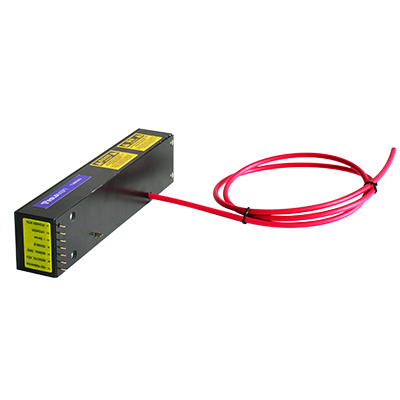
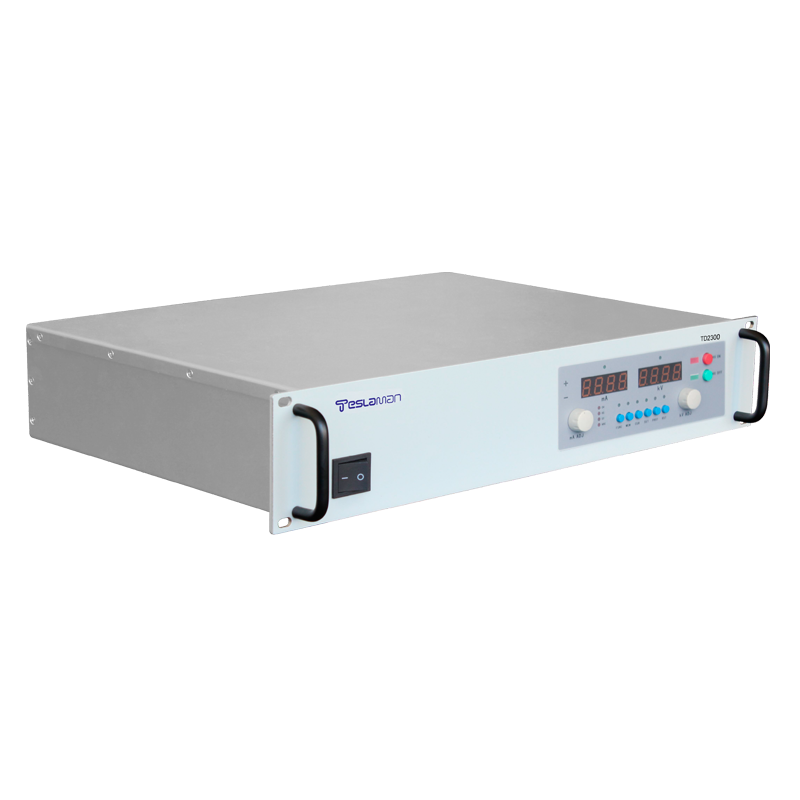
Excimer Laser Energy Monitoring Power Supply
Excimer lasers, producing high-power pulses of deep ultraviolet light, are vital tools in micromachining, photolithography, and medical applications. Their utility hinges on precise and consistent pulse energy, as variations directly translate into process non-uniformity—be it in ablated feature depth, photoresist exposure dose, or surgical effect. While the primary high-voltage pulse-forming network (PFN) that directly drives the laser discharge garners significant attention, the performance of supporting high-voltage supplies for energy monitoring subsystems is equally critical for process control. These supplies power the heart of the laser's closed-loop energy regulation: the pulse energy detector and its associated instrumentation.
The most common method for real-time pulse energy measurement employs a fast photodiode or a calibrated photodetector viewing a small, stable fraction of the beam split from the main output. For high-accuracy applications, especially in lithography where dose control is paramount, integrating spheres coupled to photodiodes or pyroelectric detectors are used. These detectors, particularly biplanar photodiodes or pyroelectric sensors, require a stable, low-noise, high-voltage bias supply to operate optimally. The applied bias voltage sets the detector's responsivity, linearity, and dynamic range. Any noise or drift on this bias line is indistinguishable from a genuine signal change, leading directly to erroneous energy readings. Consequently, the monitoring power supply must exhibit ultra-low output noise, often specified in the microvolt or low millivolt range over a wide bandwidth, to avoid injecting noise into the sensitive readout electronics.
Stability is a multi-faceted requirement. Short-term stability, or pulse-to-pulse noise, must be minimal to avoid jitter in the energy feedback signal. Long-term thermal drift over hours of operation is equally critical, as it would cause a gradual skew in the calibration of the entire energy control loop. This necessitates designs with high-stability voltage references, low-temperature-coefficient resistors in feedback networks, and careful thermal management of critical components. Furthermore, the supply must be immune to the harsh electromagnetic environment inside an excimer laser. The main discharge event is a substantial source of EMI, involving the rapid switching of tens of kilovolts and kiloamperes, generating intense broadband interference. The monitoring power supply must be housed in a fully shielded enclosure, with its input and output lines heavily filtered to prevent this noise from corrupting the bias voltage or from being conducted back into the sensitive analog signal chain.
Integration with the laser's control system adds another layer of complexity. For automated calibration sequences or different operating modes (e.g., varying pulse repetition rates or gas mixtures), the detector bias voltage may need slight adjustment. A digitally programmable interface, such as one using an isolated SPI or analog setpoint with high resolution, allows the main laser controller to optimize the monitoring circuit's operating point. Crucially, this interface must maintain perfect galvanic isolation. The detector is typically at or near ground potential, but its connection to the controller may involve paths that could couple noise or create ground loops if the bias supply's control port is not properly isolated. Optical or transformer-based isolation is standard.
In some advanced designs, the high-voltage supply for the energy monitor is part of a larger, integrated metrology chain. It may also power a reference light source, such as a stable LED, used for in-situ calibration of the photodetector path to compensate for aging or contamination. In these cases, the supply's ability to provide multiple, independently regulated and monitored outputs with precise timing (e.g., turning on a calibration source between laser pulses) becomes important. The design goal is to make the monitoring subsystem an accurate and reliable "sensor" for the control loop. Any deficiency in the bias supply manifests as reduced accuracy in energy measurement, forcing the laser's feedback system to correct for phantom fluctuations, potentially compromising the true output stability. Therefore, this unassuming high-voltage module is a key enabler of the excimer laser's reputation as a precise industrial tool, transforming an intense electrical discharge into a metrologically quantifiable optical pulse.