Proton Analysis High Voltage Power Supply Collision Cell Optimization
In modern inductively coupled plasma mass spectrometry (ICP-MS), particularly in configurations designed for high-sensitivity elemental and isotopic analysis, the collision/reaction cell (CRC) has become an indispensable component. Its purpose is to attenuate polyatomic interferences that share the same nominal mass-to-charge ratio as the analyte of interest, such as ArO+ on Fe+ or ArAr+ on Se+. While the gas chemistry (using He, H2, or NH3) within the cell is a primary focus, the electrical environment, defined by the DC and RF potentials applied to the cell's multipole rod set, is equally critical. The optimization of the high-voltage power supply system that creates this environment directly dictates the cell's efficiency in transmitting analyte ions while suppressing both interferences and secondary reactions.
The core of a collision cell is typically a quadrupole, hexapole, or octopole rod set. Unlike a mass-resolving quadrupole, the CRC rods are usually operated in RF-only mode. A high-frequency, high-amplitude RF voltage (often ranging from 100 V to 1000 V peak-to-peak at frequencies around 1-5 MHz) is applied between opposite rod pairs. This creates a pseudo-potential well that radially confines ions of a broad mass range, guiding them through the cell filled with the reaction gas. Superimposed on this RF field is a tunable DC offset, or "bias," applied to all rods relative to the upstream ion optics and the downstream mass analyzer. This DC bias controls the axial kinetic energy of ions entering the cell. Optimization of this energy is paramount: too high, and the collision-induced dissociation (CID) of polyatomics is inefficient, and unwanted secondary reactions (like charge transfer or formation of new adducts) can occur; too low, and ion transmission suffers, and space charge effects can become pronounced.
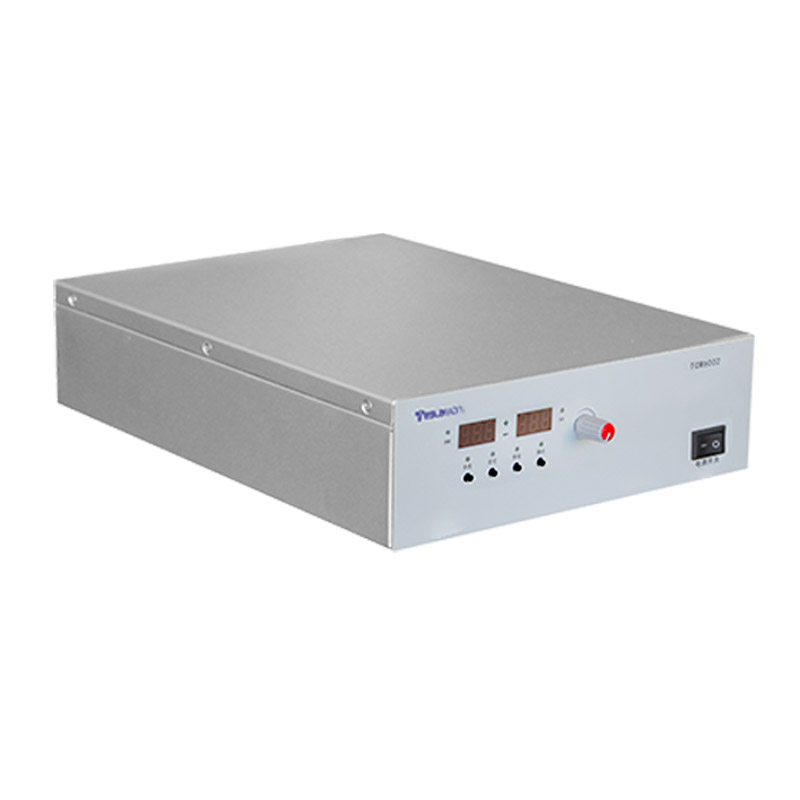
The power supply system for this application is therefore a hybrid, multi-output platform. It must generate a very stable, low-noise, digitally tunable DC voltage for the cell bias, typically in the range of -30V to -5V relative to ground. Simultaneously, it must power an RF generator capable of delivering a clean, high-voltage sine wave with exceptional amplitude stability. Any ripple or noise on the DC bias modulates the ions' axial energy, causing a distribution in the number of collisions they undergo, which broadens the signal and degrades detection limits. Similarly, instability in the RF amplitude affects the radial confinement efficiency, potentially leading to ion loss or mass-dependent transmission fluctuations. The two power domains must be perfectly isolated from one another to prevent coupling; a modulation of the DC bias must not cause frequency or amplitude shifts in the RF output, and vice-versa.
Advanced optimization goes beyond static voltage settings. Kinetic energy discrimination (KED) is a common interference suppression technique. Here, the cell is operated with a higher gas pressure and a positive exit bias relative to the rods. Polyatomic interferences, after many collisions, tend to have a lower average kinetic energy (they are "thermalized") than the heavier analyte ions. By setting the cell exit aperture to a potential that acts as an energy barrier, the thermalized interferences are rejected while the higher-energy analytes are transmitted. The precision and stability of the DC supplies setting these rod and exit biases (often differing by just 1-5 volts) are therefore extreme. Drift of a few hundred millivolts can significantly alter the discrimination cutoff, changing the method's sensitivity and selectivity.
Furthermore, research into more complex cell operation involves dynamic voltage scanning or pulsing. For instance, to study reaction kinetics or to implement advanced interference removal protocols, the DC bias may need to be ramped or stepped during the analysis of a single sample. This requires the DC power supply to have a fast slew rate and excellent linearity in its response to digital commands. The RF supply must maintain unwavering stability throughout these DC transients. The interaction between the power supplies and the physical cell is also a subject of optimization. The impedance of the rod set is capacitive and changes with gas pressure and the presence of plasma. The RF generator must be matched to this dynamic load to ensure efficient power transfer and to maintain waveform purity, preventing the generation of higher harmonics that can create nonlinear resonances and trap ions of specific masses.
Ultimately, optimizing the collision cell through its power supply is an exercise in creating a perfectly controlled, reproducible "flight tube" environment. Every volt applied to the rods shapes the ion trajectory, collision energy, and residence time. The supplies must act not as independent modules, but as a synchronized system that establishes a precise electrical landscape, allowing the gas-phase chemistry to proceed with maximum efficiency for interference removal and minimum loss of the coveted analyte ions, pushing the boundaries of detection in trace element analysis.