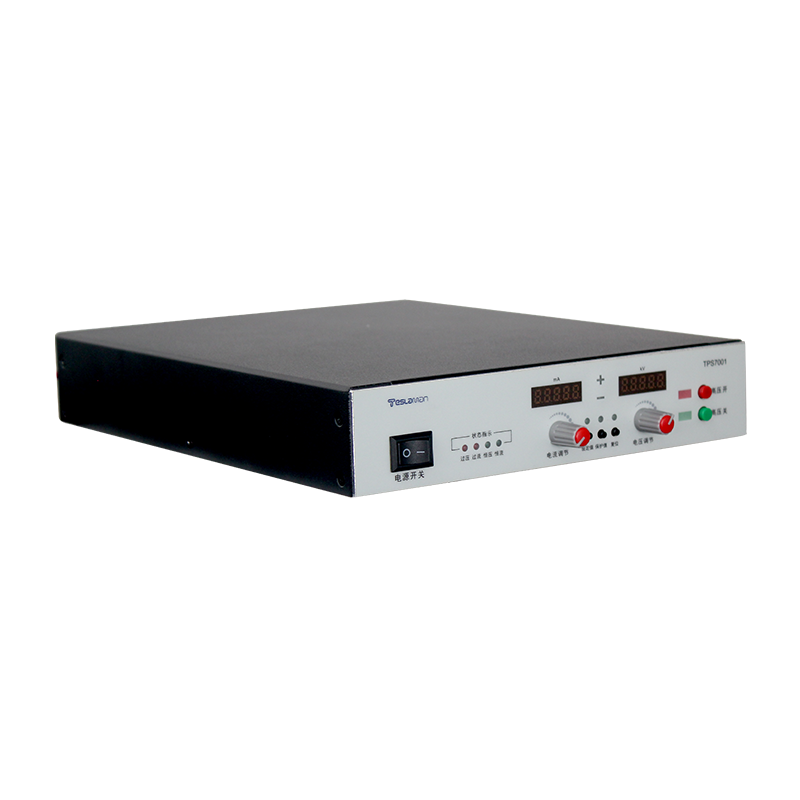
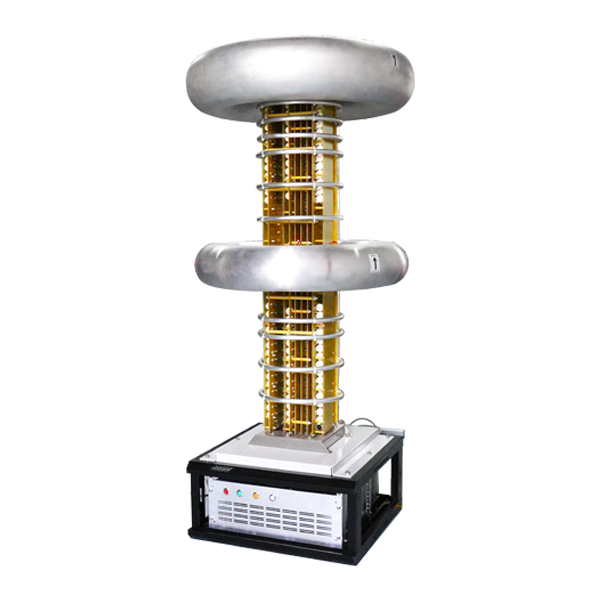
Electrostatic Spraying Reciprocating Gun Synchronization Power Supply
Automated electrostatic spraying systems for painting, coating, or powder application rely on uniform material deposition across complex surfaces. A common configuration uses a reciprocating gun mount, where the spray head moves rapidly back and forth on a vertical stroke while the workpiece moves on a conveyor horizontally. To achieve a consistent film thickness with minimal overspray and optimal transfer efficiency, the high voltage applied to the gun for charging the particles must be perfectly synchronized with the gun's reciprocating motion. A desynchronized system will apply voltage when the gun is pointing away from the target or during direction reversal, leading to wasted material, poor wrap-around (coating of recessed areas), and contamination of the booth. The synchronization power supply solves this by integrating motion control feedback with high-voltage generation and switching.
The system comprises several key elements: the reciprocating actuator (typically a servo or variable-frequency drive motor with an encoder), the high-voltage power supply (typically a DC supply in the 30-100kV range for liquid, or 60-120kV for powder), a high-voltage switching device (often a solid-state relay or a triggered spark gap for faster switching), and a master synchronization controller. The fundamental operational rule is that high voltage should only be present at the gun when it is aimed within a defined "spray window"—the angular sector of its stroke where the spray pattern effectively intersects with the target workpiece. Outside this window, at the extremes of the stroke and during turn-around, the voltage must be shut off completely and quickly.
The synchronization controller is the brain of this operation. It continuously reads the position feedback from the gun's motion encoder. This encoder provides real-time data on the gun's angle or linear position. Based on pre-programmed parameters—the spray window start angle, stop angle, and perhaps a dynamic window that changes with conveyor speed—the controller calculates when the gun is in position. It then sends a command to enable the high voltage. This command cannot directly switch the 100kV output; it controls the high-voltage switching device. For liquid spraying, where voltage needs to be on and off within tens of milliseconds, a fast solid-state HV relay is used. For powder coating, where the build-up and decay of voltage must follow the powder cloud's inertia more closely, switching times in the low millisecond range are required, and triggered vacuum relays or specially rated IGBT stacks may be employed.
The high-voltage supply itself is designed for rapid cycling. A standard corona charging supply might not tolerate its output being shorted or open-circuited at a frequency of 1-10 Hz (the typical reciprocation rate). The synchronization supply is built to be robust against such cycling. Its internal regulation loop is designed for stability even when the load impedance changes abruptly from essentially infinite (when the HV switch is open) to the finite resistance of the corona discharge or powder cloud. It often incorporates a fast feedback sensor to quickly re-establish the set voltage after each enable command. Some designs use a "keep-alive" or pre-charge circuit that maintains a lower voltage on an intermediate capacitor, allowing the final output to ramp to its full setpoint more rapidly when the switch closes.
Advanced synchronization involves more than simple on/off windowing. To optimize edge coverage and prevent a "bullseye" effect of thicker coating at the center of the stroke, the controller can implement voltage profiling. As the gun sweeps across the target, the commanded voltage level can be dynamically modulated—slightly lower at the center of the stroke and higher at the edges—to compensate for differences in dwell time. This requires a power supply capable of accepting an analog voltage programming signal and responding with high bandwidth. Furthermore, synchronization with multiple guns on the same reciprocator, or with rotating bells, adds complexity. The controller must manage phase relationships to prevent electrical interference between adjacent guns, which can lead to reduced charging efficiency or even arcing. This is often managed by time-multiplexing the high voltage, ensuring only one gun in close proximity is energized at a time, a technique requiring submicrosecond timing accuracy from the controller and switches.
Safety and diagnostics are integrated. The system continuously monitors for ground faults or arcs. If an arc is detected, the HV is shut down immediately, and the event is logged with a timestamp correlated to the gun position, aiding in troubleshooting booth geometry or gun maintenance issues. The synchronization of high voltage to mechanical motion transforms electrostatic spraying from a blanket charging process into a precision deposition tool, maximizing material utilization, ensuring coating uniformity, and enabling compliance with stringent environmental regulations on volatile organic compound and particulate emissions.