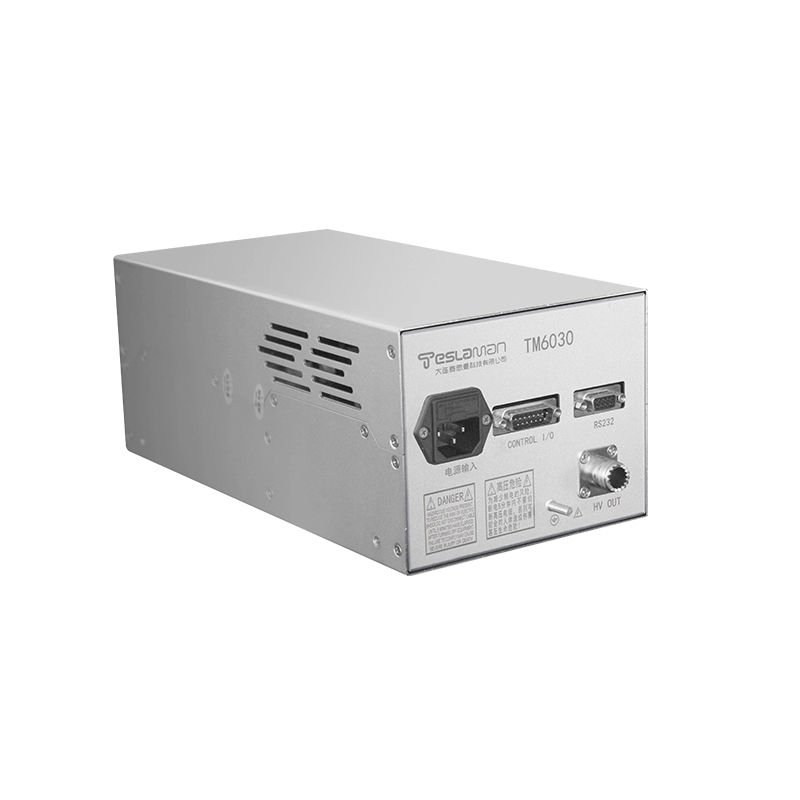
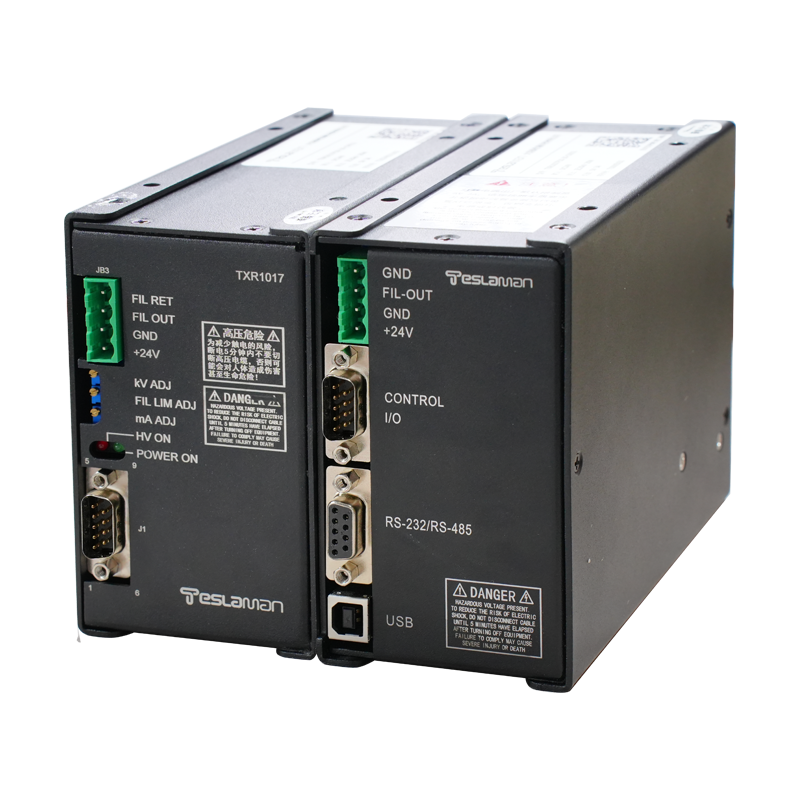
Accelerator Injector High-Voltage Pulse Power Supply
The performance of any particle accelerator chain is fundamentally limited by the characteristics of its initial stage: the injector. Whether producing electrons, protons, or heavy ions, the injector must create a particle beam of defined intensity, energy, and temporal structure for further acceleration. For many types of injectors—such as diode sources for electrons, or radio-frequency quadrupole (RFQ) injectors for ions—this requires the application of high-voltage pulses with extraordinary precision in amplitude, timing, and shape. The high-voltage pulse power supply for an accelerator injector is therefore a precision instrument, engineered to deliver not just high power, but a specific electrical signature that defines the initial quality of the beam.
The requirements are multifaceted and stringent. For a pulsed diode electron gun, a negative high-voltage pulse (e.g., -100 kV to -500 kV) with a duration of microseconds to milliseconds is applied to a cathode. The rise time of this pulse must be extremely fast (often tens to hundreds of nanoseconds) to quickly establish the extraction field and minimize the phase spread of the emitted electrons. The flat-top of the pulse must exhibit exceptional amplitude stability (better than 0.1% peak-to-peak ripple) and minimal droop, as any variation directly modulates the beam energy. The fall time must also be controlled to prevent voltage reversal that could damage the cathode or cause unwanted secondary emission. For ion sources, such as those feeding an RFQ, the requirement may be for a positive high-voltage pulse (up to 100 kV) to extract ions from a plasma, with similar demands on stability but often at lower current.
To meet these demands, the modulator topology is typically based on a Pulse-Forming Network (PFN) or a more modern solid-state Marx bank. A PFN-based system uses a network of inductors and capacitors that are charged in parallel to a high DC voltage and then discharged in series via a high-power switch (like a thyratron or a stack of semiconductor switches) to produce the shaped pulse. The high-voltage DC charging supply that charges the PFN is a critical subsystem. It must charge the network to a very precise voltage setpoint repeatedly and efficiently at the pulse repetition rate, which can be from single shot to several hundred Hertz. This charger is often a resonant converter (like a series resonant or LLC converter) operating in constant current/constant voltage mode to minimize stress on components and reduce charging time.
The switching element is the heart of the pulse generation. Modern systems increasingly employ solid-state stacks using Silicon Carbide (SiC) MOSFETs or IGBTs for their longevity, precise trigger control, and fast switching speeds. Driving these switches at hundreds of kilovolts requires sophisticated, isolated gate drive circuits with high common-mode transient immunity. The shape of the output pulse is not solely defined by the PFN; active elements are used for fine-tuning. A "de-Q-ing" circuit may be used to clip the leading edge overshoot. A series regulator tube (like a tetrode) or a solid-state linear amplifier stage can be placed in series with the output to actively correct for droop and ripple on the flat-top, creating a near-perfect square pulse. This active regulation stage must withstand the full pulse voltage and handle the beam current, representing a significant design challenge.
Timing and synchronization are perhaps the most critical aspects. The injector pulse must be synchronized with the RF phase of downstream accelerating structures (like linacs) with picosecond-level jitter. This is achieved by deriving all timing from a master oscillator. The trigger for the high-voltage pulse switch is generated by a low-jitter digital delay generator, and often this trigger signal is transmitted via fiber-optic cable to the floating pulse generator to maintain isolation. The power supply's internal diagnostics continuously monitor pulse amplitude, timing relative to the master clock, and shape, providing feedback for long-term stability and fault detection.
Furthermore, the system is designed for exceptional reliability and fault tolerance. Beam loading can vary, and arcs in the injector diode are common during conditioning or due to contamination. The modulator must incorporate fast arc detection circuitry that can crowbar the output (safely short it) within microseconds to prevent damage to the cathode and the modulator itself. Redundant systems and comprehensive remote monitoring and control are standard, as accelerator uptime is precious. In summary, the injector high-voltage pulse power supply is a complex synthesis of high-power switching, precision analog regulation, and ultra-precise timing, whose output pulse is the very genesis of the particle beam, setting the stage for all subsequent acceleration and beam quality.