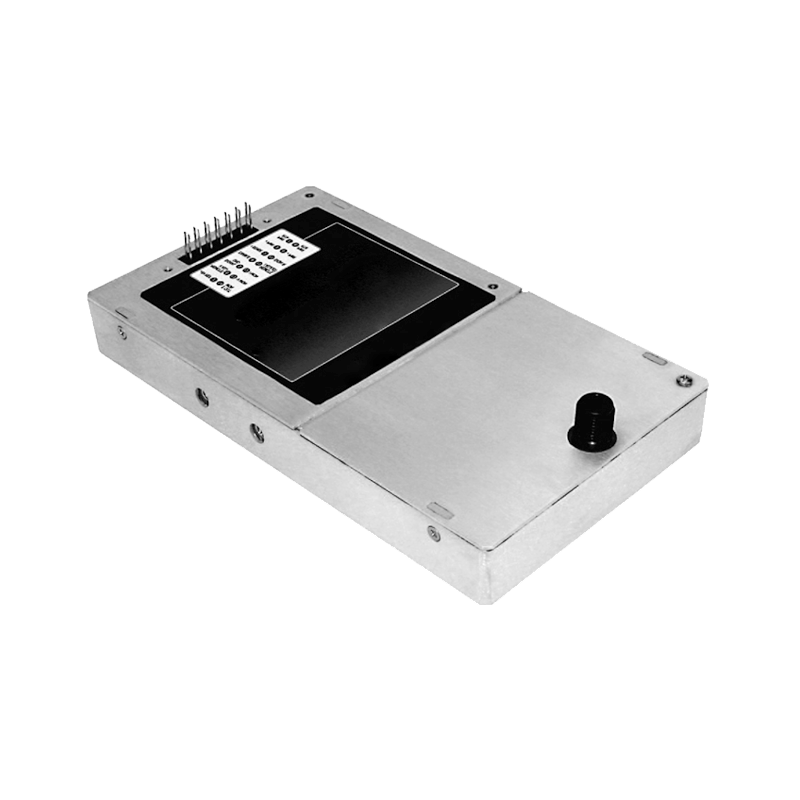
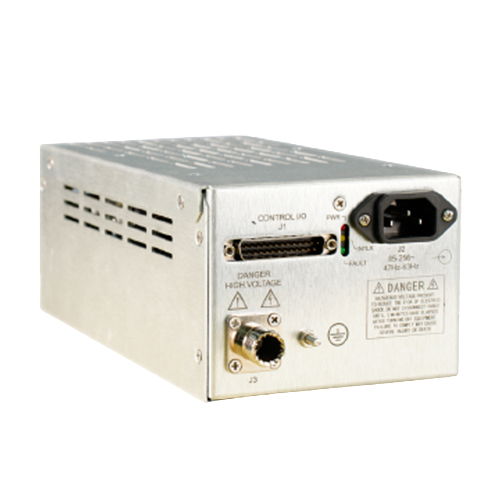
Microchannel Plate Gain Saturation Protection Power Supply
Microchannel Plates (MCPs) are electron multipliers used in extreme low-light detection applications, such as in night vision devices, particle detectors, and high-speed photon counting. They operate by applying a high voltage (typically 500-1500V) across a thin, lead-glass plate densely populated with microscopic channels. Incident particles or photons trigger electron cascades within these channels, producing gain factors of 10^3 to 10^7. A critical failure mode for MCPs is gain saturation and subsequent damage caused by excessive output current. When too many channels fire simultaneously or at a high rate, the integrated electron flux can exceed the strip current available from the conductive channel walls. This leads to a localized collapse of the electric field within the channels, halting multiplication, and can cause permanent reduction of gain or physical damage due to overheating. A specialized power supply system with integrated gain saturation protection is therefore essential for safeguarding these sensitive and expensive components during dynamic or unpredictable signal conditions.
The standard power supply for an MCP is a simple, high-voltage source with a current limit. However, a fixed current limit is often inadequate. The damaging condition is not merely the total DC current, but the peak instantaneous current drawn during a signal burst, which can be many times higher than the average. The conductive coating inside the MCP channels has a finite resistance; a sudden high current demand causes a local IR voltage drop, depleting the field. Therefore, the protection scheme must respond to dynamic current transients, not just DC overload.
An advanced protection power supply employs a fast, active feedback loop that monitors the MCP's output current or, more effectively, the voltage drop across a sense resistor in the high-voltage return path. This monitoring circuit must have a very high bandwidth, capable of detecting current spikes with rise times on the order of nanoseconds. Upon detecting a current surge that exceeds a preset dynamic threshold, the protection circuit engages within tens to hundreds of nanoseconds. The corrective action is not simply to shut off the high voltage—this would be too slow and would interrupt detection. Instead, the most common method is to momentarily "crowbar" or clamp the MCP voltage.
This is achieved using a fast high-voltage switch, such as a MOSFET or a series of transistors, placed across the output of the high-voltage supply or in series with it. When a saturation event is detected, this switch is activated, effectively shorting the MCP or drastically reducing the voltage across it for a brief, predefined period (e.g., 1-10 microseconds). This instantaneous removal of the accelerating field stops the electron cascade without allowing the damaging current to persist. After this brief clamp pulse, the voltage is automatically restored. If the overload condition persists, the circuit can enter a pulsed mode or a latched shutdown state.
The design of this clamping circuit is delicate. The switch must be rated for the full MCP voltage and capable of handling the surge current. The activation and deactivation must be clean to avoid generating voltage transients that could themselves damage the MCP or the downstream anode. The timing—the response delay, clamp duration, and restoration slew rate—must be optimized for the specific MCP's characteristics and the expected signal nature. For photon counting applications with random, isolated pulses, the clamp may rarely fire. For imaging applications with bright sources, it may activate frequently, requiring the supply to operate in a continuous dynamic protection mode without degrading the MCP's performance or lifespan.
Beyond transient clamping, the supply must also provide stable, low-noise DC biasing. The gain of an MCP is exponentially sensitive to the applied voltage. Any ripple or noise on this voltage modulates the gain, increasing the noise factor of the detector. For single-photon counting, this is particularly detrimental. Therefore, the base high-voltage generator must have exceptionally low output noise, often achieved through linear post-regulation or high-frequency switching designs with sophisticated filtering. The protection circuitry must not introduce noise into this clean supply during normal operation.
For multi-plate MCP stacks (chevron or Z-configuration), the inter-plate voltages also require precise control and individual protection. A saturation event in the first MCP can drive the second into saturation. A sophisticated system will have independent monitoring and protection for each plate's bias segment, with coordination logic to manage cascading failures.
Integration with the detector system is also key. The protection supply should provide a digital output or analog signal indicating a protection event, allowing the data acquisition system to flag or discard data acquired during the clamp period. Some systems may even implement a predictive protection algorithm, where the average count rate is monitored, and the MCP voltage is slightly lowered proactively during periods of high flux to avoid saturation, a form of automatic gain control.
In essence, a microchannel plate gain saturation protection power supply is a high-speed, high-voltage guardian. It combines the attributes of an ultra-stable bias source with those of a nanosecond-response current limiter and voltage clamp. Its primary purpose is to allow the MCP to operate at the highest possible gain for maximum sensitivity, while possessing the reflexive speed to intercept and neutralize the destructive current surges that would otherwise permanently degrade the detector. This enables the reliable use of MCPs in demanding applications where signal levels are unpredictable, preserving both the integrity of the component and the validity of the scientific or imaging data.