Scanning Electron Microscope Low Vacuum Mode High Voltage Adaptation
Scanning Electron Microscopy (SEM) in low vacuum (LV) or environmental SEM (ESEM) mode is a powerful technique for imaging non-conductive, hydrated, or volatile specimens without requiring extensive conductive coating. This mode operates by introducing a controlled gas (often water vapor or nitrogen) into the sample chamber at pressures typically between 10 and 1000 Pa. The gas molecules act to neutralize charge buildup on the specimen by creating positive ions through collisions with the primary electron beam. However, this gaseous environment fundamentally alters the operational conditions for the electron gun and the column, necessitating specific adaptations in the high-voltage power supply and its control strategy to maintain stable emission, beam integrity, and image quality.
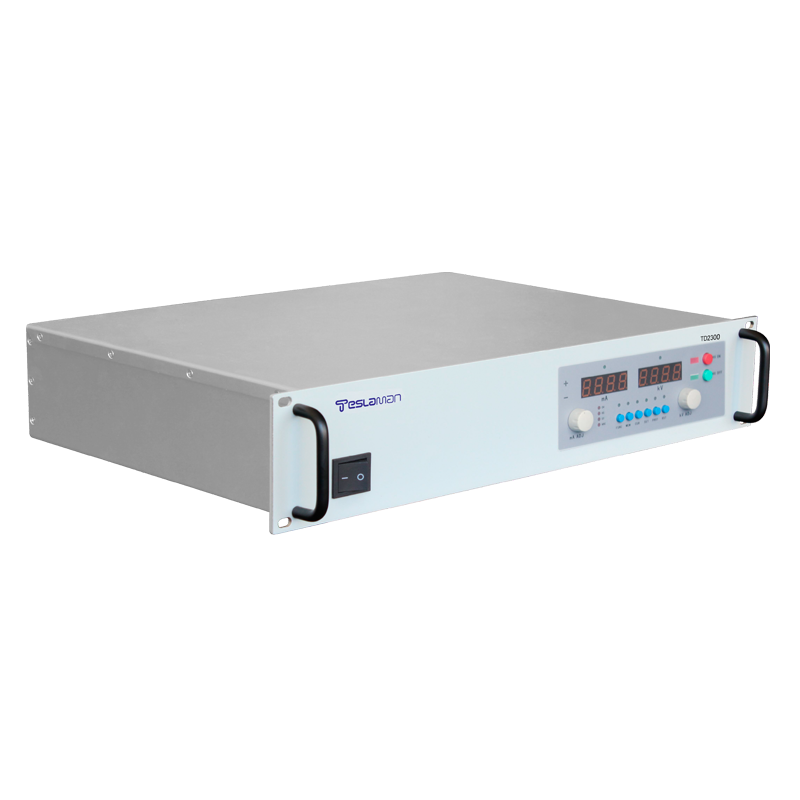
The primary high-voltage supply, which biases the cathode (typically a tungsten hairpin or field emission gun) negatively relative to ground at potentials from 1 kV to 30 kV, faces two major new challenges in low vacuum mode: voltage stability under varying load conditions and the mitigation of gas-induced discharge. In high vacuum, the insulation between the high-voltage electrode (the cathode) and ground (the anode and chamber) is nearly perfect, limited only by surface leakage. In low vacuum, the introduced gas reduces the dielectric strength of the medium. While the pressure is carefully chosen to be below the DC breakdown threshold for the given kV and gap distances, localized field enhancements or contamination can initiate Townsend discharges or glow discharges. These discharges are not necessarily catastrophic arcs but represent unstable current paths that can modulate the high voltage, causing beam current flicker and image distortion. Therefore, the high-voltage supply must have exceptionally fast current limiting and arc suppression circuitry. Upon detecting a sudden increase in current (a precursor to a discharge), the supply must be able to reduce its output voltage or temporarily shut down within microseconds to quench the discharge before it fully forms, and then recover smoothly. This is a more demanding requirement than in high vacuum SEM, where such events are far less frequent.
Furthermore, the presence of gas changes the effective load on the supply. The primary electron beam ionizes gas molecules along its path, creating a small but measurable conduction current between the beam and the chamber walls. This "environmental" current is in addition to the specimen current and can vary with gas pressure, gas type, and beam scanning position. A power supply designed with a stiff voltage output (low output impedance) is essential to prevent this variable current draw from causing local sags in the accelerating voltage, which would change the electron landing energy and degrade resolution. The supply's feedback loop must be optimized to reject these load disturbances rapidly.
For thermionic guns, the high-voltage adaptation also involves the filament heating supply. In a gaseous environment, the hot filament is subject to oxidation and chemical attack, which can shorten its life and change its emission characteristics erratically. The filament power supply may need to operate in a more tightly regulated current mode to maintain a constant temperature despite changing thermal conduction losses to the gas. For field emission guns (FEGs), which are even more sensitive, the high-voltage extraction supply (the voltage between the tip and the first anode) is critical. Any discharge or instability in the main acceleration voltage can couple back into the extraction circuit, disrupting the fragile field emission process. Enhanced isolation and decoupling between these two high-voltage systems are necessary.
The adaptation extends to the detector biasing as well. In low vacuum mode, gaseous secondary electron detectors (GSEDs) are used. They operate by applying a bias voltage (a few hundred volts) to a collection grid or electrode to attract secondary electrons, which then collide with gas molecules, creating an amplified cascade. The stability of this detector bias supply directly impacts the gain and signal-to-noise ratio of the image. It must be immune to the noisy environment created by the main high-voltage discharges.
Practically, modern SEMs with low vacuum capability incorporate high-voltage supplies with specialized operational modes. When the user selects "Low Vacuum" mode, the control software may automatically engage a more aggressive arc detection sensitivity, adjust the slew rate limits for voltage ramps to be more gradual, and potentially lower the maximum allowable high voltage to stay within a safer margin below the pressure-dependent breakdown curve. Diagnostic features, such as continuous monitoring of leakage current to ground, become important for predicting the onset of unstable conditions. In essence, adapting the high-voltage system for low vacuum mode is about managing the trade-off between the beneficial charge-neutralizing effect of the gas and its detrimental impact on electrical insulation. The power supplies must transition from being passive providers of potential in a benign vacuum to active, responsive guardians of stability in a dynamically conductive, gaseous environment.