High-Voltage Regulation for Pharmaceutical Irradiation Dose Depth Distribution
The sterilization of pharmaceutical products, medical devices, and biologics using high-energy electron beam or X-ray irradiation is a critical and regulated process. A key challenge is ensuring a uniform and sufficient minimum absorbed dose throughout the entire product volume, particularly for dense or heterogeneous items where dose deposition exhibits a pronounced depth-dose curve. Passive methods like product rotation or dual-side irradiation are common, but active high-voltage regulation of the beam energy during irradiation presents a more precise and flexible approach for controlling the three-dimensional dose distribution.
For electron beam systems, the penetration depth is directly governed by the electron's kinetic energy, which is determined by the accelerating voltage. A monoenergetic beam produces a characteristic depth-dose profile where the dose rises to a maximum (the Bragg peak for electrons in low-Z materials) before falling off. For a product with significant thickness, this results in a dose differential between the front surface and the deepest layers. To flatten this profile, the accelerating voltage can be dynamically modulated during the irradiation scan. This is not a simple on-off process but involves programming the high-voltage power supply to sweep through a range of energies according to a pre-calculated algorithm. As the beam scans across the product, its energy is varied such that the superposition of the depth-dose curves from different energies results in a more uniform dose from top to bottom.
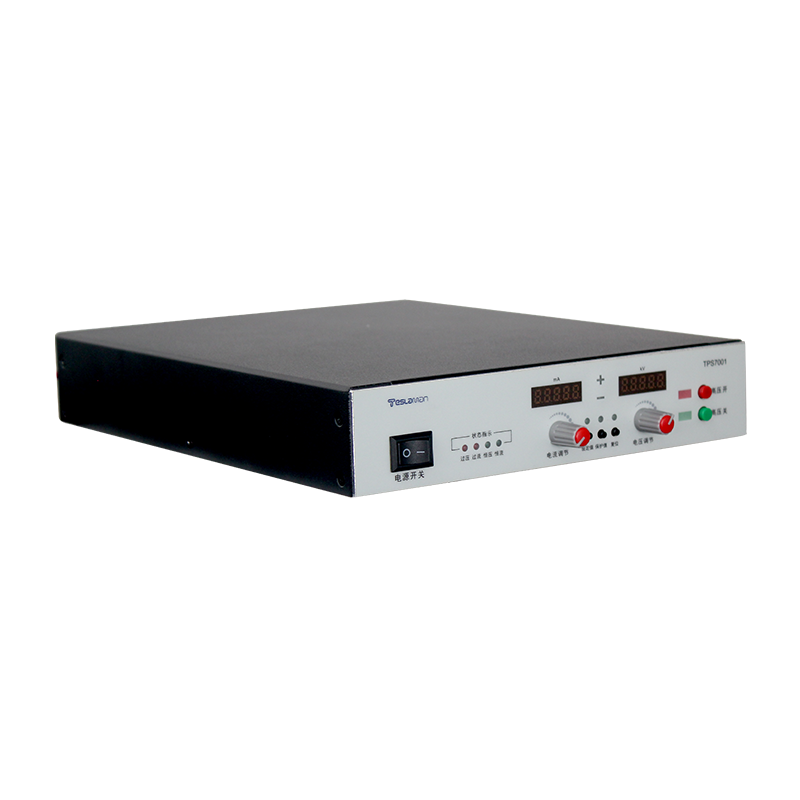
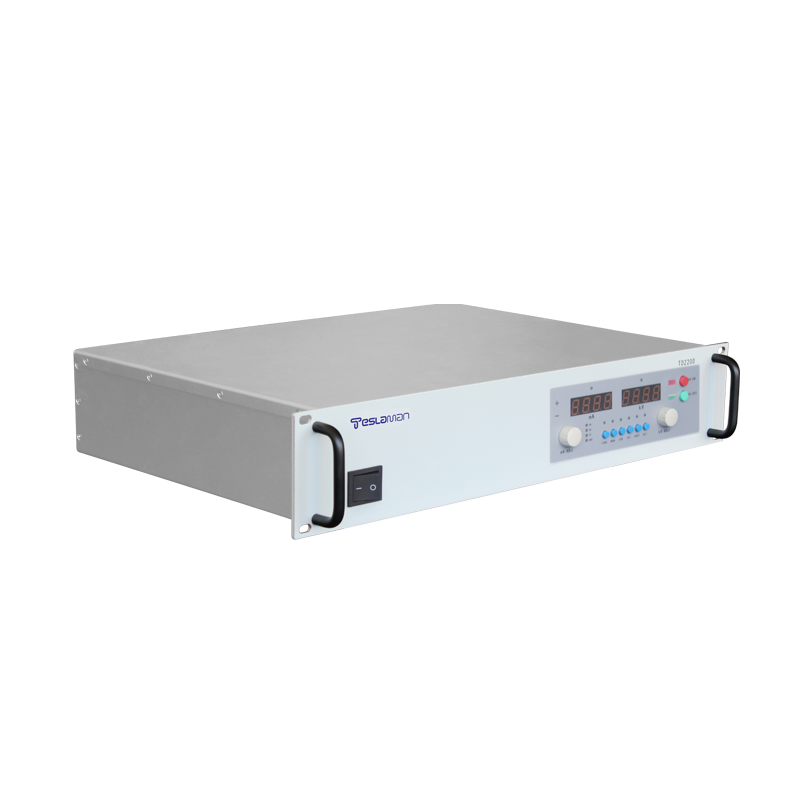
Implementing this requires a high-voltage supply with exceptional dynamic performance. It must be capable of changing its output voltage rapidly and reproducibly while maintaining beam current stability. The relationship between voltage, beam current, and the resulting dose rate is non-linear and must be characterized precisely. The control system integrates a model of the beam's energy deposition in the product material, often based on Monte Carlo simulations. As the product conveyor moves, the system calculates the required voltage in real-time based on the product's density (which may be measured inline via sensors), its current position under the beam, and the target dose map. This transforms the high-voltage supply from a static parameter into a real-time actuator for dose shaping.
For X-ray systems used in irradiation, where X-rays are generated by impinging a high-energy electron beam onto a converter target, the dose depth distribution is governed by the X-ray spectrum, which is in turn dictated by the electron energy. Modulating the high voltage on the electron accelerator therefore changes the effective X-ray energy and its penetration. The control is more indirect due to the bremsstrahlung process, but the principle remains: a time-varying high voltage can be used to tailor the depth-dose characteristic. This is particularly valuable for sterilizing palletized goods, where achieving dose uniformity from the front to the back of a dense pallet is notoriously difficult.
System integration and validation are paramount in this regulated environment. The high-voltage modulation waveform must be perfectly synchronized with the product handling system and the beam scanning magnets. Every parameter of the irradiation cycle, including the complete time-history of the high voltage, beam current, and scan pattern, is recorded as part of the mandatory dose audit trail. The system must include redundant monitoring of the high-voltage output, using independent calibrated dividers, to ensure the commanded dose distribution is accurately delivered. Safety interlocks must account for the dynamic voltage range, ensuring that no part of the system is subjected to voltages outside its safe operating window during the modulation cycle.
Beyond uniformity, this capability enables advanced processing strategies. For instance, a product with a sensitive component buried within a protective casing could be processed with a voltage profile designed to deliver a higher dose precisely at the depth of that component while sparing the surface. Or, for a vial containing a liquid drug, the voltage could be programmed to minimize dose variation between the meniscus and the bottom of the vial. This level of control, made possible by a programmable, high-performance high-voltage source, moves pharmaceutical irradiation from a bulk sterilization step towards a precision engineering process, enhancing safety and potentially enabling the treatment of more complex, radiation-sensitive products.