High-Voltage Lens Systems for Collision Cell Energy Focusing in Mass Spectrometers
In tandem mass spectrometry, particularly with triple quadrupole and Q-TOF instruments, the collision cell is a central region where precursor ions are fragmented to produce product ions for structural analysis. The efficiency and quality of this fragmentation process, and the subsequent transmission of product ions to the analyzer, are heavily dependent on the precise control of electric fields within the cell. This control is achieved through a system of high-voltage lenses and their associated power supplies, which together perform the critical function of energy focusing. This is distinct from mass focusing; it involves managing the kinetic energy spread of the ion population to optimize collision dynamics and ion transport.
A collision cell is typically a multipole (quadrupole, hexapole, or octopole) filled with a neutral gas such as argon or nitrogen. Ions enter the cell with a specific kinetic energy, determined by the potential difference between the preceding ion optics and the cell entrance. Upon entering, they undergo numerous collisions with gas molecules. These collisions can cause fragmentation (collision-induced dissociation) but also scatter the ions, both in direction and in kinetic energy. If left unchecked, this energy dispersion leads to significant ion loss as the ions exit the cell and attempt to enter the next stage of the mass spectrometer, which has a narrow energy acceptance window.
The role of the high-voltage lens system is to counteract this dispersion. It creates a shaped electrostatic field along the axis of the collision cell. A common configuration involves a series of lens elements at the entrance, within, and at the exit of the multipole rods. These lenses are held at carefully optimized DC potentials, creating a potential energy gradient or well. The primary objective is to provide a gentle restoring force that guides ions along the axis while managing their kinetic energy. An entrance lens may slightly retard incoming ions to control the effective collision energy. Internal lenses can create a flat or slightly curved potential profile to confine ions radially. The most critical is often the exit lens system, which is designed to re-accelerate or focus the scattered product ions into a tight energy bundle as they leave the gas-filled region.
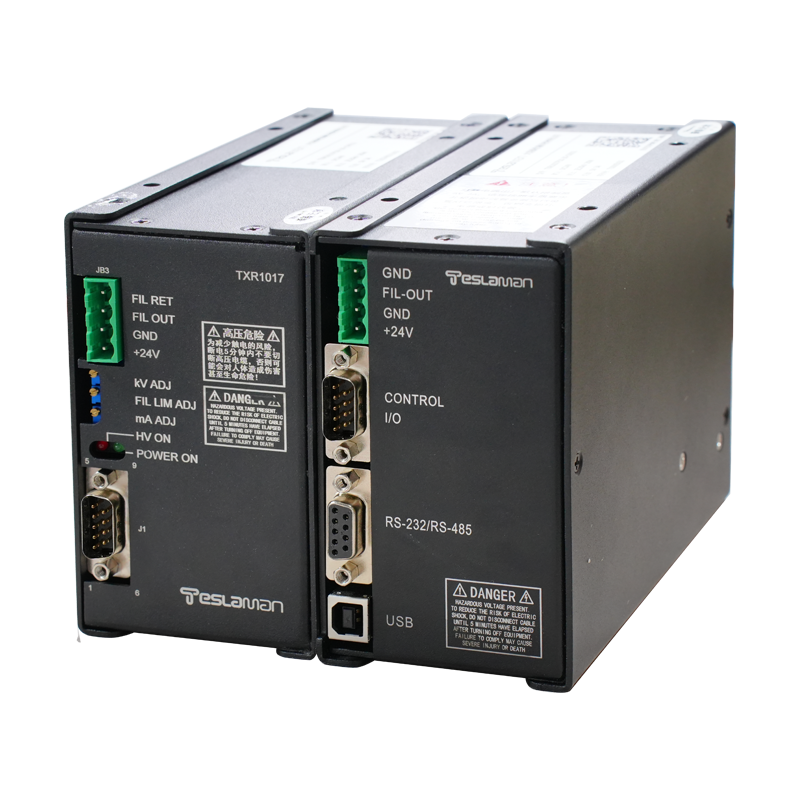
The power supplies for these lenses must meet stringent specifications. Each lens element requires an independent, highly stable voltage. The required voltages can range from a few volts to several hundred volts, relative to a common offset that may itself be at a potential of tens of volts relative to ground. Stability is paramount; drift in a lens voltage of even 0.1 volt can alter the focusing properties enough to degrade sensitivity over the course of a long chromatographic run. Low output noise is equally critical, as electrical noise modulates the lens fields, effectively blurring their focusing action and increasing the background signal.
The supplies must also exhibit excellent tracking accuracy. Often, the voltages on several lenses need to be offset together as a group when the instrument's mass scale or collision energy is changed. For instance, increasing the collision energy might involve raising the potential of the entire collision cell assembly. All lens voltages must shift by exactly the same amount to maintain their relative offsets; any mismatch distorts the internal electric field geometry. This demands power supplies with precise analog programming or digital control where the digital-to-analog converters have excellent integral and differential nonlinearity.
Furthermore, the response time of these supplies can be important in advanced scanning modes. In some experiments, like stepped collision energy scans or MRM transitions, the collision cell offset may need to change rapidly between mass scans. The lens power supplies must settle to their new voltages within microseconds to prevent cross-talk between adjacent data points. This requires designs with high bandwidth control loops and low output capacitance.
Integration with the instrument's control system is sophisticated. The lens voltages are not fixed values but are part of a complex tuning table that is optimized during instrument calibration. The optimal settings depend on the mass and charge of the precursor ion, the type and pressure of the collision gas, and the desired fragmentation efficiency. The high-voltage system must therefore accept digital commands from the main controller and reproduce the demanded voltages with absolute fidelity. Safety interlocks are also integrated to ensure all high voltages are safely discharged if the vacuum is lost or a panel is opened.
In practice, a well-designed high-voltage lens system for a collision cell is a masterpiece of subtle field engineering. It operates invisibly to the user, who simply sets a collision energy value. Behind the scenes, the system applies a precisely calculated set of potentials that create an electrostatic environment which maximizes the conversion of precursor ions into useful product ions and then efficiently herds those products toward the detector. This directly translates to higher sensitivity, better signal-to-noise ratios, and more reproducible fragmentation patterns, which are the bedrock of reliable quantitative and qualitative analysis in modern mass spectrometry.