High-Voltage Following Control for Profiled Trajectory in Electrostatic Spraying
Electrostatic spraying is a key process in applying uniform coatings to complex three-dimensional objects, such as automotive bodies, furniture, or agricultural equipment. The principle involves charging paint particles and using an electric field to direct them toward a grounded target. However, achieving a consistent film thickness on surfaces with varying geometry and distance from the spray gun remains a challenge. High-voltage following control addresses this by dynamically adjusting the electrostatic high voltage applied to the spray gun in real-time, synchronized with the gun's robotic trajectory and distance to the target surface.
The core objective is to maintain a constant electric field strength between the spray gun nozzle and the workpiece surface. According to basic electrostatics, for a given voltage V and distance d, the average field strength is V/d. If a robot arm moves the gun closer to a concave region of the part, the distance decreases. If the voltage remains constant, the field strength increases dramatically, which can lead to excessive charge density, a risk of back-ionization (resulting in a rough orange-peel finish), and even safety hazards from arcing. Conversely, when the gun moves away from a convex surface, the field weakens, reducing paint transfer efficiency and potentially causing uneven coverage.
The following control system integrates several data streams. The robot controller provides real-time positional data of the spray gun tip, including its coordinates and orientation. A secondary sensor, often a laser rangefinder mounted on the gun, provides a precise, continuous measurement of the distance to the target surface. This distance data is fed into a high-speed control algorithm along with the robot's positional data. The algorithm calculates the optimal voltage required to maintain a pre-set, constant electric field strength or a specific current density at the target. It then sends a command to the high-voltage power supply to adjust its output accordingly.
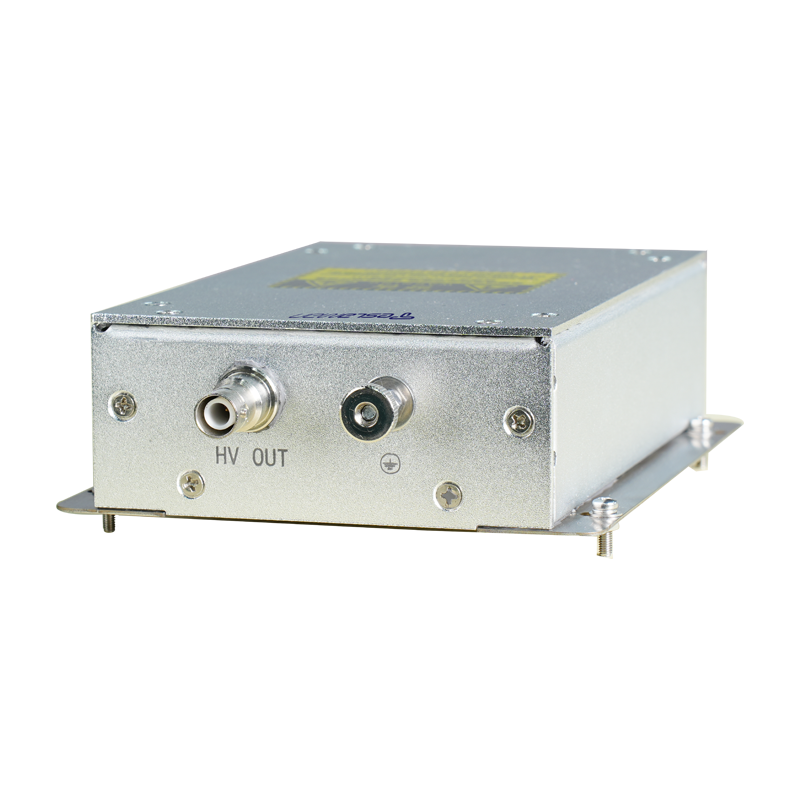
The high-voltage supply for this application must have distinct characteristics. First, it must have a wide output range, perhaps from 40 kV to 100 kV, to accommodate varying standoff distances. Second, and most critically, it must have a very fast response time. As the robot moves at speeds up to several meters per second, the distance to the part can change rapidly. The power supply must be able to change its output voltage with a slew rate of several kilovolts per millisecond to track these changes accurately. This rules out traditional line-frequency transformer-rectifier sets and necessitates high-frequency switch-mode designs with advanced feedback loops.
Third, the supply must maintain stability and low ripple even while modulating. Any noise on the high-voltage output modulates the charging of the paint particles, leading to streaks or mottling in the final coat. The control interface must accept an analog or high-speed digital setpoint signal from the main controller. Integration with the overall system also requires sophisticated safety protocols. The system must include arc detection and suppression, as operating at variable voltages near complex surfaces increases the likelihood of occasional arcs. The suppression must be fast enough to quench the arc and reset the voltage without causing a visible defect in the coating.
Beyond maintaining a constant field, advanced systems use the following control to implement programmed voltage profiles for specific geometric features. For example, when spraying into a deep recess, the algorithm might intentionally reduce the voltage below the nominal field-maintaining value to prevent Faraday cage effects and ensure paint wraps into the cavity. When spraying sharp edges, a slightly higher voltage might be used to ensure coverage on both sides. This transforms the high-voltage parameter from a global setting into a spatially mapped process variable, stored as part of the robotic spray path program.
The benefits are multifaceted: dramatic reduction in paint usage through improved transfer efficiency, elimination of defects like back-ionization and dry spray, superior film uniformity on complex parts, and enhanced operator safety by minimizing arcing. The high-voltage power supply thus becomes an intelligent, dynamic component of the robotic cell, its output precisely choreographed with the mechanical motion to deposit a perfect coating regardless of the underlying geometry.