High-Voltage Adaptation for Backscattered Electron Diffraction in Scanning Electron Microscopes
Scanning Electron Microscopy (SEM) equipped with Electron Backscatter Diffraction (EBSD) detectors is a powerful technique for microstructural and crystallographic analysis of materials. While conventional SEM imaging primarily uses secondary electrons, EBSD relies on the diffraction patterns generated by backscattered electrons (BSE) emerging from a crystalline sample at shallow depths. The quality and interpretability of these Kikuchi patterns are profoundly sensitive to the accelerating voltage of the primary electron beam, necessitating specialized high-voltage supply adaptations to optimize the system for this analytical mode beyond standard imaging.
The primary electron beam, accelerated by a high voltage typically ranging from 5 kV to 30 kV, penetrates the sample. The depth of penetration and the volume of interaction (the teardrop-shaped region where scattering occurs) increase with increasing beam energy. For EBSD, the goal is to maximize the signal from near-surface crystal planes while minimizing noise and pattern blurring from deeper, possibly deformed or differently oriented material. Therefore, the optimal accelerating voltage is a compromise. A lower voltage (e.g., 10-15 kV) produces a smaller interaction volume, leading to sharper patterns with better spatial resolution, which is critical for analyzing fine grains or near-boundary regions. However, the intensity of the backscattered electron signal is lower, requiring longer acquisition times or higher beam currents, which can lead to sample drift or charging.
A higher voltage (e.g., 20-30 kV) increases the BSE yield and improves the signal-to-noise ratio, allowing for faster mapping. However, it increases the interaction volume, causing patterns from multiple grains or from a gradient of lattice strain beneath the surface to be superimposed, blurring the Kikuchi bands and reducing angular resolution. This is particularly problematic for deformed materials or samples with steep orientation gradients.
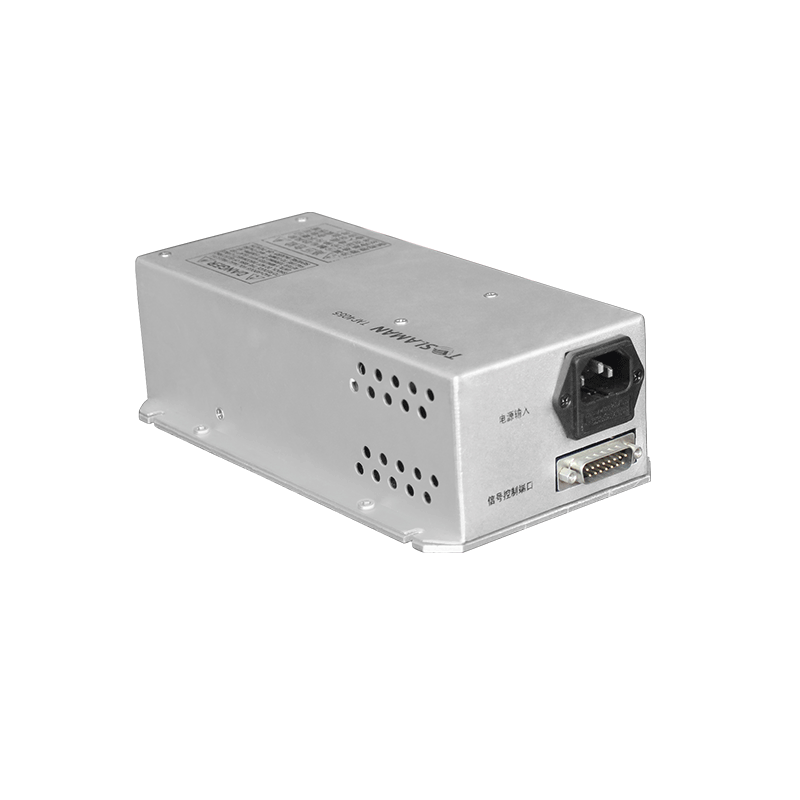
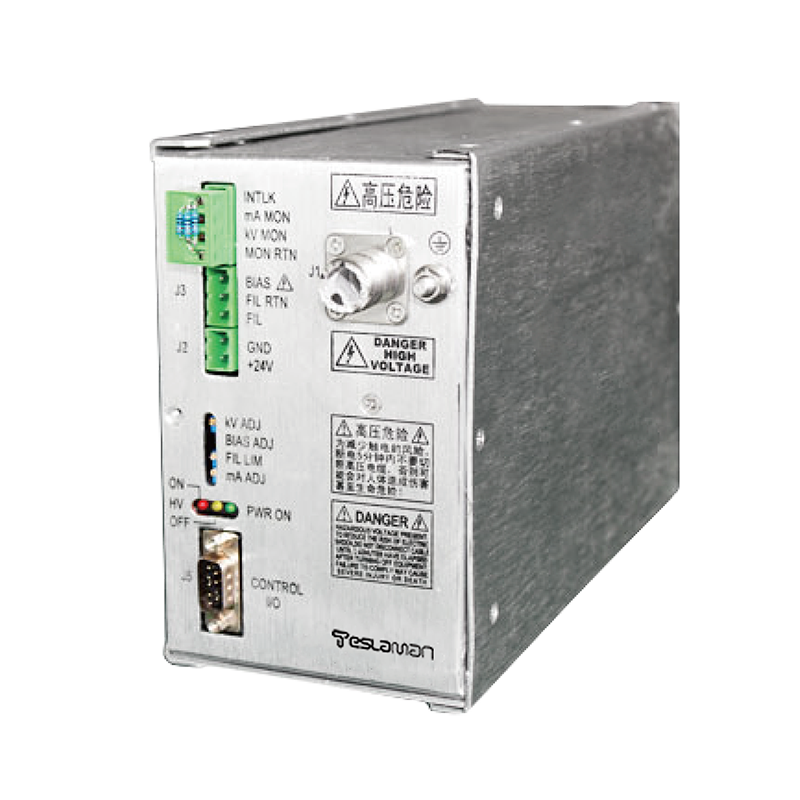
A high-voltage supply adapted for advanced EBSD work must therefore offer exceptional stability and fine control across its entire range. Instability or ripple in the accelerating voltage directly broadens the energy spread of the electron beam, which smears the diffraction patterns. Furthermore, the supply must allow for rapid but controlled switching between voltages, as a modern analytical session may involve switching between high-voltage for efficient imaging or Energy Dispersive X-ray Spectroscopy (EDS) and a lower, optimized voltage for EBSD mapping on the same area.
Beyond simple voltage selection, some cutting-edge applications employ dynamic high-voltage control during EBSD acquisition. One technique involves applying a small, high-frequency modulation to the accelerating voltage. By synchronously detecting the resulting modulation in the EBSD pattern intensity, it is possible to perform energy-filtering, effectively selecting only electrons that have lost very little energy (so-called "low-loss" BSE). These electrons originate from the shallowest depths, providing dramatically improved pattern sharpness and spatial resolution, effectively decoupling it from the nominal beam energy. Implementing this requires a high-voltage supply with a modulation input and a bandwidth capable of handling frequencies in the kilohertz range without introducing phase shift or distortion.
Another consideration is the suppression of stray magnetic and electric fields. The EBSD detector is extremely sensitive to fields that can distort the delicate trajectories of the backscattered electrons between the sample and the phosphor screen. The high-voltage cables and the supply itself must be meticulously designed to minimize electromagnetic emissions. This often involves coaxial construction, Mu-metal shielding, and careful grounding schemes to prevent ground loops that could induce small but disruptive potential differences on the sample stage.
Therefore, the high-voltage system for an SEM dedicated to high-performance EBSD is more than just a power source. It is a precision instrument that enables the microscopist to trade off between signal intensity, spatial resolution, and analytical depth by selecting the optimal beam energy. Its stability determines the ultimate quality of the crystallographic data, and its advanced features, like modulation capability, open doors to novel analysis techniques. This adaptation is essential for pushing the boundaries of quantitative microstructural analysis in materials science, geology, and metallurgy.