High-Voltage Control for Three-Dimensional Relief Effects in Electrostatic Flocking
Electrostatic flocking is a process for creating a velvet-like or textured surface by applying short fibers, called flock, to an adhesive-coated substrate under the influence of a high-voltage electric field. While conventional flocking produces a uniform, upright pile, advanced applications seek to create three-dimensional relief effects, where the pile height, density, or orientation varies across the surface to produce patterns, logos, or tactile textures. Achieving this artistic and functional control demands sophisticated management of the high-voltage electrostatic field, transforming it from a uniform forcing function into a spatially and temporally programmable sculpting tool.
The basic flocking process involves applying a high voltage, typically 20-100 kV DC, between a grounded electrode behind the adhesive-coated substrate and a grid or electrode above the flock supply. The flock fibers, dispensed onto the lower electrode, become charged in the field, align with the field lines, and accelerate towards the substrate, embedding themselves in the adhesive. In uniform flocking, the field is homogeneous, and the fibers land vertically and densely.
To create a relief effect, this homogeneity must be broken. One method involves the use of shaped or segmented electrodes. Instead of a single planar upper electrode, an electrode with cut-out patterns or varying distance from the substrate can be used. The electric field strength is highest where the electrode is closest and in areas directly under conductive electrode segments. By designing the upper electrode as a three-dimensional sculpted plate, the field lines can be focused or diverged, causing more fibers to land and embed more deeply in the high-field regions, creating a raised pile pattern. Conversely, areas under electrode cut-outs receive a weaker field, resulting in lower pile density or height.
A more dynamic method employs a multi-zone electrode system, where the upper electrode is divided into independently addressable segments. Each segment is connected to its own high-voltage power supply channel. By varying the voltage applied to each zone, the field strength across the substrate can be controlled in real-time. For example, to create a gradient from a high pile at one edge to a low pile at the other, the voltage to the corresponding zones is ramped down. To create a sharp logo, adjacent zones can be switched between high voltage (for flocked areas) and zero voltage (for bare adhesive or low pile). The transition between zones must be managed to avoid sharp field discontinuities that could cause arcing.
Furthermore, the timing of the field application is critical. In a pulsed flocking system, the high voltage is applied in short bursts. By varying the duration and duty cycle of these pulses in different zones, the flock density can be fine-tuned. A longer pulse duration allows more fibers to land in that zone before the adhesive begins to set. This temporal control can be synchronized with a moving substrate, effectively printing the flock pattern.
Beyond simple on-off control, the voltage polarity and waveform can be manipulated. For instance, applying a bipolar AC field can cause fibers to oscillate and potentially land at an angle, creating a directional pile effect. By carefully controlling the waveform, the fiber orientation can be controlled, adding another dimension to the tactile feel of the surface.
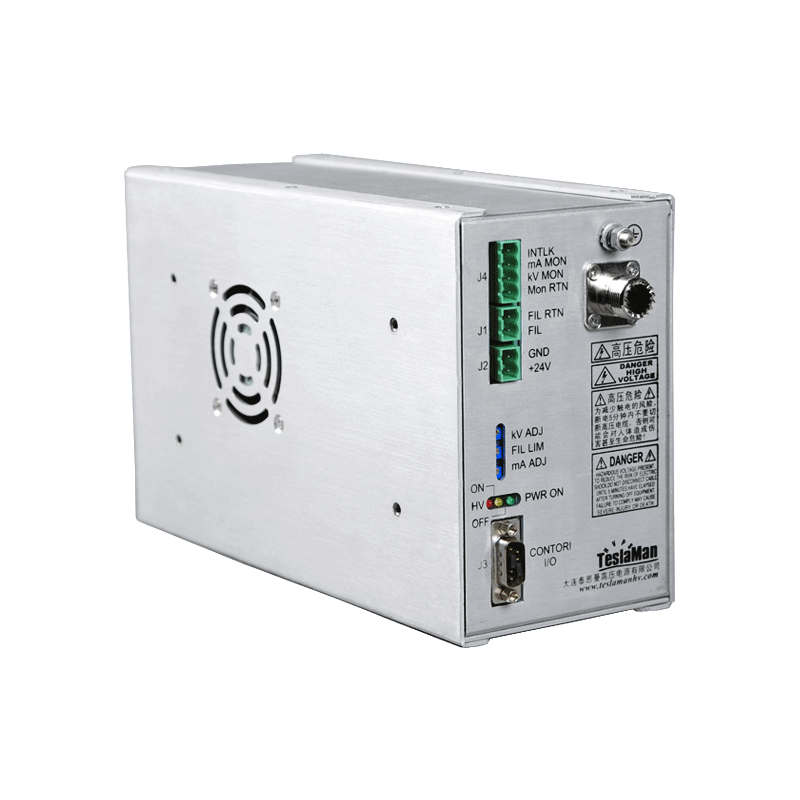
The high-voltage power system for such advanced flocking is a multi-channel, programmable instrument. Each channel must be independently controllable in terms of voltage amplitude, pulse timing, and waveform shape. The system must be protected against the inevitable short circuits caused by fibers bridging the electrode gap, with fast-acting arc detection and recovery circuits. The entire system is controlled by a central computer running pattern-generation software, similar to a printer driver, that translates a digital design into a sequence of high-voltage commands.
This high-voltage control transforms electrostatic flocking from a simple texturing process into an additive manufacturing technique for fibrous surfaces. It enables the creation of automotive interiors with branded logos, apparel with textured designs, and functional surfaces with controlled friction or liquid management properties. The high-voltage supply, once a simple workhorse, becomes the painter's brush, precisely controlling the deposition of millions of individual fibers to create a three-dimensional work of art or a precisely engineered functional surface.