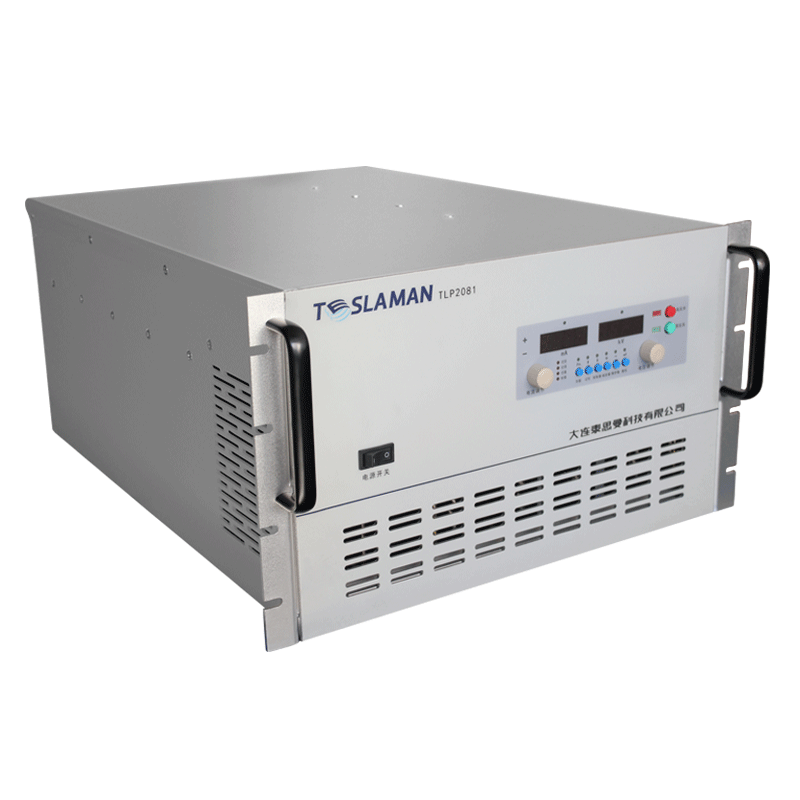
Intelligent Voltage Sharing Control for 320kV High-Voltage Power Supply Modules
Achieving DC voltages of 320 kV and beyond for applications such as medical X-ray systems, industrial electron beam welders, and high-energy physics experiments is typically accomplished by connecting multiple lower-voltage modules in series. This modular approach offers advantages in manufacturing, maintenance, and scalability. However, it introduces a critical challenge: ensuring that the DC voltage is shared equally among all series-connected modules. Any imbalance leads to overvoltage stress on individual modules, accelerating aging and potentially causing catastrophic failure. Intelligent voltage sharing control, using active feedback and digital communication, provides a dynamic solution to this problem.
The traditional passive method for voltage sharing is to connect a high-value balancing resistor in parallel with each module. The resistor network forces a crude equalization by providing a current path that bypasses any module with a lower leakage current. This method is simple but inherently inefficient, as the resistors continuously dissipate power. More critically, it cannot compensate for dynamic imbalances caused by differences in ripple current, transient load changes, or the aging of internal components.
An intelligent, active sharing system replaces the passive resistors with a closed-loop control architecture. Each high-voltage module contains its own sensing and control electronics. A precision resistive divider within each module measures its individual output voltage. This measurement is digitized and communicated to a central system controller, or broadcast to all other modules via a high-speed isolated communication bus (e.g., CAN, fiber optic).
The control algorithm, which can be implemented in the central controller or distributed among the modules, compares each module's voltage to the average voltage of all modules. The error signal for each module is used to adjust its output slightly. The adjustment can be achieved in two primary ways. The first is by modulating the module's internal DC-DC converter's reference voltage. A small increase in the reference for a module with a lower-than-average voltage will cause its output to rise, bringing it back into balance. The second method is to use an active current injection circuit at the output of each module, which can sink or source a small balancing current.
The communication link is critical for this scheme to work. It must be fast enough to respond to transient imbalances that occur during load steps (e.g., when an X-ray tube is switched on). The data exchanged is not just the voltage value; it may also include temperature and status information. The controller can use this data to implement predictive balancing. For example, if a module is running hotter than its neighbors, the controller can slightly reduce its voltage share, anticipating that its output will drift as the temperature changes. This predictive capability extends the life of the entire stack.
Fault tolerance is a key benefit. If a module fails, the intelligent controller can detect the failure and either shut down the entire system gracefully or, if the system is designed with redundancy, reconfigure the remaining modules to share the total voltage. This might involve increasing the voltage of each surviving module within safe limits, allowing the system to continue operating at a reduced power level until maintenance can be performed.
Implementing such a system at 320 kV requires extreme attention to isolation. The communication link between modules, which are at different electrical potentials, must provide galvanic isolation capable of withstanding the full stack voltage. Fiber optics are the preferred solution. The control electronics within each module must be powered from the module's own low-voltage supply, which is referenced to the module's local ground. This power supply must also be isolated to withstand the voltage difference between modules.
Intelligent voltage sharing transforms a simple series connection of power supplies into a cohesive, resilient, high-voltage generator. It maximizes the utilization of each module, prevents premature failure due to overstress, and provides a wealth of diagnostic data about the health of the system. For the operators of large-scale X-ray or accelerator facilities, this translates to higher uptime, lower maintenance costs, and greater confidence in the stability of their critical high-voltage infrastructure.