High-Voltage Closed-Loop Control for Film Thickness Uniformity in Electrostatic Spray Coating
In the industrial application of electrostatic spray coating, the pursuit of perfect film thickness uniformity is a relentless endeavor. The principle is well-established: a high-voltage potential applied to the spray nozzle creates a powerful electric field that charges the paint or powder particles, which are then attracted to the grounded workpiece. This process dramatically improves transfer efficiency and wraps around edges. However, the reality of achieving a consistent, defect-free coating across complex geometries is a sophisticated control problem where the high-voltage power supply plays the central role. After fifty years in this field, I have seen the evolution from simple, constant-voltage generators to the intelligent, closed-loop systems that are now essential for modern manufacturing quality.
The fundamental challenge in electrostatic coating is that the workpiece is not a perfect, flat plate. It has curves, cavities, and edges. The electric field, and consequently the flux of charged particles, is naturally highest at sharp edges and projections. This phenomenon, known as the Faraday cage effect in recessed areas, leads to the classic problem: heavy coating on edges and thin, insufficient coverage in corners and depressions. A fixed, open-loop high voltage applied to the gun will only exacerbate this non-uniformity. The solution lies in modulating the high voltage and the spray parameters in real-time, based on feedback from the coating process itself.
The first layer of closed-loop control involves monitoring the current drawn from the high-voltage supply. This current is a direct measure of the charge being deposited on the workpiece. If the gun approaches a sharp edge, the local field intensifies, and the current spikes. A simple but effective control algorithm can detect this current spike and instantly reduce the voltage to the gun, limiting the deposition rate at that point. Conversely, as the gun moves into a recessed area, the current drops, and the controller can boost the voltage to enhance particle penetration and deposition. This real-time current limiting is a mature technology, but its implementation requires a power supply with a bandwidth far beyond that of a typical industrial rectifier. It must respond to current changes in milliseconds, dropping the voltage without generating harmful transients that could destabilise the spray cloud.
A more sophisticated approach to thickness uniformity involves integrating the high-voltage control with robotic motion systems and predictive models. In a modern coating cell, the robot path is programmed, but the actual film build on the part is a function of many variables, including part temperature, humidity, and paint resistivity. By incorporating a real-time thickness sensor, such as an infrared gauge or a laser-based profilometer, at a point downstream of the spray booth, we can close the loop on the actual result. If the sensor detects that a particular area is consistently receiving too much paint, the control system can instruct the robot to increase its traversal speed over that area, or it can command the high-voltage power supply to reduce the voltage and thus the charging efficiency when the gun is in that zone on subsequent passes.
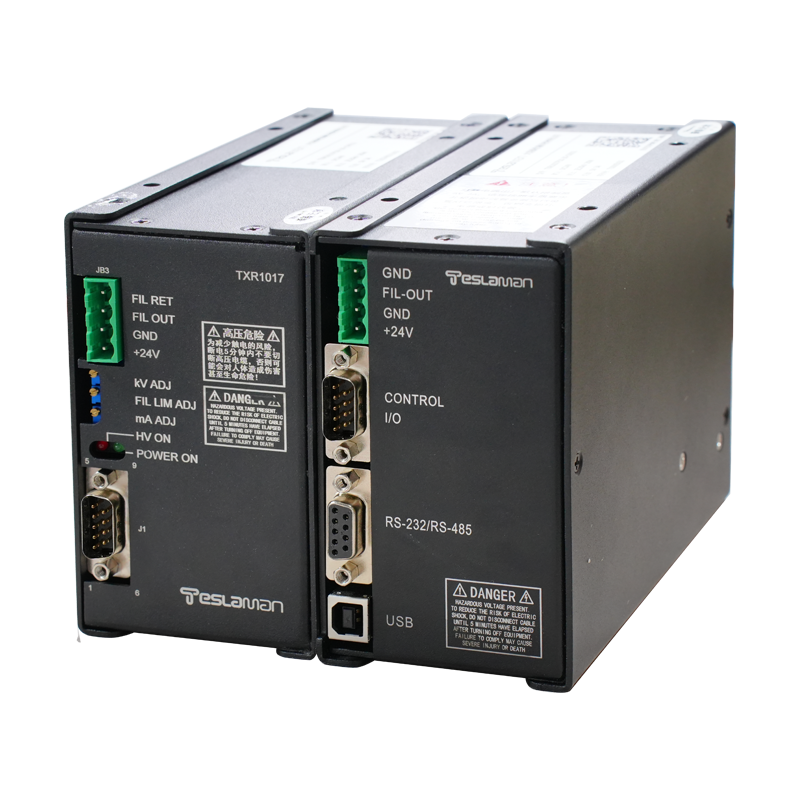
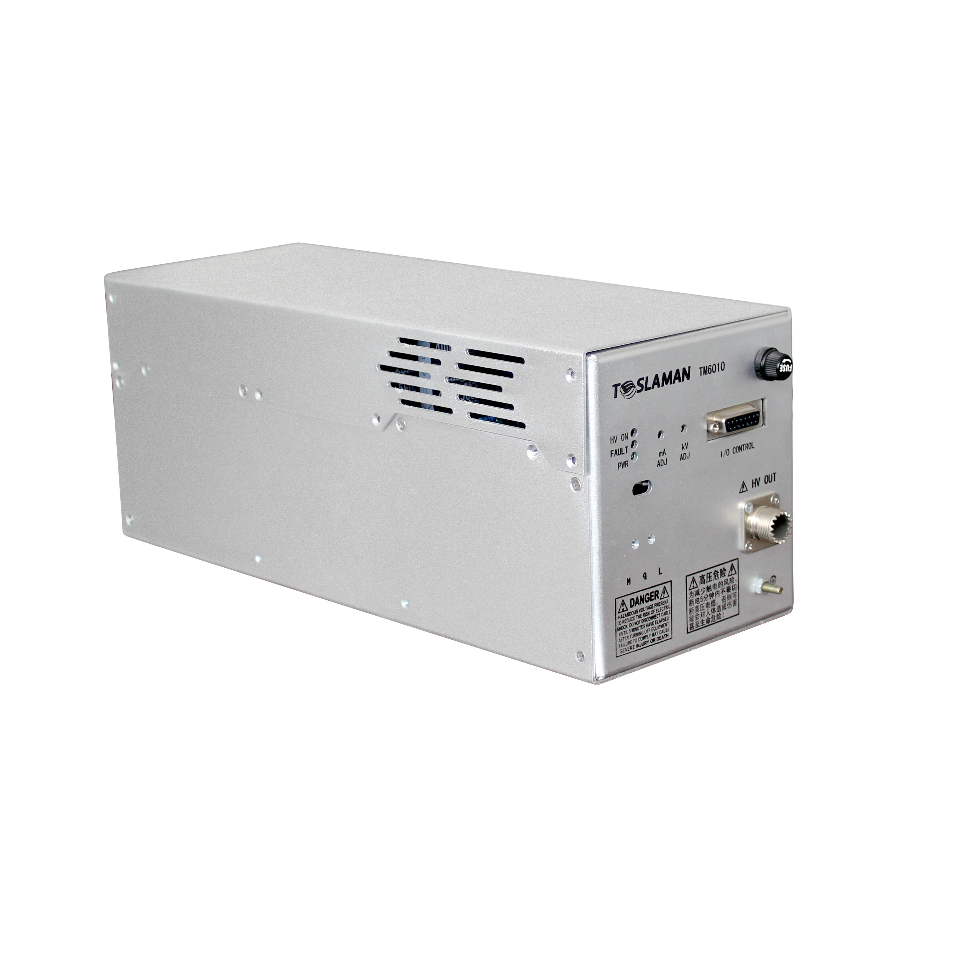
This level of coordination demands a high-voltage power supply with a fast and precise analogue or digital interface. The setpoint must be changeable on the fly, with the voltage settling to a new value without overshoot. Overshoot is particularly damaging in electrostatic coating. A momentary over-voltage can cause a back-corona discharge from the grounded part, ionising the air and creating a reverse flow of positive ions that ruins the finish and causes a defect known as cratering. The supply's transient response must therefore be critically damped, a design challenge that requires careful attention to the output filter network and the control loop compensation.
Another critical parameter for uniformity is the voltage waveform itself. While DC is the standard, pulsed or modulated high voltage offers distinct advantages. By applying a high-frequency ripple or discrete pulses to the charging electrode, we can influence the size and charge distribution of the droplets or powder particles. A highly charged, fine droplet follows the field lines perfectly, which is good for wrap-around but can also lead to excessive edge build-up. A less charged, larger droplet has more momentum and is better at penetrating recesses but may have lower transfer efficiency. By dynamically switching between different voltage waveforms during the coating cycle, we can optimise for coverage in different areas of the part. Implementing such a multi-modal waveform requires a power supply based on a high-frequency switching topology, such as a resonant converter, which can generate arbitrary waveforms with high efficiency and precision.
In conclusion, achieving film thickness uniformity in electrostatic coating is no longer just about paint chemistry and gun positioning. It is a cyber-physical process where the high-voltage power supply is an active, intelligent actuator. It responds to feedback from the process, whether it is the instantaneous gun current, the output of a thickness gauge, or a pre-programmed map of the part's geometry. The modern power supply for this application is a high-bandwidth, programmable, and highly reliable instrument, a far cry from the simple transformers of the past, and its performance is directly visible in the quality and consistency of the finished product.