High-Voltage Thermal Control for Wavelength Stabilization in Excimer Lasers
Excimer lasers, with their powerful ultraviolet emissions, are workhorses of modern industry and medicine, driving processes from semiconductor lithography to refractive eye surgery. The active medium in these lasers is a complex mixture of a noble gas and a halogen, which exists only in an excited state, typically formed by a high-voltage electrical discharge. The wavelength of the laser, determined by the specific excimer molecule such as argon fluoride or krypton fluoride, is remarkably stable in theory, but in practice, it is exquisitely sensitive to the temperature and pressure of the gas mixture. For over five decades, I have observed how the high-voltage power supply, often viewed merely as the energy source for the discharge, plays a far more nuanced and critical role in maintaining the precise thermal environment required for wavelength stabilization. The marriage of high-voltage engineering with precision thermal control is what transforms a simple gas discharge into a coherent, stable, and tunable light source.
The relationship between the high-voltage discharge and the gas temperature is fundamental and inseparable. When the main discharge electrodes fire, they deposit a substantial amount of energy into a small volume of the laser gas. This energy rapidly heats the gas, causing it to expand and change its refractive index. The laser cavity, defined by the mirrors, resonates at a wavelength that is an integer multiple of the cavity length divided by the refractive index. As the refractive index changes with temperature, the resonant condition shifts, causing the laser wavelength to drift. For many applications, a few picometers of drift is unacceptable. Therefore, the high-voltage system must be designed not just to create the discharge, but to do so in a way that minimizes thermal perturbations and integrates with active wavelength control loops. This begins with the pulse-forming network. The shape, duration, and repetition rate of the high-voltage pulse directly determine how efficiently energy is coupled into the gas and how much waste heat is generated. A poorly designed pulse can create strong shock waves and thermal gradients in the gas, leading to beam distortion and wavelength instability.
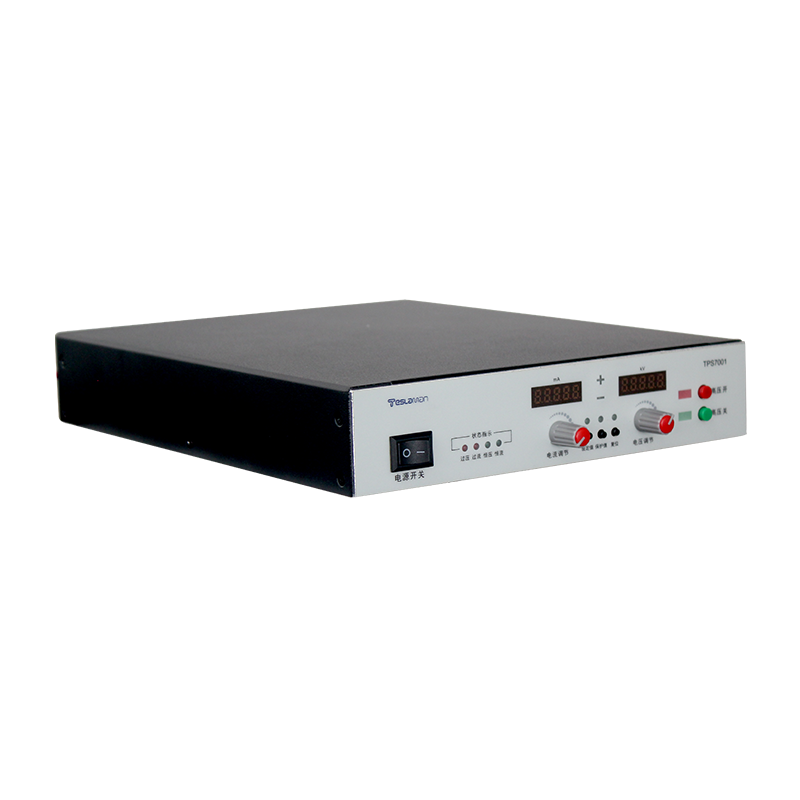
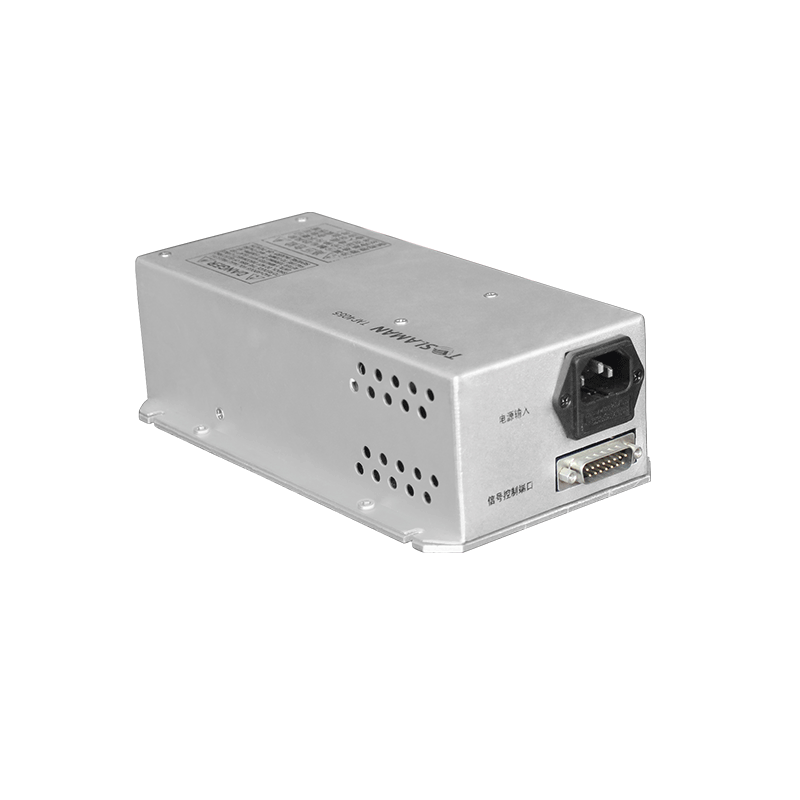
Beyond the main discharge, a secondary, often overlooked, high-voltage application is used for precision thermal control. Many modern excimer lasers employ a technique called transverse discharge stabilization, where a low-current, high-voltage pre-ionization or corona discharge is used to condition the gas before the main pulse arrives. This pre-ionization serves two purposes. First, it creates a uniform background of seed electrons, ensuring that the main discharge is homogeneous and arcfree. Second, and more relevant to thermal control, it can be used to gently and uniformly heat the gas. By carefully regulating the power of this pre-ionization discharge, which is itself controlled by a dedicated high-voltage supply, we can establish a stable baseline temperature in the laser cavity. This active pre-heating reduces the thermal shock when the main, high-energy pulse fires, leading to a more consistent refractive index throughout the pulse train. The high-voltage supply for this pre-ionization must be exceptionally stable and adjustable, capable of delivering a constant power level that can be modulated by the lasers central wavelength controller.
The wavelength itself is monitored by a precision wavemeter, which feeds a signal back to the laser control system. This system then adjusts a series of actuators to lock the wavelength. One of these actuators is often a high-voltage-driven piezoelectric element that tilts or moves one of the cavity mirrors, providing fine-tuning of the cavity length. This is a classic high-voltage application, requiring amplifiers with nanometer-scale resolution and low hysteresis. However, a more elegant and direct method of thermal control involves manipulating the gas temperature itself. By incorporating a high-voltage, high-frequency discharge in a side arm of the gas circulation loop, we can act as a controllable heater. The power deposited by this auxiliary discharge, governed by its own dedicated high-voltage supply, adds a precise amount of heat to the gas. This allows the main system to operate at a constant repetition rate while the auxiliary heater compensates for changes in room temperature or cooling water variations. The thermal time constants of the gas are relatively short, allowing for a fast control loop. In my experience, the most sophisticated excimer lasers are those that treat the gas as an active, controllable element of the optical cavity, with the high-voltage system serving as the primary means of manipulating its thermodynamic state. This integrated approach, where high voltage is used not only for the main event but also for the subtle art of thermal management, is what enables the remarkable wavelength stability that modern lithography and surgery demand. It is a testament to the fact that in high-power laser engineering, every joule of electrical energy must be accounted for, not just in the light it produces, but in the heat it generates and the subsequent effect on the optical path.