Enhanced High-Voltage Substrate Cleaning: The Ion Source Bias Supply in Vacuum Coating
In the world of vacuum coating, the quality of the interface between the substrate and the deposited film is paramount. It is a foundational principle, taught in every introductory course and proven in countless industrial processes, that a clean, activated surface is essential for achieving strong adhesion. Over my fifty years in this field, I have seen numerous cleaning methods come and go, but one technique has remained a cornerstone, constantly evolving and improving: ion bombardment cleaning, powered by a dedicated high-voltage bias supply. This is not simply a matter of attaching a high voltage to the substrate; it is a sophisticated process of surface engineering, where the power supply plays an active and critical role in defining the energy, flux, and uniformity of the cleaning ions.
The fundamental concept is straightforward. The substrate is placed in a vacuum chamber, and a low-pressure gas, typically argon, is introduced. A plasma is then generated within the chamber using a separate source, such as a filament, a magnetron, or an RF antenna. By applying a negative high voltage to the substrate, positive ions from the plasma are accelerated across the plasma sheath and strike the substrate surface. The physical momentum transfer from these energetic ions effectively sputters away contaminants, such as adsorbed water vapor, hydrocarbons, and native oxide layers. The result is a pristine, atomically clean surface, ready for film deposition. Furthermore, the ion bombardment can create surface defects and dangling bonds, enhancing the chemical reactivity and providing nucleation sites for the arriving film atoms, a process often referred to as substrate activation.
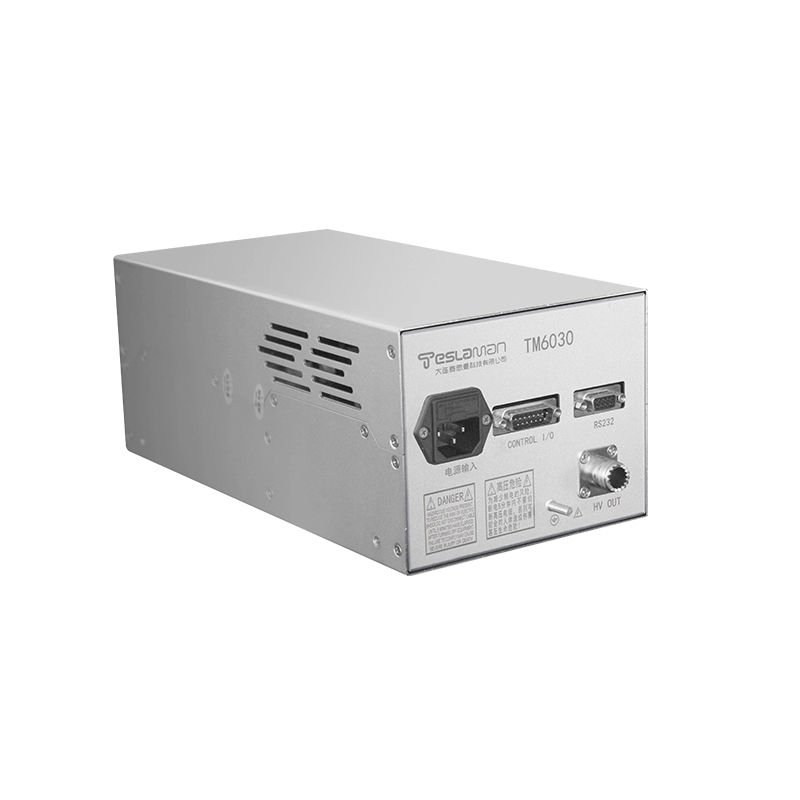
The design of the high-voltage bias supply for this application is deceptively complex. The primary requirement is a stable, controllable DC voltage source, typically ranging from a few hundred volts to several kilovolts negative, with a power rating determined by the size of the substrate and the desired ion current density. However, the devil is in the details. The supply must be capable of handling the dynamic nature of the plasma load. The impedance of the plasma sheath is not constant; it varies with the applied voltage, the gas pressure, and the plasma density. The power supply must therefore have a robust output stage that can maintain a stable voltage regardless of these fluctuations. A simple, unregulated supply would be inadequate, as the voltage would collapse under heavy ion current load.
One of the most critical parameters is the energy of the ions arriving at the substrate, which is directly proportional to the applied bias voltage. If the voltage is too low, the cleaning will be ineffective, failing to remove tenacious contaminants. If it is too high, the ions can penetrate deep into the substrate, causing implantation and crystal damage, a phenomenon known as subplantation. For delicate substrates like semiconductors or certain optical materials, this damage can be catastrophic, altering their electrical or optical properties. Therefore, the power supply must offer precise voltage regulation, typically within ±1% or better, to ensure that the ion energy is maintained within a tight, process-specific window. In many modern systems, this is achieved through the use of high-frequency switch-mode technology, which allows for fast feedback control and a highly stable output.
The issue of arcing is, once again, a central concern. During the cleaning process, the substrate surface is not uniform. There may be areas with different conductivities, sharp edges, or particles that can enhance the local electric field. As the bias voltage is applied, these points can become sites for micro-arcing. Each arc is a momentary short circuit, releasing a burst of energy that can melt microscopic areas of the substrate surface, creating defects that will be replicated in the subsequent film. The high-voltage bias supply must be equipped with a fast-acting arc suppression system. This system must be able to detect the onset of an arc by sensing a sudden drop in voltage or a spike in current, and then cut off the output power within microseconds. The energy delivered into the arc must be limited to a few millijoules to prevent any visible damage. After the arc is extinguished, the supply must then rapidly restore the bias voltage to continue the cleaning process with minimal interruption.
Beyond simple DC biasing, the field has advanced towards the use of pulsed or AC biasing to gain greater control over the process. Pulsed DC biasing, where the voltage is switched on and off at a frequency of tens to hundreds of kilohertz, can be particularly effective. During the pulse-off period, the plasma sheath can collapse, allowing electrons to neutralize any charge buildup on insulating substrates. This prevents the phenomenon of arcing caused by charge accumulation, a common problem when cleaning glass or ceramic materials. The pulse parameters, such as the duty cycle and frequency, become additional tools for the process engineer. A higher frequency can lead to a more stable and uniform plasma sheath, while a lower duty cycle reduces the overall thermal load on the substrate.
Furthermore, in complex coating systems, the bias supply does not operate in isolation. It must be synchronized with the deposition sources. For example, a common technique to enhance adhesion is to perform an initial period of high-voltage ion cleaning, then gradually reduce the bias voltage as the deposition begins. This creates a graded interface, transitioning from a pure, ion-bombarded substrate surface to a growing film. This requires a sophisticated control system that can communicate with the other power supplies in the system, executing a pre-programmed voltage ramp or sequence. The bias supply becomes an integrated part of a larger, coordinated process recipe.
In my experience, the influence of the bias supply extends even to the film s microstructure. By manipulating the ion energy and flux during the initial stages of growth, we can influence the nucleation density and the preferred crystallographic orientation of the film. For hard, wear-resistant coatings like titanium nitride (TiN), a well-controlled ion bombardment during deposition is essential for achieving a dense, columnar structure with high hardness. The bias supply, therefore, is not just a cleaning tool; it is a lever for controlling the fundamental properties of the thin film itself. The silent, high-voltage potential applied to the substrate is a powerful force, shaping the material from its very first atomic layers.