High-Voltage Synchronization for Beam Scanning in Excimer Laser Systems
Excimer lasers are indispensable tools in semiconductor lithography, corneal refractive surgery, and precision materials processing. Their ability to produce high-energy pulses in the deep ultraviolet spectrum relies on a fast, high-voltage discharge through a mixture of rare gas halides. However, for applications requiring a shaped or scanned beam, the control of the laser's output must be synchronized with external optical elements. After fifty years in high-voltage engineering, I have come to understand that this synchronization is not merely a matter of triggering, but a complex dance between the laser's high-voltage pulser and the beam positioning system, a dance that must be choreographed with nanosecond precision to achieve the desired outcome on the target.
The core of an excimer laser is its high-voltage discharge circuit. A large capacitor bank is charged to a voltage of many kilovolts, and then discharged through the laser gas via a fast switch, typically a thyratron or a solid-state switch. This creates a population inversion and results in a powerful laser pulse. The timing of this pulse is the starting point for all subsequent synchronization. The beam scanning system, which may consist of rotating mirrors, galvanometer-driven scanners, or acousto-optic deflectors, must be precisely positioned at the exact moment the laser fires. If the scanner is in the wrong position, the beam will hit the wrong spot on the workpiece, ruining the pattern.
The first level of synchronization is simple triggering. The laser's control system sends a trigger pulse to the high-voltage switch to initiate the discharge. Simultaneously, it sends a command to the scanner driver to move to a specific position. However, this open-loop approach ignores the inherent delays in the system. The high-voltage switch has a turn-on delay, and the laser pulse itself has a build-up time. The scanner has its own settling time after receiving a command. For nanosecond-scale precision, these delays must be measured and compensated for.
A more sophisticated approach uses a delay generator. The master trigger is sent to the scanner driver. The scanner begins its move. A position sensor on the scanner, often an optical encoder, provides real-time feedback. When the scanner reaches the desired position, it generates a signal that is sent, via a programmable delay line, to the laser's trigger. This delay line is adjusted to account for the laser's internal delay, ensuring that the optical pulse arrives exactly when the scanner is stable at its target. This closed-loop synchronization ensures that the beam is always directed correctly, even if the scanner's response time varies with temperature or age.
For applications requiring continuous scanning, such as laser patterning of a large area, the synchronization becomes even more critical. The scanner is commanded to move at a constant velocity. The laser must then fire at precise spatial intervals along the scan path. This requires a position-triggered mode. The scanner's encoder produces a continuous stream of pulses, each representing a small increment of motion. These pulses are counted, and when a predetermined count is reached, a trigger is sent to the laser. This ensures that the laser pulses are spaced exactly the same distance apart on the workpiece, regardless of any minor variations in scanner velocity. The high-voltage pulser must be capable of accepting these external triggers at a high repetition rate, often thousands of pulses per second, with very low jitter.
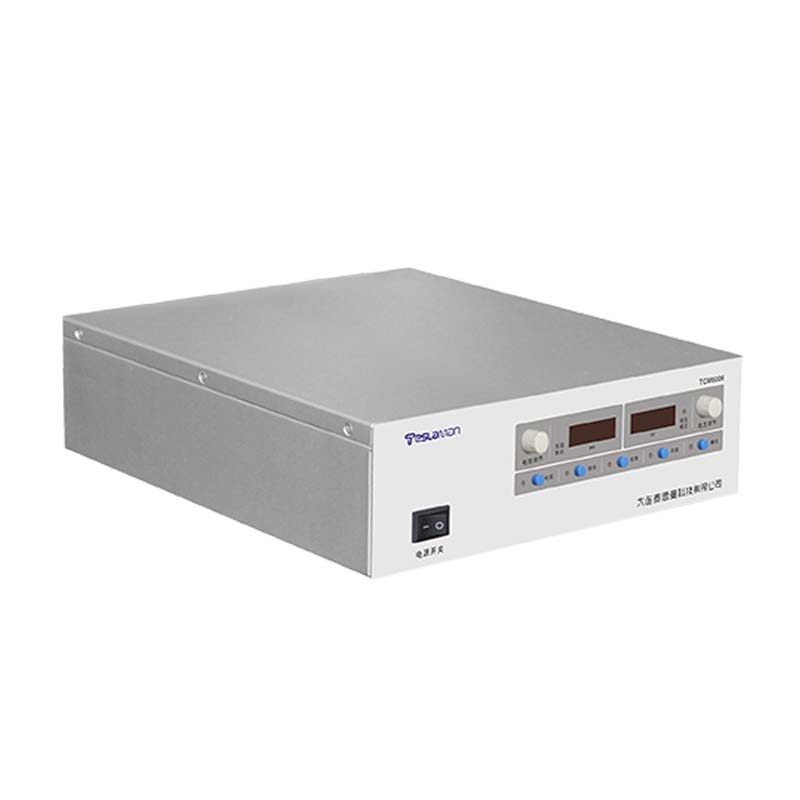
The energy stability of each laser pulse is also paramount. In a scanning system, variations in pulse energy translate directly into variations in the depth of ablation or exposure. The high-voltage power supply that charges the capacitor bank must maintain a consistent voltage on a pulse-to-pulse basis. This requires a fast-recharging supply that can replenish the energy used in the previous pulse during the interval before the next trigger. The regulation of this charging supply is critical; any droop or overshoot will change the discharge voltage and, consequently, the laser output energy.
Another layer of complexity is added when beam shaping optics are used. An excimer beam often passes through a homogenizer to create a flat-top profile, and then through a mask to define the shape of the illuminated area. This mask may need to be changed dynamically during the scanning process. The synchronization system must therefore coordinate the laser pulse, the scanner position, and the mask selection. This requires a high-speed digital control system that can manage multiple axes of motion and multiple triggers simultaneously.
The electromagnetic interference generated by the high-voltage discharge is a significant challenge for synchronization. The fast rise time of the discharge current creates a powerful electromagnetic pulse that can disrupt the sensitive electronics of the scanner controller and the position encoder. Careful shielding, filtering, and the use of fibre-optic links for trigger signals are essential to maintain reliable synchronization. The entire system must be designed as a single, integrated electromagnetic entity, with a common ground scheme and well-defined signal paths.
In conclusion, the precision of an excimer laser processing system is a direct function of the precision of its high-voltage synchronization. The ability to fire a multi-kilovolt, multi-joule pulse at the exact nanosecond that a scanner is in the correct position is the result of decades of advancement in both high-voltage switch technology and low-voltage digital control. The high-voltage power supply is no longer a standalone unit; it is a tightly integrated component of a complex, real-time control system, where its firing is slaved to the motion of the beam. This synchronization is what enables the microscopic precision of modern laser surgery and the intricate patterning of the most advanced computer chips.