High-Voltage Shaping with Environmental Airflow Assistance in Electrospinning
Electrospinning has become a ubiquitous technique for producing nanofibers from a vast array of polymers. The process is elegantly simple: a high voltage is applied to a polymer solution or melt, charging it and causing a jet to be drawn from a needle tip towards a grounded collector. As the jet travels, it undergoes a whipping instability that stretches it into incredibly fine fibers. However, controlling the deposition of these fibers to create aligned or patterned scaffolds remains a significant challenge. After fifty years in this field, I have observed that the key to mastering fiber morphology and deposition lies not in the high voltage alone, but in its synergistic combination with precisely controlled environmental airflow.
The classical electrospinning setup produces a non-woven mat of randomly oriented fibers. For many applications, such as tissue engineering or filtration, this is sufficient. However, for applications requiring aligned fibers for directional cell growth or for creating complex 3D structures, the chaotic nature of the whipping jet is a hindrance. The high-voltage electric field is the primary driver of the jet's motion, but it is also the source of its instability. The challenge is to use the electric field to draw the fiber, while using an auxiliary force, such as airflow, to guide it.
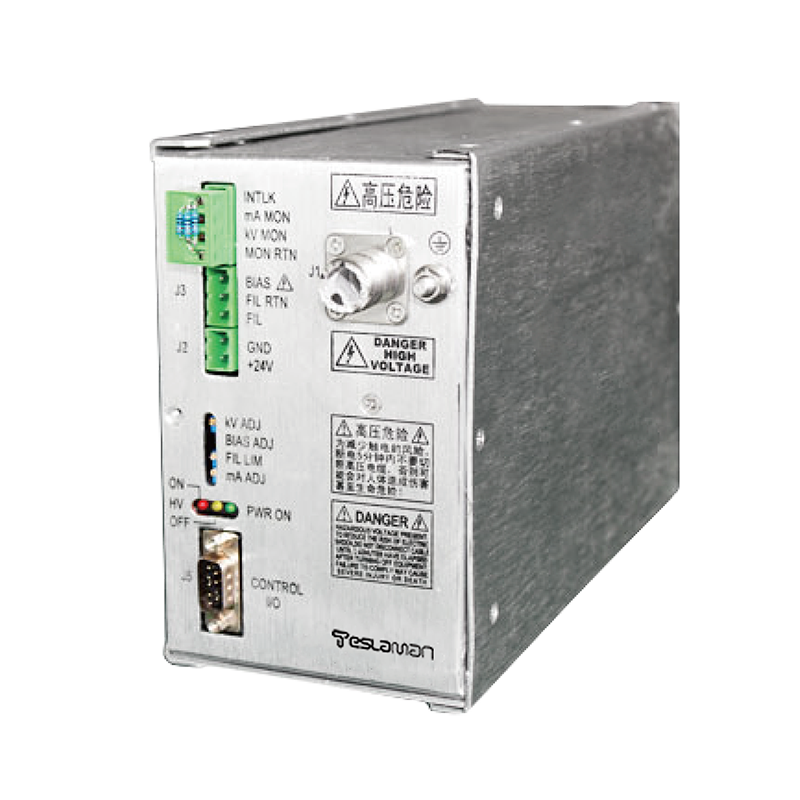
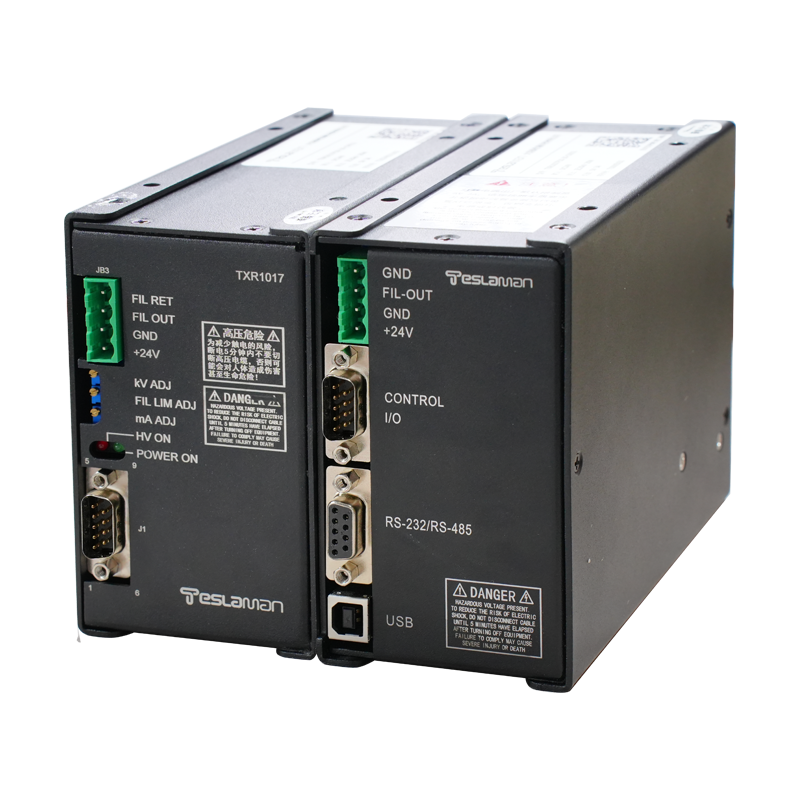
The high-voltage power supply in an electrospinning system must provide a stable, adjustable DC potential, typically ranging from 5 to 50 kilovolts. The stability of this voltage is critical. If the voltage fluctuates, the electrostatic force on the jet varies, leading to variations in fiber diameter. The supply must have low ripple and be immune to drift over the long duration of a spinning run, which can last for hours. For creating aligned fibers, the voltage must be precisely tuned to establish the initial jet and to control the onset of the whipping instability.
The introduction of airflow assistance adds another layer of control. By directing a stream of air coaxially with the polymer jet, or from the side, we can exert a drag force on the fiber. This force can be used to suppress the whipping instability, keeping the jet straight and allowing it to be deposited in a highly aligned manner on a moving or rotating collector. The airflow can also be used to accelerate the evaporation of the solvent, which is crucial for solidifying the fiber before it reaches the collector and for preventing the merging of adjacent fibers.
The integration of high voltage and airflow requires a holistic system design. The air nozzles must be positioned and shaped so that they do not distort the electric field. A conductive air nozzle, if grounded, can act as an electrode, altering the field lines and potentially attracting the jet away from the intended path. Therefore, the nozzles are often made of insulating materials, or they are electrically floated or biased to a specific potential to maintain the desired field geometry. The high-voltage power supply must be capable of providing this bias if required.
Furthermore, the airflow itself can be used as a switching or steering mechanism. By rapidly turning on and off a set of air jets, we can deflect the electrospun jet to different positions on the collector. This could be used to create patterned fiber mats or to write fibers in specific locations, a technique sometimes called direct-writing or near-field electrospinning. The high-voltage supply must be stable enough to maintain a continuous jet while these pneumatic deflectors operate. The timing of the air pulses must be synchronized with the motion of the collector, requiring a sophisticated control system that integrates the high-voltage and pneumatic components.
The temperature and humidity of the airflow are also critical parameters. Heated air can be used to control the evaporation rate of the solvent, influencing the fiber's morphology and crystallinity. Humid air can affect the charge dissipation on the fiber. Controlling these parameters requires additional sensors and actuators, all of which must be integrated into the overall system control. The high-voltage power supply must be able to operate reliably in this environment, with its electronics protected from the solvent vapors and any changes in ambient conditions.
Another advanced technique is the use of multiple electrospinning emitters in an array, combined with airflow to focus or collimate the jets. This is a pathway to scaling up the production rate of nanofibers. However, managing the electric field interactions between multiple jets is a complex problem. Each jet carries charge and repels its neighbors. Airflow can be used to confine the jets, preventing them from spreading apart and ensuring they all deposit on the same area of the collector. This requires a carefully designed manifold that delivers uniform air velocity across the array, and a high-voltage system that can independently bias each emitter or groups of emitters.
In conclusion, the future of electrospinning lies in the convergence of multiple physical fields. The high-voltage electric field provides the primary drawing force, but the addition of precisely controlled environmental airflow adds a new dimension of control. It allows us to tame the chaotic whipping instability, to guide the fiber to specific locations, to control its solidification, and to scale up the process. The high-voltage power supply is no longer a standalone instrument; it is an integral part of a multi-physics system, working in concert with pneumatic, thermal, and mechanical actuators to create the next generation of nanofiber materials. This synergy is the result of decades of refinement in both high-voltage engineering and fluid dynamics, a testament to the power of interdisciplinary innovation.