High-Voltage Adaptive Regulation for Beam Collimators in Particle Accelerators
In the complex ecosystem of a particle accelerator, the beam collimator plays a critical role in machine protection and beam quality. These devices are designed to intercept and absorb errant particles that stray from the nominal orbit, preventing them from damaging sensitive superconducting magnets or other components. Traditionally, collimators are passive, fixed-position blocks of material. However, the demands of high-power, high-brightness beams have driven the development of active collimators whose position and material composition can be adjusted in real-time. After fifty years in high-voltage engineering, I have seen that the key to this adaptive collimation lies in the high-voltage systems that control the collimator actuators and, more importantly, in the high-voltage biasing of the collimator jaws themselves to manage beam-induced effects.
The primary challenge in collimator design is managing the immense thermal load. When a high-energy particle strikes the collimator material, its energy is deposited as heat. In a high-power accelerator, this can be hundreds of kilowatts, enough to melt or severely damage the collimator if not managed properly. The first role of the control system is to adjust the position of the collimator jaws to intercept the beam halo while minimizing the interaction with the beam core. This is typically done with precision stepper motors or piezoelectric actuators. However, the environment is intensely radioactive, and conventional electric motors will fail quickly. Therefore, the actuators are often custom-designed, radiation-hardened devices, and their power supplies must be located outside the radiation zone, with long cables running to the actuators. Driving these long cables at the required voltages and currents without signal degradation is a high-voltage challenge in itself.
A more sophisticated approach to adaptive collimation involves the use of high-voltage bias on the collimator jaws themselves. The jaws are typically made of a low-Z material like graphite or beryllium, often with a high-Z coating. By applying a DC or pulsed high voltage to the jaws, we can create an electric field that actively deflects charged particles away from the collimator, reducing the direct impact and spreading the thermal load. This is a form of 'invisible' collimation, where the field does the work of cleaning the beam halo without requiring the jaws to be moved as close to the beam.
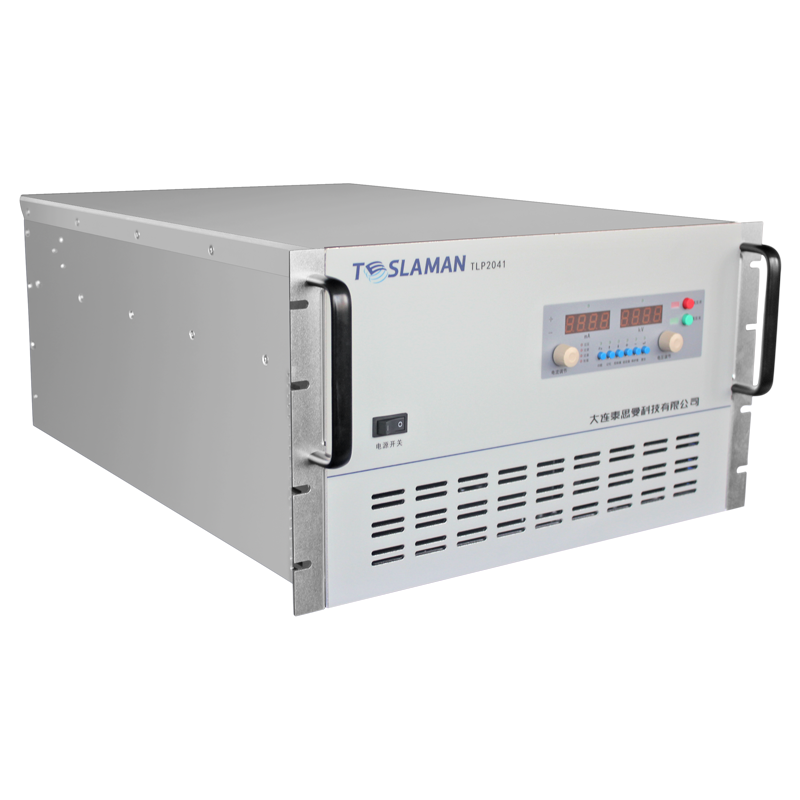
The voltage required for this electrostatic deflection can be substantial, often tens of kilovolts. The power supply for this bias must be exceptionally stable and reliable, as a failure could result in the full beam power being suddenly dumped onto the collimator. Furthermore, the supply must be able to operate in a high-radiation environment, or be located remotely and connected via radiation-hardened, high-voltage cabling. The bias voltage also interacts with the beam-induced plasma that forms around the collimator. This plasma can partially neutralize the applied field, reducing its effectiveness. The power supply must therefore have enough current capacity to maintain the desired voltage despite the presence of this plasma, which acts as a dynamic, non-linear load.
Another critical aspect is the detection of beam losses. The collimator is equipped with various diagnostic sensors, including beam loss monitors, thermocouples, and secondary emission monitors. These sensors generate small signals that must be amplified and transmitted to the control room. In the high-radiation field, conventional electronics are useless. The signals must be converted to light and transmitted via fibre optics. This requires low-power, radiation-hardened converters located right at the collimator, powered by highly filtered, stable low-voltage supplies. The high-voltage bias supply must not introduce noise into these sensitive diagnostic channels, requiring careful filtering and shielding.
The control system for an adaptive collimator is a real-time feedback loop. The beam loss monitors detect an increase in halo. The control algorithm calculates a new optimal position for the collimator jaws and a new optimal bias voltage. Commands are sent to the motor drivers and the high-voltage bias supply. The position and voltage are adjusted, and the loss monitors are checked again. This loop runs continuously, adapting to the changing beam conditions. This requires a high-bandwidth communication link between the accelerator control system and the collimator's local electronics, all of which must be immune to the electromagnetic interference generated by the beam and the high-voltage systems.
Furthermore, the collimator is a critical element in the machine protection system. If a significant beam loss is detected, the collimator control system must be able to send a fast, hardwired interlock signal to the accelerator's beam abort system, demanding that the beam be dumped within a few microseconds. This interlink is separate from the main control system and must be fail-safe. The high-voltage bias supply must be designed to shut down rapidly and safely upon receipt of such an interlock signal, without generating any damaging transients.
In conclusion, the modern adaptive beam collimator is a sophisticated electromechanical device that relies heavily on high-voltage engineering. The precise positioning of the jaws, the electrostatic biasing of their surfaces, the readout of the diagnostic signals, and the integration into the machine protection system all depend on specialized high-voltage and high-reliability power supplies. This adaptive approach allows accelerators to operate at higher intensities and brightness than ever before, by actively managing the beam halo and protecting the sensitive components that make these machines possible. The high-voltage systems, working silently and reliably in the most hostile environments, are the unsung guardians of the particle beam.