High-Voltage Switching for Multi-Reaction Ion Channels in Proton Analysis
The analysis of protons and other light ions is fundamental to a vast range of scientific endeavors, from fundamental nuclear physics experiments to the characterization of materials for fusion energy research and the development of new radiation therapy techniques. Many of these analyses rely on sophisticated ion optical systems that can steer, focus, and select ions of specific energies or types. A critical component in many such systems is the fast high-voltage switch, which is used to route ion beams between different reaction chambers or to select ions from a specific portion of an energy spectrum. In the context of multi-reaction ion channel analysis, where a single beamline may feed multiple experimental end-stations, the ability to rapidly and reliably switch the beam between these stations is paramount. After five decades of designing and implementing high-voltage systems for particle accelerators, I have learned that the fast ion beam switch, or kicker, is one of the most demanding and elegant applications of high-voltage technology. It requires the generation of precise, fast-rising, and flat-topped voltage pulses to create a transient electric field that deflects the beam onto a new trajectory without distorting its quality.
The principle of a beam switch is straightforward. A pair of parallel plates, or a more complex electrostatic deflector, is placed in the beamline. Normally, these plates are at ground potential, and the beam travels straight through to a default destination, such as a beam dump or a primary experiment. When a fast, high-voltage pulse is applied to one of the plates, a transverse electric field is established, and the beam is deflected. By carefully controlling the amplitude of the pulse, we can steer the beam into a secondary beamline that branches off at a specific angle. The requirements for this pulse are extremely stringent. The rise time of the pulse must be short enough that the beam is deflected cleanly, without a portion of it being partially deflected and ending up in the wrong place. For a beam traveling at a significant fraction of the speed of light, the rise time may need to be on the order of nanoseconds. Once the pulse reaches its full amplitude, it must remain perfectly flat for the duration of the beam pulse, which could be microseconds to milliseconds, to ensure that the beam's trajectory to the secondary target is stable. When the pulse ends, it must fall just as rapidly, so that the next pulse of beam can return to the default path without a transient tail.
Generating such a pulse at voltages of several kilovolts is a formidable challenge. The traditional solution has been the use of a high-voltage pulser based on a pulse-forming network and a fast switch, such as a hydrogen thyratron or a stack of power MOSFETs. The pulse-forming network, which is essentially a transmission line or a network of capacitors and inductors, is charged to the desired voltage by a high-voltage DC power supply. When the switch is triggered, it discharges the network into the deflector plates, which act as a capacitive load. The impedance of the pulse-forming network must be matched to the impedance of the load and the cables to prevent reflections that would distort the pulse. For a multi-channel system, where the beam may need to be switched to one of several destinations, the complexity increases. We may need multiple pulsers, or a single pulser with a fast, high-voltage switching network that can route the pulse to different sets of deflector plates. This switching must be synchronized with the beam pulse and with the data acquisition systems at each experimental station. The timing of all these events is typically controlled by a master clock and a series of digital delay generators, which must have jitter measured in picoseconds to ensure that the beam arrives at the correct target at the correct time.
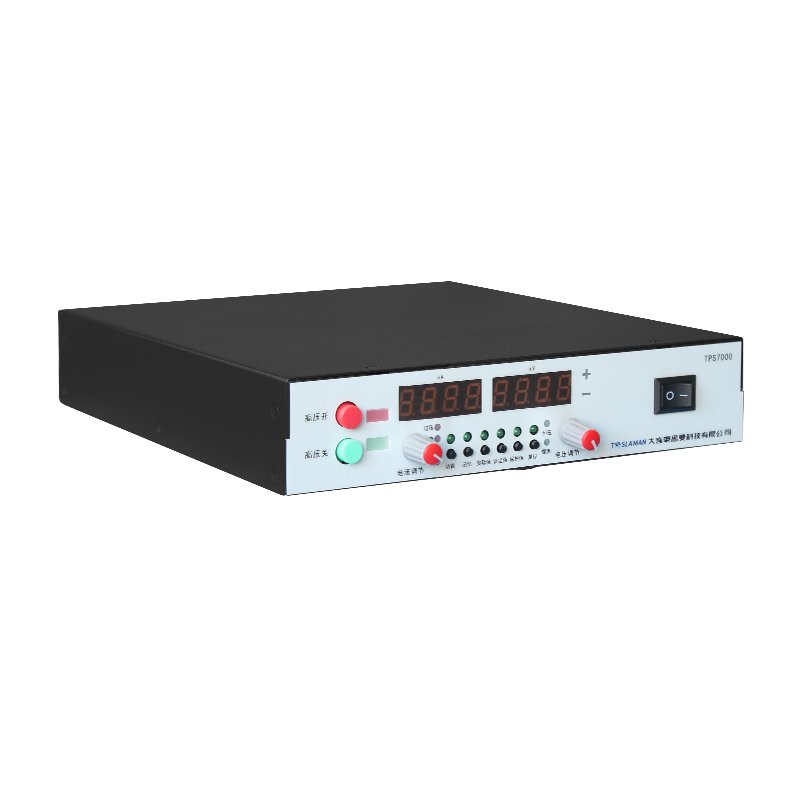
The high-voltage power supply that charges the pulse-forming network must be exceptionally stable. Any drift in the charging voltage will directly translate into a change in the deflection angle, causing the beam to miss its target. The supply must also be capable of recharging the network very quickly after each pulse, especially in experiments with high repetition rates. This requires a fast, regulated charging supply with a high average power capability. The entire pulser system must be carefully shielded to prevent the intense electromagnetic interference generated by the fast switching from disrupting the sensitive beam diagnostics and data acquisition electronics. In my experience, the most successful ion beam switchyards are those where the high-voltage pulsers are treated as precision instruments, designed and built with the same attention to detail as the beamline optics themselves. They are the silent sentinels that stand at the crossroads of the beamline, directing the flow of ions with nanosecond precision, enabling a single accelerator to serve multiple masters and to conduct a diverse array of experiments in parallel, maximizing the scientific output of these complex and expensive facilities.