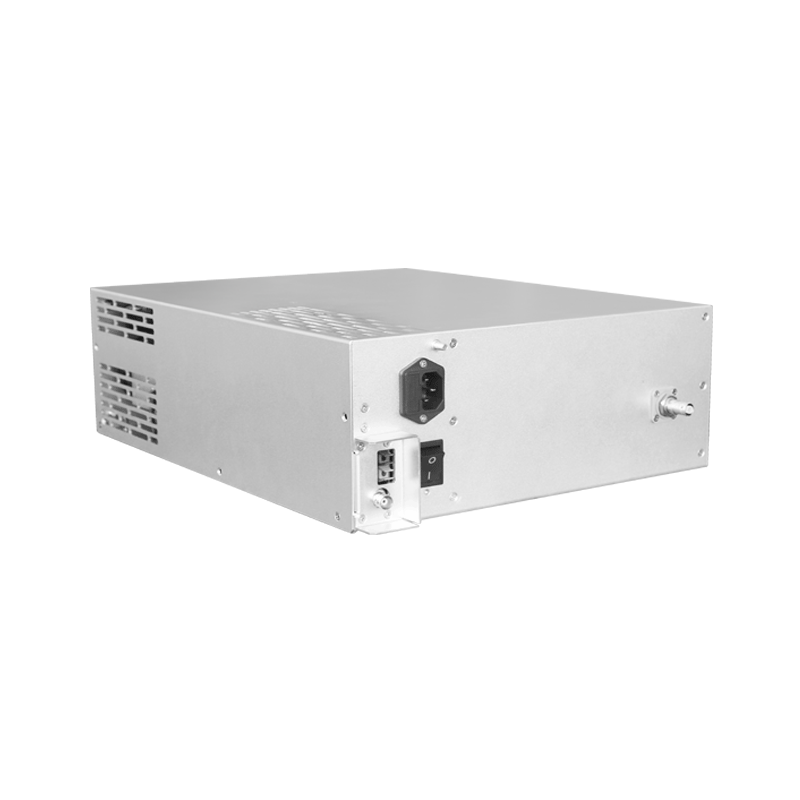
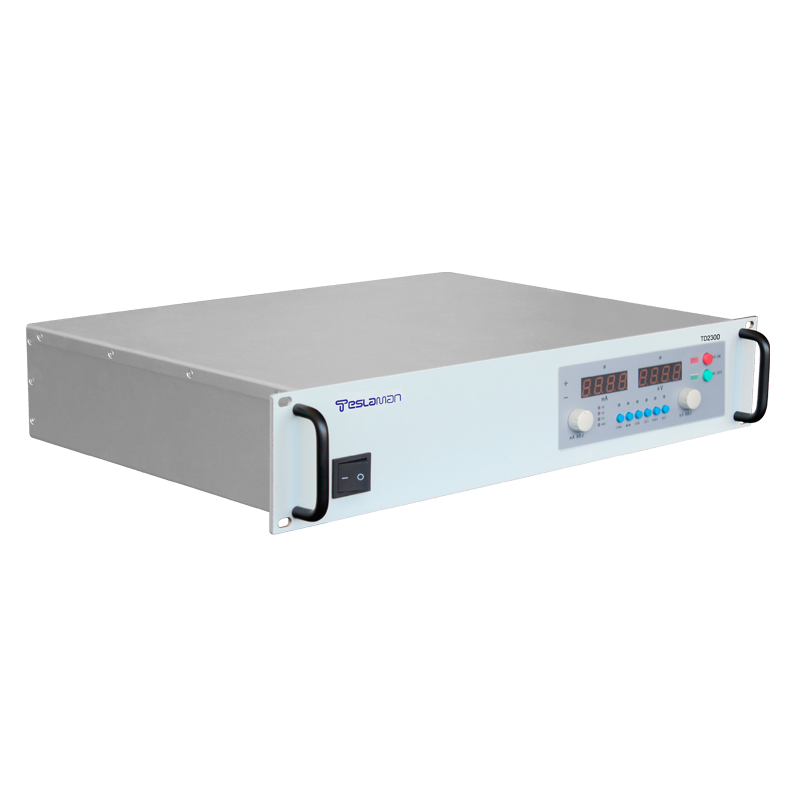
Hundred-volt Level Low Noise High Voltage Bias Power Supply for Single Photon Avalanche Diode
Single photon avalanche diodes have emerged as powerful detectors for applications requiring single-photon sensitivity with excellent timing resolution. These semiconductor devices operate in the Geiger mode, where a bias voltage above the breakdown voltage creates a condition where a single photon can trigger an avalanche breakdown. The bias power supply must provide stable voltage with extremely low noise to ensure reliable single-photon detection without false counts.
The single photon avalanche diode operates by applying a reverse bias voltage exceeding the breakdown voltage of the pn junction. In this condition, the junction is in a metastable state where a single carrier, generated either thermally or by photon absorption, can trigger an avalanche breakdown. The breakdown produces a detectable current pulse that signals the arrival of a photon. After each breakdown, the bias must be reduced below the breakdown voltage to quench the avalanche before the bias is restored for the next detection.
The excess bias voltage, defined as the difference between the applied voltage and the breakdown voltage, determines the photon detection efficiency and the timing characteristics of the detector. Higher excess bias increases the probability that a photon will trigger an avalanche, improving the detection efficiency. However, higher excess bias also increases the dark count rate from thermally generated carriers and increases the afterpulsing probability from trapped carriers.
The noise requirements for the bias power supply are extremely stringent. Any noise on the bias voltage modulates the excess bias, affecting the detection probability and the dark count rate. Voltage increases raise the dark count rate, potentially masking the photon signal. Voltage decreases reduce the detection efficiency, causing photon events to be missed. The power supply noise must be low enough that these effects are negligible compared to the inherent statistical fluctuations in the photon detection process.
The voltage level for single photon avalanche diodes typically ranges from tens of volts to a few hundred volts, depending on the device structure and material. Silicon devices typically operate at voltages below two hundred volts, while devices made from wider bandgap materials may require higher voltages. The power supply must provide the appropriate voltage range with adequate adjustment resolution for setting the optimal excess bias.
Low noise design begins with the selection of low-noise components. Reference voltage sources with low noise characteristics provide the foundation for stable output. Low-noise operational amplifiers and feedback resistors minimize the noise contribution from the control circuits. Capacitors with low dielectric absorption and low equivalent series resistance provide effective filtering without introducing noise.
Linear power supply topologies offer advantages for low-noise applications. The absence of high-frequency switching eliminates the switching noise that can be difficult to filter completely. Series pass transistors regulate the output voltage with minimal added noise. However, linear supplies have lower efficiency and generate more heat than switching supplies, requiring careful thermal management.
For applications requiring the efficiency of switching supplies, post-regulation with linear stages can achieve low noise performance. The switching supply provides the bulk of the power conversion with reasonable efficiency, while a linear post-regulator cleans up the output and provides the final voltage regulation. This hybrid approach balances efficiency and noise performance.
Filtering is essential for achieving the required noise performance. Multi-stage RC or LC filters attenuate noise across the frequency spectrum. The filter design must balance noise attenuation against response speed for applications requiring voltage adjustment. The filter components must be selected for low noise characteristics, avoiding components that could introduce additional noise.
Temperature stability affects the noise performance through temperature-dependent component characteristics. Temperature coefficients of reference voltages and feedback components cause the output voltage to drift with temperature. This drift can appear as low-frequency noise if the temperature fluctuates. Thermal design that maintains stable temperatures minimizes this contribution. Temperature compensation circuits can further reduce the temperature sensitivity.
Shielding and grounding practices significantly affect the noise performance. The power supply must be shielded from external electromagnetic interference that could couple into the sensitive bias voltage. Grounding must be designed to avoid ground loops that could introduce noise. The entire system from power supply to detector must be designed for minimal noise pickup.
Testing and characterization verify that the power supply meets the noise requirements for single photon detection. Noise measurements using spectrum analyzers or sensitive voltmeters characterize the noise amplitude across the frequency spectrum. Photon counting measurements with the actual detector demonstrate the impact of power supply noise on detection performance. Correlation of noise measurements with photon counting results guides optimization of the power supply design.