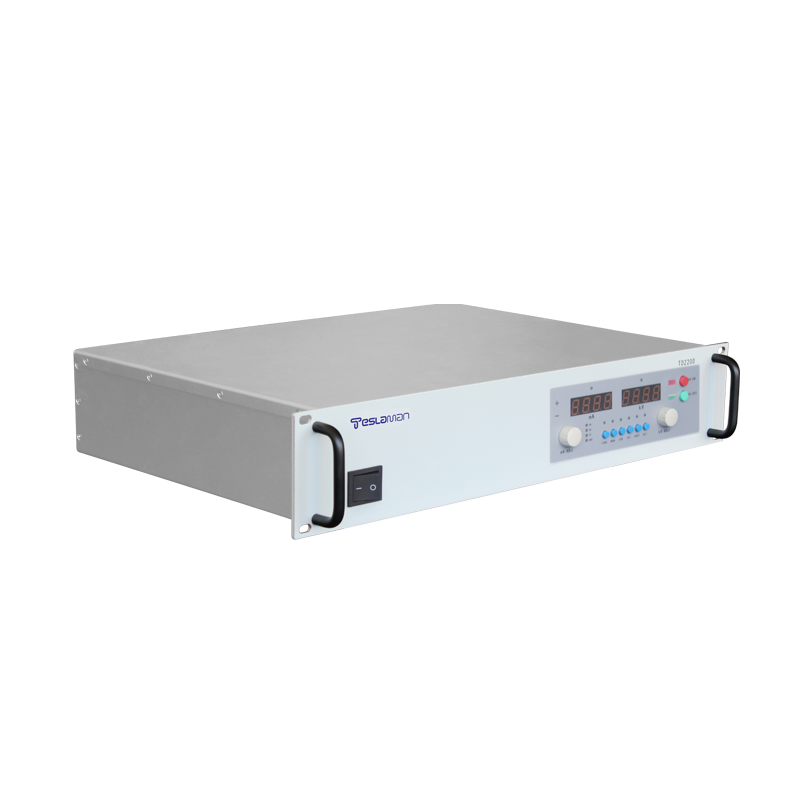
High Voltage Plasma Power Supply for Multilayer Mirror Cleaning in Extreme Ultraviolet Lithography
Extreme ultraviolet lithography represents the leading edge of semiconductor patterning technology, enabling the continued miniaturization of integrated circuit features. The optical system of extreme ultraviolet lithography tools employs multilayer mirrors consisting of alternating molybdenum and silicon layers that reflect extreme ultraviolet radiation at near normal incidence. Contamination of these delicate mirror surfaces by hydrocarbons and other organic compounds degrades reflectivity and reduces tool productivity. High voltage plasma power supplies enable in situ cleaning of multilayer mirrors through controlled plasma processes that remove contaminants without damaging the multilayer structure.
The multilayer mirror structure consists of dozens to hundreds of bilayer pairs of molybdenum and silicon, each layer only a few nanometers thick, designed to constructively interfere at the target wavelength around 13.5 nanometers. The reflectivity of these mirrors is highly sensitive to surface contamination, with even submonolayer coverage of carbonaceous material causing measurable reflectivity loss. The mirrors operate in high vacuum conditions, but residual hydrocarbons from outgassing materials and previous processing can deposit on the mirror surfaces under extreme ultraviolet irradiation.
Plasma cleaning processes remove organic contaminants through reactions with atomic hydrogen or other reactive species generated in the plasma. The hydrogen atoms abstract carbon from hydrocarbon deposits, forming volatile species that desorb from the surface and are pumped away. The plasma must be carefully controlled to provide sufficient reactive species for effective cleaning while avoiding energetic ion bombardment that could damage the multilayer structure or cause intermixing of the molybdenum and silicon layers.
High voltage power supplies for plasma cleaning generate the discharge that dissociates hydrogen molecules into atomic hydrogen. The discharge may be a radio frequency discharge, a microwave discharge, or a direct current discharge, each with particular characteristics suited to different cleaning configurations. The power supply must provide stable output with controlled power level to maintain the desired plasma density and electron temperature. Fluctuations in power can cause variations in reactive species production and affect the cleaning uniformity.
The geometry of the plasma source relative to the mirror surface affects the cleaning uniformity and the risk of ion damage. Remote plasma sources generate the plasma upstream and allow reactive species to flow to the mirror surface, minimizing ion bombardment. Direct plasma configurations expose the mirror to the plasma, providing higher reactive species flux but also exposing the surface to ions accelerated by plasma sheath potentials. The power supply and source design must balance cleaning effectiveness against the risk of mirror damage.
Cleaning process parameters include the gas composition, pressure, power, and duration. Hydrogen is the primary cleaning gas for carbon removal, but other gases may be added for specific contaminant types. The pressure affects the mean free path and the transport of reactive species to the surface. The power determines the dissociation fraction and the reactive species production rate. The duration must be sufficient to remove the estimated contamination load without unnecessary exposure of the mirror to the plasma environment.
In situ monitoring of the cleaning process enables endpoint detection and prevents overexposure. Reflectivity measurements using a probe beam at the extreme ultraviolet wavelength or a surrogate wavelength indicate the cleaning progress. Optical emission spectroscopy of the plasma provides information about the reactive species concentrations and the removal of contaminants. Mass spectrometry of the gas phase can detect the volatile products of cleaning reactions. These monitoring approaches enable real time assessment of cleaning effectiveness.
Integration with the lithography tool control system enables automated cleaning sequences with minimal impact on tool productivity. The cleaning may be performed during scheduled maintenance periods or triggered by reflectivity monitoring that indicates contamination buildup. The power supply must interface with the tool control for automated startup, parameter setting, and shutdown. Safety interlocks ensure that the cleaning plasma is not activated when conditions are inappropriate, such as when the tool is open for maintenance.
The reliability requirements for plasma cleaning power supplies in lithography tools are stringent given the high cost of tool downtime. The power supply must operate reliably over extended periods with minimal maintenance. Self diagnostic capabilities detect developing problems before they cause failures. Redundancy in critical components may be employed to maintain cleaning capability even if some elements fail. The power supply design must also accommodate the cleanroom environment with its temperature, humidity, and particulate requirements.