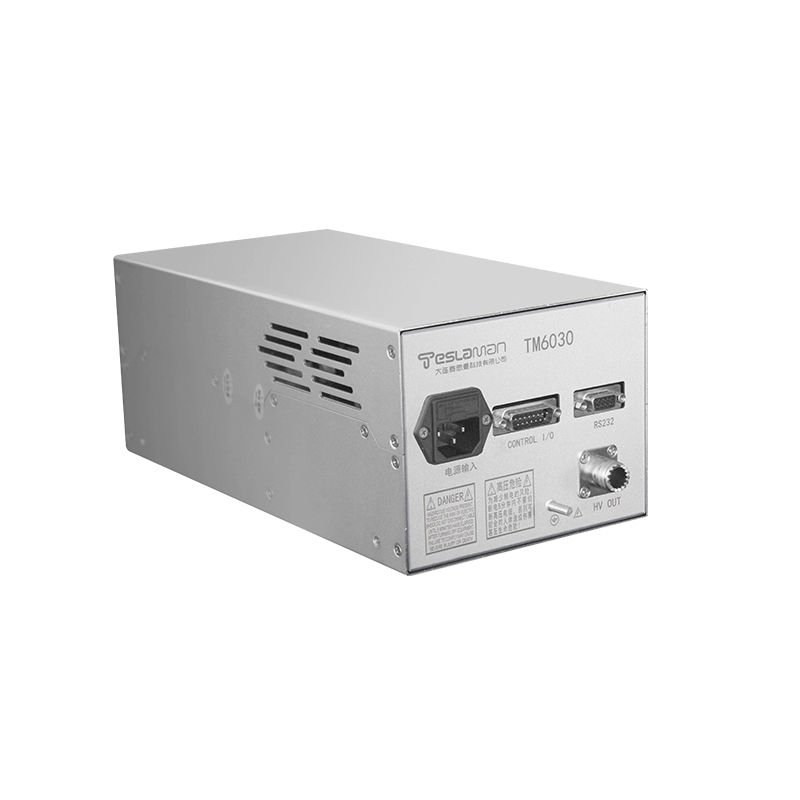
Polarity Switching Speed of Positive Negative Polarity Switching High Voltage Power Supply in Ion Mobility Spectrometry
Ion mobility spectrometry separates ions based on their drift velocity in an electric field through a buffer gas, providing rapid analysis for security screening, environmental monitoring, and process control. The technique can analyze both positive and negative ions, requiring the high voltage to be switched between polarities to detect both ion types. The polarity switching speed determines the time required to change from positive to negative ion mode, affecting the analysis throughput and the ability to detect both polarities in a single sample introduction.
Ion mobility spectrometry operates by injecting ions into a drift tube where they migrate under the influence of an electric field toward a detector. The drift velocity depends on the electric field strength and the ion mobility, which depends on the ion size, shape, and charge. Ions with higher mobility arrive at the detector earlier, providing separation based on mobility. The drift time distribution constitutes the ion mobility spectrum, which identifies the ion types present in the sample.
Positive and negative ions are produced through different ionization mechanisms and provide complementary information about the sample composition. Many compounds produce both positive and negative ions, while some produce predominantly one polarity. Comprehensive analysis requires detection of both polarities to maximize the identification capability. The drift field polarity must be appropriate for the ion polarity being detected, with the field direction determining the drift direction toward the detector.
Polarity switching involves reversing the high voltage applied to the drift tube electrodes. The voltage magnitude remains the same, but the sign changes from positive to negative or vice versa. The switching must occur without damaging transients, without excessive settling time, and without introducing artifacts in the mobility spectrum. The switching speed determines how quickly the instrument can alternate between positive and negative ion detection.
The switching circuit topology affects the switching speed and the transient characteristics. Relay based switching uses electromechanical relays to reverse the connections to the high voltage supply. Relays provide complete isolation and can handle high voltages, but the switching time is limited by the relay mechanical motion, typically milliseconds. Solid state switching uses semiconductor switches to reverse the polarity, providing much faster switching in microseconds but with limitations on the voltage and current handling.
The high voltage supply output characteristics affect the switching behavior. The supply output capacitance stores energy that must be discharged or reversed during switching. The discharge path and the discharge rate determine the switching time. Supplies with low output capacitance switch faster but may have higher ripple. The supply response to load transients affects the voltage settling after the switch.
Drift tube capacitance adds to the total capacitance that must be charged to the new polarity. The drift tube consists of a series of ring electrodes with capacitance between adjacent rings and to ground. The total capacitance can be substantial for long drift tubes with many electrodes. The switching circuit must handle the capacitive charging current without excessive voltage overshoot or ringing.
Switching transients can affect the detector and the ion distribution in the drift tube. Rapid voltage changes induce currents in the detector circuitry that can appear as spurious signals. The electric field transient can perturb the ion distribution, affecting the mobility spectrum. The switching waveform should be controlled to minimize these transients, with appropriate slew rate limiting and damping.
Settling time after switching is the time required for the voltage to stabilize at the new polarity within the tolerance required for accurate mobility measurement. The settling time includes the time for the switching action itself and the time for any transients to decay. The instrument must wait for the voltage to settle before acquiring data, making the settling time a component of the total analysis time.
Alternating polarity operation switches between positive and negative modes repeatedly during a single sample analysis, providing quasi simultaneous detection of both polarities. The switching frequency determines how often each polarity is sampled, affecting the temporal resolution for monitoring time varying samples. Higher switching frequencies require faster switching capability. The duty cycle between polarities can be adjusted to optimize the detection for specific applications.
Control system integration coordinates the polarity switching with the ion injection, the data acquisition, and the signal processing. The switching command must be synchronized with the instrument timing to ensure that data acquisition occurs only when the voltage is stable. The control system must account for the switching time in the timing calculations. Status indicators confirm the polarity state for proper data interpretation.