Nonlinear Optimization Algorithm of High Order Field Correction High Voltage Power Supply for Orbitrap Mass Spectrometer
Orbitrap mass spectrometers achieve high resolution mass analysis by trapping ions in electrostatic fields and measuring their oscillation frequencies. The mass resolution depends on the precision of the electrostatic field shape. High order field corrections adjust the field to achieve the ideal shape for optimal resolution. Nonlinear optimization algorithms determine the correction voltages that minimize field deviations from the ideal.
Orbitrap mass analyzers use a specially shaped electrode structure that creates an electrostatic field with specific characteristics. Ions are injected into the trap and oscillate around the central electrode. The oscillation frequency depends on the ion mass to charge ratio. Measuring the frequency determines the mass. The resolution depends on the field quality and the measurement precision.
The electrostatic field in an Orbitrap has a specific shape that enables harmonic ion motion. The ideal field shape produces oscillations where the frequency is independent of the ion energy and depends only on the mass to charge ratio. Deviations from the ideal shape cause frequency variations that reduce the resolution. Field corrections adjust the shape to approach the ideal.
High order field corrections use additional electrodes to modify the field shape. The correction electrodes apply voltages that create field components that compensate for deviations. Different correction electrodes address different order field components. The correction voltages must be set to values that minimize the overall field deviation.
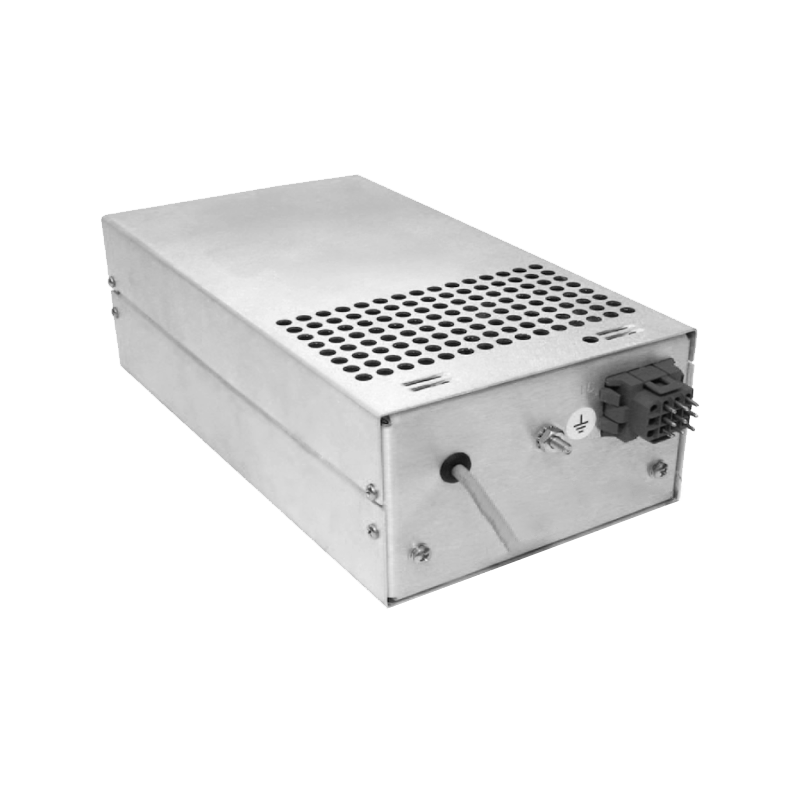
The high voltage power supply for field correction provides the voltages for the correction electrodes. The voltages must be precise and stable to maintain the corrected field shape. Voltage errors cause field errors that affect the resolution. The power supply must provide multiple independent voltages for different correction electrodes.
Nonlinear field correction addresses the complex relationship between correction voltages and field shape. The field shape depends nonlinearly on the electrode geometry and the applied voltages. Multiple correction electrodes interact, with each electrode affecting multiple field components. The optimization must find the voltage combination that minimizes the overall deviation.
Optimization algorithms for field correction search the voltage parameter space to find the optimal combination. The search must minimize an objective function that quantifies the field deviation. The objective function may be based on measured field characteristics or on simulated field predictions. The algorithm must efficiently navigate the parameter space to find the optimum.
Gradient based optimization uses the gradient of the objective function to guide the search. The gradient indicates the direction of improvement in the parameter space. Following the gradient leads toward the optimum. Gradient methods require calculation or estimation of the gradient at each point. The gradient may be computed from field simulations or estimated from measurements.
Newton methods use second order information to accelerate convergence. The Newton step uses the gradient and the curvature to predict the optimum location. Newton methods converge faster than gradient methods but require more computation. Quasi Newton methods approximate the curvature from gradient observations, reducing the computation requirement.
Global optimization methods search the entire parameter space to find the global optimum. Local methods may converge to local optima that are not the global optimum. Global methods such as genetic algorithms, simulated annealing, and particle swarm optimization explore broadly to avoid being trapped in local optima. Global methods are computationally intensive but can find better solutions.
Hybrid methods combine local and global search strategies. Global search identifies promising regions of the parameter space. Local search refines the solution within promising regions. The combination provides both broad exploration and efficient refinement. Hybrid methods balance computational cost against solution quality.
Field measurement for optimization validation measures the actual field characteristics. Ion trajectory measurements reveal the field shape through the ion motion. Frequency measurements at different ion energies indicate field deviations. The measurements validate that the optimized voltages achieve the desired field correction.
Simulation based optimization uses electrostatic field simulations to predict the field shape. The simulations calculate the field from the electrode geometry and the applied voltages. The simulations enable optimization without physical measurements, reducing the experimental effort. The simulation accuracy must be adequate for reliable optimization.
Calibration procedures establish the correction voltages for specific instruments. Each instrument may have slightly different electrode geometry that requires different correction voltages. Calibration measurements characterize the field for each instrument, and optimization determines the appropriate voltages. The calibration ensures that each instrument achieves optimal resolution.
Real time adjustment maintains field correction during operation. Temperature changes or other factors may cause field drift that requires voltage adjustment. Monitoring the resolution during operation enables detection of drift. Real time optimization can adjust the voltages to maintain optimal resolution. The real time adjustment requires efficient optimization algorithms that can compute corrections quickly.