Electrostatic Flocking High Voltage Power Supply Voltage Waveform Influence on Pile Uniform Distribution
The electrostatic flocking process relies on the precise application of high voltage to create an electric field that aligns and accelerates flock fibers onto an adhesive-coated substrate. The uniformity of the pile distribution is directly influenced by the characteristics of the voltage waveform applied to the flocking electrodes. Over five decades of experience with high voltage systems in electrostatic flocking have demonstrated that the voltage waveform parameters must be carefully controlled to achieve consistent flock density and orientation across the substrate surface. The relationship between the voltage waveform and the pile distribution involves complex interactions between the electric field, the fiber charging dynamics, and the aerodynamic forces in the flocking chamber.
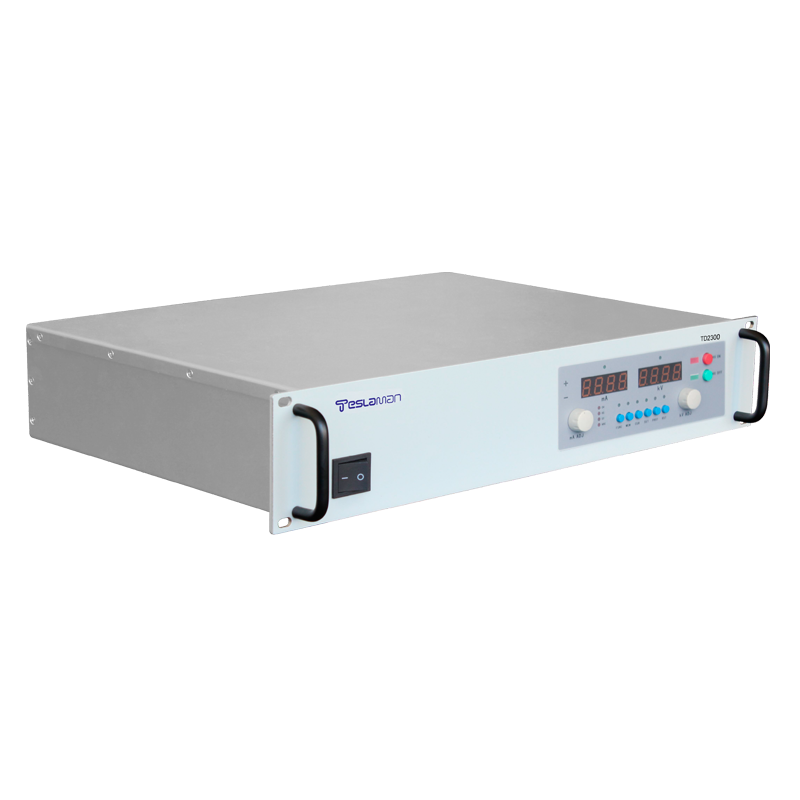
The basic electrostatic flocking system consists of a high voltage power supply connected to a grid or plate electrode positioned above the substrate. The flock fibers are introduced into the electric field where they become charged and are accelerated toward the substrate. The voltage applied to the electrode determines the field strength and the charging rate of the fibers. The uniformity of the pile distribution depends on the spatial and temporal uniformity of the electric field, which is influenced by the voltage waveform characteristics.
DC voltage operation provides a steady electric field that continuously accelerates the fibers toward the substrate. The pile density achieved with DC voltage depends on the voltage level and the fiber feed rate. Higher DC voltages produce stronger electric fields that accelerate the fibers to higher velocities, resulting in deeper penetration into the adhesive layer and denser pile. However, excessive DC voltage can cause field emission and corona discharge that disrupts the flocking process and creates non-uniformities in the pile distribution. The optimal DC voltage must be determined experimentally for each fiber type and substrate configuration.
Pulsed voltage operation introduces a time-varying electric field that can improve the pile distribution uniformity compared with DC operation. The voltage pulse charges the fibers rapidly and then decreases to a lower holding voltage that maintains the fibers in position while the adhesive cures. The pulse width and repetition rate determine the charging time available for the fibers and the time between successive charging events. Short pulses with high repetition rates can charge the fibers more efficiently than DC voltage, resulting in more uniform pile distribution. The pulse rise time is critical because fast rise times produce higher charging currents that can cause fiber damage or arcing.
The voltage waveform shape influences the trajectory of the fibers in the electric field. A square wave voltage produces a constant field during the pulse that accelerates the fibers uniformly. A sinusoidal voltage produces a time-varying field that causes the fibers to experience oscillatory forces during the pulse. The fiber trajectory in a sinusoidal field depends on the phase of the voltage at the instant the fiber enters the field. The variation in fiber trajectories with the voltage phase can cause non-uniformities in the pile distribution that are correlated with the frequency of the sinusoidal voltage.
The amplitude modulation of the voltage waveform can be used to control the pile distribution across the substrate. The voltage amplitude is varied across the width of the substrate to compensate for the non-uniformities in the electric field caused by the electrode geometry. The modulation pattern is determined by measuring the pile distribution with uniform voltage and then applying the inverse modulation to achieve uniform distribution. The amplitude modulation capability requires a high voltage power supply that can respond to the modulation signal with sufficient bandwidth to track the desired waveform.
The frequency of the voltage waveform affects the charging dynamics of the fibers. The charging time constant depends on the fiber resistance and capacitance, which vary with the fiber material and dimensions. The voltage waveform frequency must be matched to the charging time constant to achieve efficient charging of the fibers. Frequencies that are too high prevent the fibers from reaching their full charge before the voltage changes, while frequencies that are too low allow the fibers to discharge between voltage cycles. The optimal frequency is determined by the fiber characteristics and the flocking conditions.
The voltage waveform also affects the aerodynamic forces on the fibers in the flocking chamber. The electric field generates ionic wind that creates air currents in the chamber. The ionic wind velocity depends on the voltage amplitude and the waveform shape. High voltage amplitudes with fast rise times generate strong ionic winds that can disrupt the fiber trajectories and create non-uniform pile distribution. The voltage waveform must be designed to balance the electrostatic forces that accelerate the fibers with the aerodynamic forces that can disturb the fiber motion.
The measurement of the voltage waveform at the flocking electrode is essential for process control. The high voltage probe used for the measurement must have sufficient bandwidth to capture the waveform details without distortion. The probe should be calibrated at the operating voltage levels to ensure accurate measurement of the waveform amplitude and shape. The measurement system should record the waveform parameters for each production batch to provide a record of the process conditions and to enable correlation between the waveform parameters and the pile quality.
The pile density measurement provides the feedback for adjusting the voltage waveform parameters. The pile density is measured using optical methods that analyze the fiber coverage of the substrate. The measurement system should provide a spatial map of the pile density across the substrate to identify non-uniformities that can be corrected by waveform adjustment. The correlation between the waveform parameters and the pile density distribution is established through experimental studies that vary the waveform parameters systematically and measure the resulting pile distribution.
The effect of the voltage waveform on the pile orientation is also important for the quality of the flocked product. The fibers should be oriented perpendicular to the substrate surface to achieve the desired appearance and performance. The voltage waveform influences the fiber orientation through the direction of the electric field and the charging dynamics of the fibers. The waveform parameters that produce the most uniform pile density may not produce the best fiber orientation, requiring a compromise between density uniformity and orientation quality.
The voltage waveform stability over time is essential for maintaining consistent flocking quality. The high voltage power supply must maintain the waveform parameters within the specified tolerances throughout the production run. The waveform stability is affected by the temperature of the power supply components, the aging of the switching elements, and the variations in the load impedance. The power supply control system must compensate for these variations to maintain the waveform parameters at the set points. The waveform monitoring system should generate an alarm if the parameters deviate from the specified range.
The voltage waveform influence on the pile uniform distribution in electrostatic flocking is a complex interaction between the electric field, the fiber charging dynamics, and the aerodynamic forces. The optimization of the waveform parameters requires a systematic approach that considers the fiber characteristics, the substrate configuration, and the production requirements. The high voltage power supply must provide the waveform flexibility and stability required for the optimal flocking process. The continuing development of high voltage power supply technology will provide new capabilities for waveform control that will further improve the uniformity and quality of electrostatic flocking products.