Low-Ripple High-Voltage Supply for Precision High-Voltage Resistive Dividers
Precision high-voltage resistive dividers are used as measurement references in calibration laboratories, particle accelerators, and high-voltage test facilities. The accuracy of the divider depends not only on the resistance ratio and the temperature stability of the resistor elements but also on the quality of the high-voltage supply that feeds the divider under test. A low-ripple high-voltage supply is therefore an essential companion to the precision divider, because any ripple or noise on the supply voltage propagates directly into the measurement uncertainty. The supply and the divider together form the measurement chain, and the performance of the chain is limited by the weakest component.
The measurement application demands an exceptionally clean output. The ripple specification is typically expressed in parts per million of the output voltage, and the noise specification covers the frequency range from the line frequency to the upper limit of the measurement bandwidth. The supply achieves these levels through a combination of a low-noise regulation stage, a multi-stage passive filter, and careful attention to grounding and shielding. The output is isolated from the mains by the high-frequency transformer, and the residual coupling is minimized by the shield configuration of the transformer.
The supply is designed around a precision voltage reference that determines the absolute accuracy of the output. The reference is a temperature-stabilized element with a low temperature coefficient, and the voltage divider that scales the reference to the output level uses precision resistors with matched temperature characteristics. The regulation loop compares the scaled output with the reference and corrects the error through the inverter duty cycle. The loop gain is high at low frequencies, where the drift and the ripple components are suppressed, and the loop response is optimized for the measurement bandwidth.
The output filter is a critical element of the design. The switching frequency of the inverter generates ripple at the switching frequency and at the harmonics of this frequency, and the filter must attenuate these components to the required level. The filter topology combines capacitive elements with a damping network that prevents resonance, and the component values are chosen to minimize the output impedance at the frequencies of interest. The filter also isolates the supply from the load, so that variations in the load current do not couple noise into the measurement.
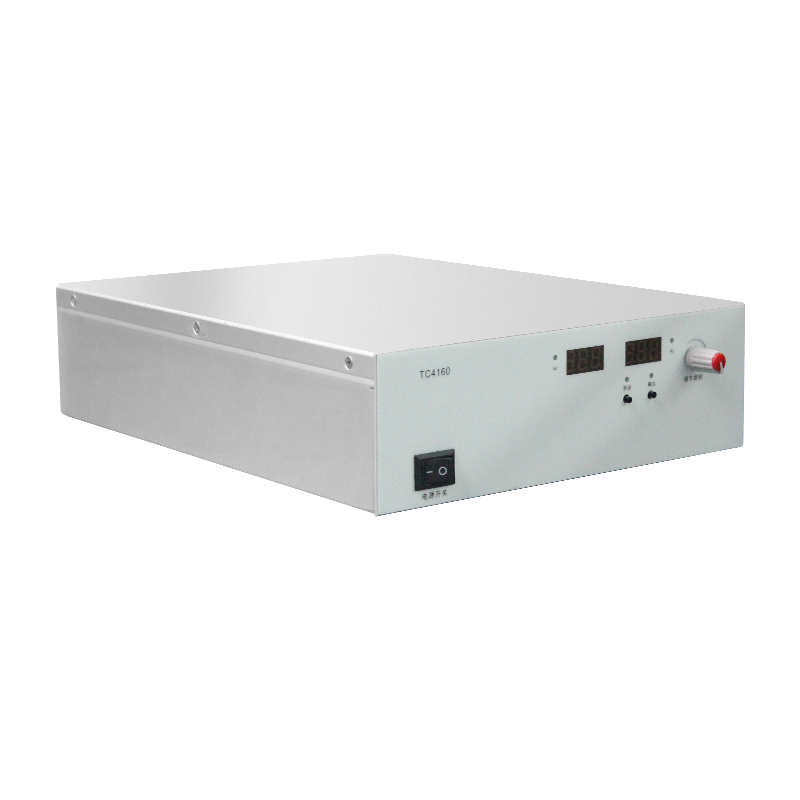
Thermal stability is a dominant factor in the accuracy of the divider supply. The resistors of the divider network change value with temperature, and the temperature coefficient of the combination must be minimized by matching and by temperature stabilization. The supply cabinet is designed so that the heat of the power components is carried away from the measurement elements, and the measurement section is kept at a controlled temperature. The calibration of the supply is valid only within the specified temperature range, and the operating limits are documented for the user.
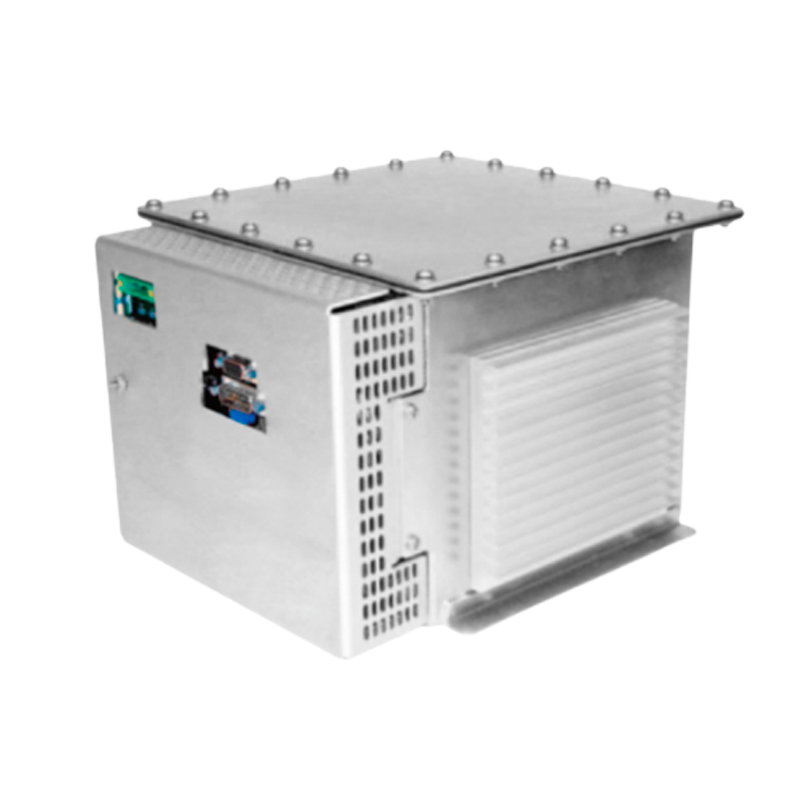
Electromagnetic shielding protects the measurement from external interference. The supply is enclosed in a conductive housing that attenuates the radiated fields, and the output cable is a shielded construction with the shield connected at the measurement ground point. The grounding topology follows a single-point scheme that prevents ground loops, because a ground loop converts magnetic interference into a voltage error in the measurement path. The shield of the transformer and the shield of the filter are connected according to the signal-flow direction to avoid circulating currents.
Long-term stability is verified by periodic recalibration. The supply is calibrated against a reference standard at defined intervals, and the drift between calibrations is recorded. The drift data show the aging behavior of the components, and the calibration interval is chosen so that the accumulated drift remains well below the accuracy requirement. The calibration records are maintained as part of the quality system of the laboratory.
The supply also serves as a test source for divider characterization. The divider under test is connected to the supply output, and the ratio is measured with a precision voltmeter or a bridge circuit. The supply voltage is varied over the operating range, and the ratio error of the divider is plotted as a function of voltage. The low ripple of the supply ensures that the ratio measurement is not corrupted by the supply noise, so the measurement reflects the true performance of the divider.
Safety is an important aspect of a high-voltage laboratory supply. The output voltage is dangerous, and the supply is equipped with interlocks, discharge circuits, and protective covers that prevent accidental contact. The discharge circuit bleeds the stored energy of the output capacitance when the supply is switched off, and the discharge time is documented. The operator interface provides a clear indication of the energized state, and the control logic prevents the output from being enabled unless the safety conditions are satisfied.
The supply supports the automation of the calibration laboratory. Remote setpoint control, status monitoring, and data logging are implemented through a digital interface, and the measured values are timestamped for the calibration records. The supply can be operated from a control program that sequences the measurements and collects the results, reducing the manual effort and improving the consistency of the calibration procedures.
Environmental conditions in a calibration laboratory are controlled, but the supply must still tolerate the normal variations of temperature, humidity, and mains voltage. The input section accepts a range of mains voltages and frequencies, and the output regulation is maintained across the input range. The humidity protection covers the high-voltage section, where condensation could cause leakage currents that disturb the measurement.
In summary, the low-ripple high-voltage supply for precision resistive dividers integrates a stable reference, a clean regulation stage, a well-designed filter, and rigorous thermal and shielding measures into a measurement-grade instrument. The result is a supply that provides the output purity required for accurate divider characterization while maintaining the safety and the long-term stability demanded by the calibration environment. Every improvement in the noise performance, every refinement of the filter, and every enhancement of the calibration support contributes directly to the accuracy of the measurement chain. The engineering effort continues as the accuracy requirements of high-voltage metrology become ever more demanding.