High-voltage output of electron beam system power supplies in vacuum melting furnaces and electron gun emission
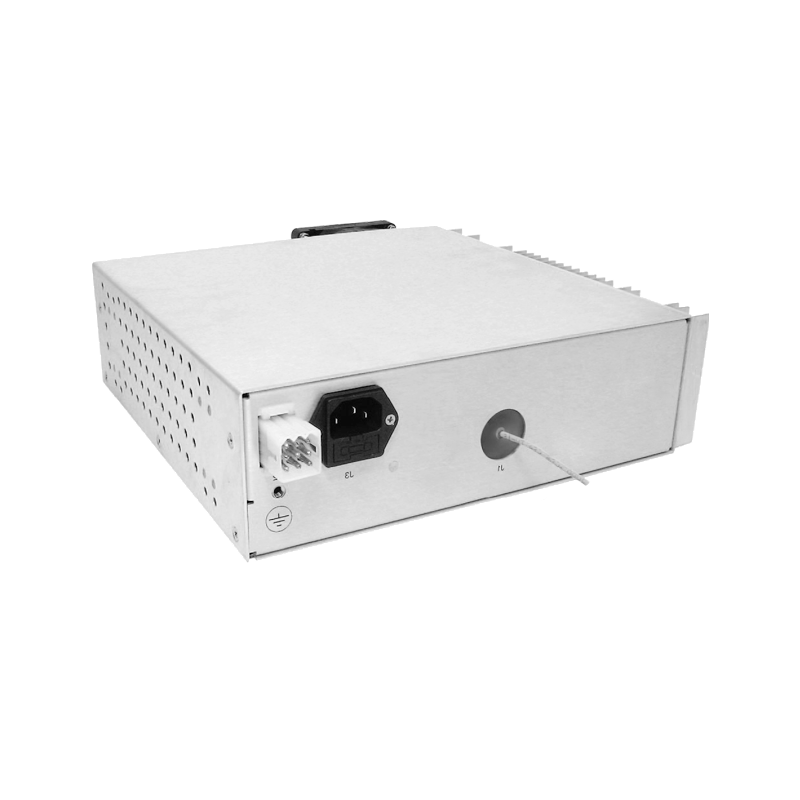
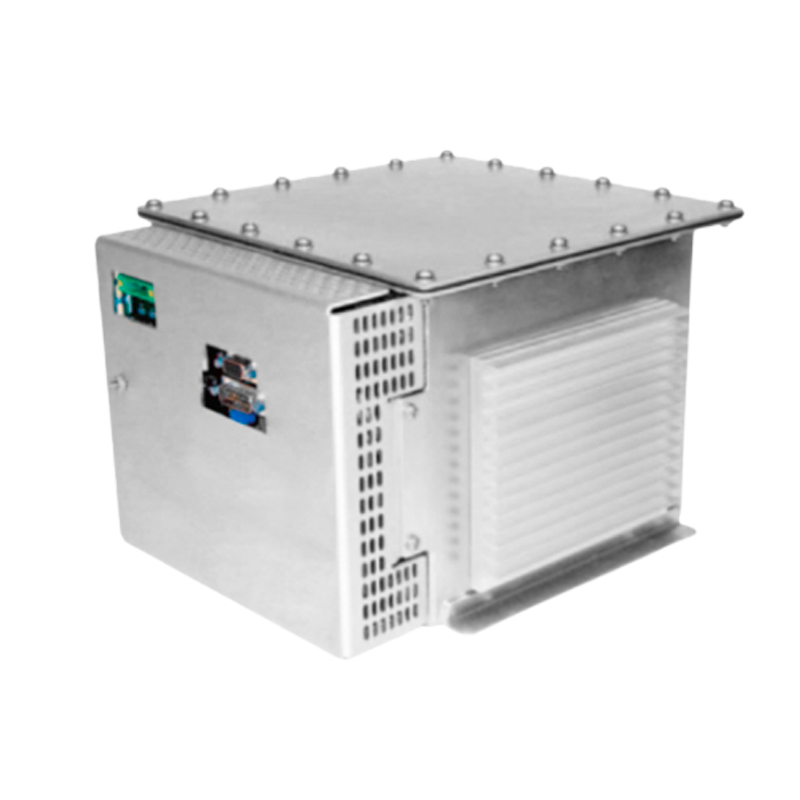
The vacuum melting furnace in the foundry melts titanium scrap into small ingots, and the electron gun above the water-cooled copper crucible runs at 45 kV with a beam current up to 1000 mA. The gun supply occupies a floor-standing cabinet beside the furnace, fed by a 60 kW three-phase transformer, and the cabinet ties to the furnace through an oil-filled HV bushing on the chamber roof. Furnace pressure during melting holds at 5e-2 Pa, pulled by a diffusion pump backed by a rotary vane pump. Charge loads weigh 25 kg per batch, and a batch melts down over 45 minutes, with power staged from 15 kW at warm-up to 55 kW at full melt. The copper crucible holds a skull of solid titanium around the molten pool, so the pool never touches the mold wall.
Emission regulation sets the pool temperature. At 45 kV, full beam current of 1000 mA lands 45 kW onto a 60 mm diameter pool, and the pool surface measures 1750 degrees by optical pyrometer sighted through the chamber viewport. The emission loop samples current through a shunt on the gun cathode lead and adjusts grid bias every millisecond, holding within plus or minus 5 mA at setpoint. A 1 percent emission dip cools the pool center enough to freeze a crust, and a frozen crust deflects the beam into the crucible wall, where the copper would melt through if left for more than 10 seconds. The wall temperature interlock sits at 80 degrees on the crucible water outlet, and a rise past the limit cuts the beam and alarms.
Gun cathode life dictates the maintenance calendar. A tungsten basket cathode holds 140 hours of emission at the 1000 mA work point, and basket evaporation thins the wire until emission falls short at the normal bias setting. Basket swap takes 5 hours, including vent, column open, and pump-down back to 5e-2 Pa, and the shop keeps two baskets on the shelf at 900 dollars each. Cathode evaporation deposits metal on the anode aperture, and aperture resistance to grounded parts gets a leakage check at every basket change, reading under 50 megaohms when clean. One neglected changeover let the aperture leakage grow to 2 megaohms, and the leakage current pulled the cathode potential sideways, causing beam wandering that scorched a ring into the crucible rim. Replacement of the basket includes realignment of the Wehnelt aperture, and the alignment target, a crosshair viewed through the viewport, must center within 0.5 mm. A misaligned realignment once put the hot spot 3 mm off the pool center, and the first batch after that swap showed uneven ingot density that required a second melt. The realignment step now follows a written checklist with a sign-off line, and the checklist page gets filed with the batch record.
Sweep motion spreads the beam over the pool. Two deflection coils, driven at 60 Hz by a sweep amplifier in the cabinet, trace a spiral that covers the 60 mm pool plus a 5 mm margin onto the skull. The spiral amplitude maps on the pyrometer image, and the operator trims amplitude until the pool edge shows uniform orange. Too narrow a spiral leaves a cold ring that never melts, and gas trapped in the scrap escapes from the cold ring as spatters during the next stage, each spatter a shower of sparks in the chamber. The sweep amplifier shares the tank with the 45 kV stack, and coil wires cross through capacitors that block DC while passing 60 Hz, the same arrangement as the treatment lines.
Pool level rises as the ingot solidifies below. The crucible bottom lowers in stages, 2 mm every 3 minutes during the solidification stage, and the beam stays on while the block grows. Lowering power follows a staged table: 55 kW while the pool is open, 30 kW while solidifying the bottom half, 15 kW on the last 20 mm. The supply ramps through the table under the furnace controller, and a manual override lets the operator hold power at any step. On one batch, the lowering mechanism jammed 15 mm short, and the operator held the pool open for 12 minutes at 15 kW until maintenance freed the mechanism, producing a slightly porous bottom that had to be machined off at 8 mm depth.
Vacuum arcs interrupt melting more often on titanium than on steel practice. When the pool outgasses a burst of trapped argon from scrap chunks, a low-density plasma forms and an arc fires between cathode and pool, pulling emission to 1500 mA in 8 microseconds. The arc detector trips the grid bias to minus 2000 V within 6 microseconds, and recovery waits 60 ms before a half-power ramp of 200 ms. On dirty scrap, arcs run 8 to 12 per batch, and each arc leaves a brief power dip that extends melt time by about 1 minute. Raising the trip level to 1800 mA was never tried, after an early incident where a missed arc burned a 2 mm pit in the crucible wall and the water in the wall hissed into the chamber.
Crucible cooling carries the biggest interlock risk. Water flows through the copper wall at 18 liters per minute, inlet 22 degrees, outlet rising 6 degrees at full power. Flow switches on the inlet and outlet both wire to the furnace PLC, and either switch opening cuts beam within 50 ms. A blocked filter on the inlet once cut flow to 9 liters per minute without tripping, and the outlet climbed to 75 degrees before the wall-temperature alarm caught the situation. The filter now gets a pressure-drop check at every charge, and the flow alarm threshold tightened to 14 liters per minute. Cooling water uses a closed loop with deionized makeup, and loop conductivity stays under 5 microsiemens per centimeter. Water makeup passes through a mixed-bed polisher, and the polisher cartridge change happens quarterly at 280 dollars. A conductivity drift to 9 microsiemens in one winter traced to a cartridge exhausted early, and the early exhaustion tied to a humid outdoor air intake on the loop cooler. The intake got a drip cover, and cartridge life returned to the quarter mark. Cooling water outlet temperature reads with a pt100 sensor, and the sensor gets a yearly ice-point check against a reference bath.
Beam alignment drifts with cathode wear. As the basket thins, the emission center shifts 1 to 2 mm sideways, and the pool hot spot follows. The operator re-centers the hot spot twice per batch on the pyrometer image, adjusting the static offset on the deflection coils. Without re-centering, the hot spot crawls onto the skull edge and warms a spot on the crucible rim, which showed as a brown heat stain after 30 batches. The stain habit prompted the twice-per-shift check, and the rim now stays clean. Alignment adjustment takes 2 minutes per trim, and the trim values get written in the batch logbook for the next shift to compare.
Power staging during warm-up protects the gun. Cold titanium scrap has poor emissivity and reflects beam energy back at the gun, and full power on a cold charge would overheat the cathode assembly. The procedure ramps beam from 10 kW to 25 kW in the first 10 minutes, watching pool glow spread across the charge before stepping to 45 kW. A production rush on one day skipped the warm-up table and hit 45 kW on a cold load, and reflected radiation warmed the column wall past the 90 degrees alarm, tripping the supply and shutting the batch down for 2 hours. The procedure lockout now requires the controller to read the pyrometer above 800 degrees before allowing the 45 kW step.
Evaporated titanium coats the chamber walls steadily. Titanium vapor rises from the pool and condenses on the cold chamber walls as a gray layer, growing 0.1 mm per 40 batches. When the layer passes 0.5 mm, flakes drop onto the pool and pop, and arc frequency doubles. The chamber opens for scraping at the 40-batch mark, and scraping takes 4 hours with hand tools, since the layer bonds tightly to the stainless wall. A disposable aluminum foil liner inside the wall halved the scraping work, but the liner outgassed at the vacuum hold and extended pump-down by 30 minutes, so the shop went back to bare walls.
Scrap quality decides batch consistency. Clean machining chips melt quietly with 2 to 3 arcs per batch, while chip stock mixed with mill oil outgasses smoke and pushes chamber pressure up to 2 Pa, tripping the pressure interlock before melting starts. The shop preheats oil-contaminated stock in a separate vacuum oven at 400 degrees for 2 hours, and the preheated stock then runs through the furnace without pressure trips. The preheat step adds a day to the material cycle, and the purchase specification now demands clean chips only, passing the preheat burden back to the supplier.
The furnace controller logs power, emission, pressure, and cooling data every second to the batch file. A monthly review plots the emission setpoint drift across batches, and the plot shows the cathode aging curve: setpoint bias drifts 15 percent upward over 140 hours as the basket thins. When the drift crosses 12 percent, the next basket swap gets scheduled into the maintenance week. Spare fuses for the supply transformer sit in the cabinet drawer, and one fuse blew in 2024 on a control-power short, traced to a rodent nest in the cabinet base, and the base mesh got repaired after that.
A trial batch of nickel-based superalloy chips ran last quarter and exposed a new outgassing habit. Nickel vapor condenses on the viewport glass and darkens the sight path within 15 batches, and the pyrometer reading loses accuracy when the glass transmission falls below 60 percent. The trial swapped the viewport cover glass after every 10 batches, costing 30 minutes per swap, and the batch ended before a cleaner window design was settled. The superalloy jobs now carry a note in the routing sheet that glass consumption will be higher.
Scrap sorting at the furnace feed dock eats a full shift weekly. Titanium scrap arrives in drums, and the feeder sorts by alloy grade on the sheet: grade 1 chips, grade 5 turning, and mixed swarf go to separate containers. Contamination with steel, from a tipped lathe tool, shows up in the melt as bright inclusions that the pyrometer picks out as hot sparks, and a contaminated drum once put 150 grams of steel into a 25 kg titanium ingot, ruining the ingot and the skull below. X-ray fluorescence check at the dock runs 3 samples per drum, and the check takes 5 minutes per sample. Alloy-grade mixing between drums costs a day of sorting time, and the purchase contract now requires the supplier to mark drums with grade tags verified at delivery. Charge weight per batch, metered on a floor scale, reads within 0.2 kg of target, and scale calibration against a 20 kg reference weight happens monthly. Lightweight swarf, which packs poorly in the crucible, gets briquetted in a press before charging, and the press station occupies 6 square meters beside the furnace. A non-briquetted swarf batch once packed too loosely, and the charge collapsed halfway through melting, dropping 3 kg of cold charge into a hot pool and triggering 20 arcs in 2 minutes.
Ingot yield follows the melting parameters closely. A 25 kg charge yields a finished ingot around 21 kg, the loss going to skull, wall coating, and gutter splash, and the 16 percent loss sits in the costing sheet. The ingot cools in the crucible for 2 hours before the bandsaw opens the chamber side door, and the saw cuts the skull off the bottom and crops the ends. Saw swarf collects in a tray and returns to the sorting dock, closing the material loop. Ingot porosity, inspected on the saw cross-section by eye and magnifier, must show no voids larger than 1 mm, and one batch with 2 mm voids traced back to a cold pool during solidification, when the beam lowering stalled on a controller glitch. The glitch fix required a firmware reload on the furnace controller, and the reload took 3 hours with the furnace cold. End crop weight per ingot averages 1.2 kg, and the crop returns to the swarf bin for re-melt.
Bandsaw blade life runs 12 ingots per blade, and blade replacement takes 20 minutes. Cutting fluid on the saw recirculates through a filter, and the filter bag change happens weekly. The saw station shares the hall with the furnace, and the noise level at the saw reads 92 dBA, so the crew wears hearing protection whenever the saw runs. The ingot trolley, a 300 kg rated cart on rails, moves the crucible base from furnace to saw station, and the trolley brake gets a function test weekly. A trolley brake slip once dropped a partially sawn ingot 5 cm off the rail, and the ingot cracked on the floor, losing the batch. The brake cables after that event get a visual check at every batch exit, and cable fraying shows as a fuzzy strand that the inspector flags.