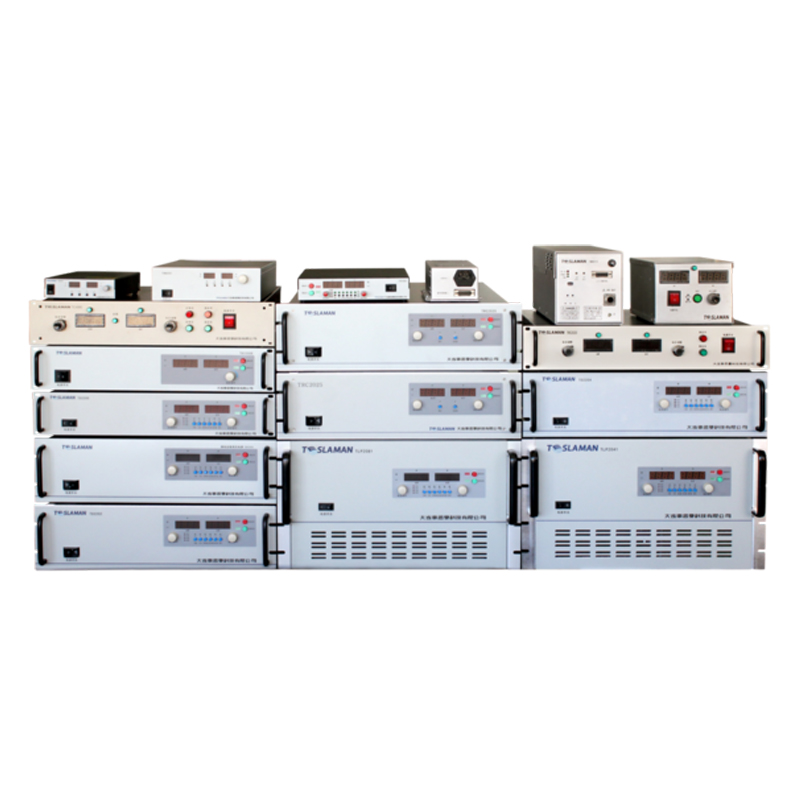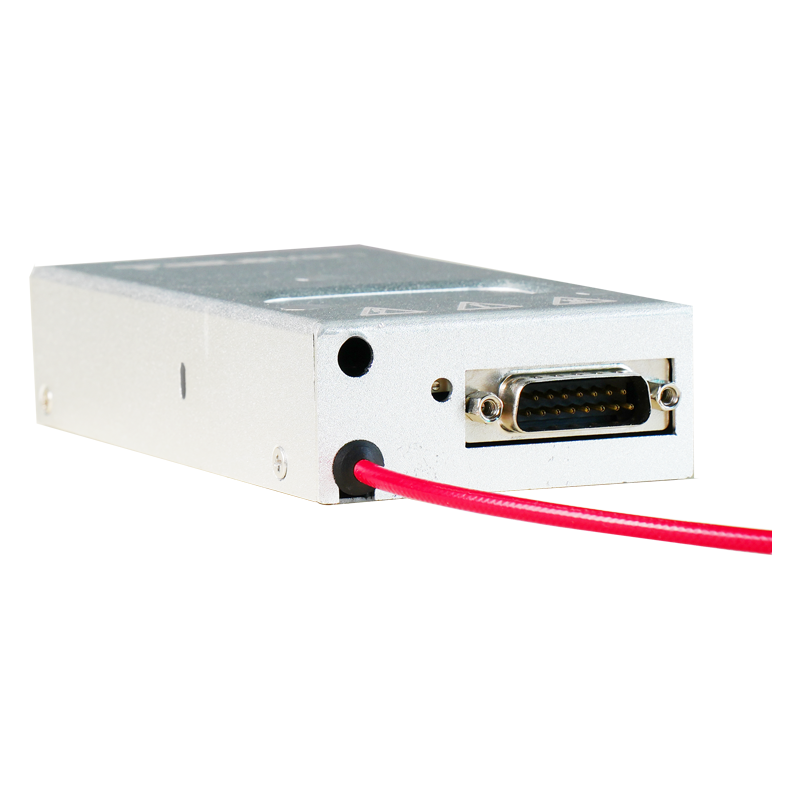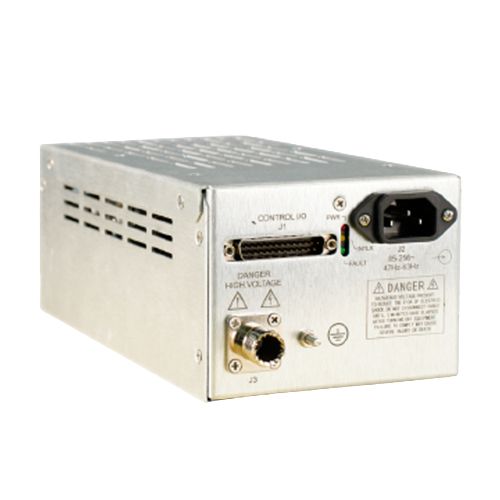








电子束系统高压电源在3D微结构加工与真空器件中的供电
An electron beam column is a chain of electrodes, each at its own potential, and the supply that feeds the chain decides how cleanly the beam lands on the workpiece. In micro-structure fabrication the beam is focused to a spot of a few nanometres and then scanned, so the landing energy and the working distance must hold steady while the pattern is written. In vacuum device manufacture the beam is used to weld, braze or anneal inside a sealed envelope, and the supply must survive a chamber that degrades slowly because of outgassing from the parts being processed.
The cathode supply is the first element. It sets the emission, and emission is exponentially sensitive to the cathode temperature and to the extraction field. A supply with a stable output to one part in ten thousand and a regulation band narrow enough that the emission loop does not chase noise gives a beam current that holds within a percent over hours. The alternative, a wide regulation band feeding a fast emission loop, gives good transient response but a current that wanders with the cathode work function, which changes as the cathode ages.
The accelerating supply is the second element. It sets the landing energy, and the landing energy sets the interaction volume in the workpiece. In micro-structure work the volume must be small and predictable, so the accelerating voltage must hold to a few parts in ten thousand and its ripple must be low at the frequencies that modulate the deflection. A ripple at the scan frequency appears in the pattern as periodic line-width variation, which is hard to correct after exposure because the correction depends on the local pattern density.
The lens supply is the third element. Magnetic lenses are driven by current, and the focal length depends on the ampere-turns. A current supply with a stability of one part in ten thousand holds the focus over a shift; a supply with a stability of one part in a thousand forces the operator to refocus between exposures, and refocusing introduces its own error. Thermal drift in the lens coil and in the supply's sense resistor dominate the long-term behaviour, so a sense resistor with a low temperature coefficient and a lens coil with a temperature sensor that trims the current give a focal length that holds without operator intervention.
Stigmation and deflection supplies are the fourth element. These are low voltage, high bandwidth channels, and their quality shows up not in the spot size but in the placement accuracy. A deflection amplifier with a settling time of a few microseconds and a linearity of one part in ten thousand places the beam where the pattern data expect it; an amplifier that is fast but slightly non-linear places the edges of a large feature a few nanometres away from the intended position, which in a dense pattern becomes a visible seam.
The vacuum environment changes the rules for insulation. At pressures below one pascal the mean free path is long and the breakdown behaviour follows the Paschen curve, with a minimum in the range where the column usually operates. Spacers and feedthroughs must be dimensioned for the low pressure branch rather than for air at atmospheric pressure, and the surfaces must be clean, because a fingerprint on an insulator is a source of field emission that grows into a flashover after a few hundred hours.
Outgassing is the slow threat. Every material in the chamber releases water and hydrocarbons, and the release rate falls with time but never reaches zero. The supply's own insulation contributes, so the choice of potting compound and the bake-out schedule matter as much as the electrical design. A bake at eighty degrees for twenty-four hours before sealing removes most of the surface water, and the residual release from the potting is then small enough that the column pressure stays in the operating range.
Cable routing inside the column deserves attention because the space is tight and the field is high. A cable that runs close to a spacer concentrates the field and creates a path for surface tracking. Routing with a defined clearance from the spacers, and using a cable with a semi-conductive layer over the insulation to grade the field, keeps the stress below the tracking threshold. The semi-conductive layer must be terminated correctly, because an unterminated layer concentrates the stress at its end.
Protection must be fast and must not nuisance trip. The column arcs occasionally during conditioning, and each arc draws a current spike that a slow protection would read as a fault. A protection that discriminates between an arc, which clears within microseconds, and a fault, which persists, avoids the nuisance trips while still removing the energy before damage occurs. The discriminator is usually a current threshold combined with a time window, and the window must be short enough that the arc energy stays below the damage threshold of the workpiece.
Records make the system maintainable. A log of cathode hours, arc counts, chamber pressure and landing energy for each exposure allows a drift in any of these to be seen before it becomes a defect. The log also allows the supply to be compared with its own history, which is the only reliable way to separate a column problem from a supply problem when a pattern suddenly shifts.
Column conditioning is a procedure rather than an event. After a bake-out the electrodes carry adsorbed water, and the first application of the accelerating voltage produces a series of small arcs as the water desorbs. Conditioning raises the voltage in steps, holds each step until the arc rate falls below a threshold, and only then moves up. The supply must report the arc rate rather than suppress it, because a suppressed rate hides the point at which conditioning has stalled. A simple counter with a rolling window of ten minutes gives the operator a number to work against.
The energy spread of the beam is influenced by the supply in two ways. Ripple on the accelerating voltage translates directly into an energy spread, and a spread of a few electron volts is visible in the spot for a low landing energy. Ripple on the cathode supply modulates the emission, which modulates the space charge, which in turn modulates the energy through the Boersch effect. The second mechanism is less obvious and often the larger of the two at low landing energies, so a supply specified only for accelerating voltage ripple can still produce a blurred spot.
Beam blanking brings a transient requirement. Blanking switches the beam on and off in a few nanoseconds, and the switching produces a current step at the column electrode. That step couples through the capacitance of the column to the accelerating supply, and the supply must absorb it without a visible voltage excursion. A local storage capacitor at the column feedthrough, sized to supply the step for the duration of the blanking edge, keeps the excursion within a few parts in ten thousand, and it also keeps the high frequency return current out of the main cable.
Maintenance intervals follow from the measurements. Cathode hours, arc counts, and the trend of the lens current together predict when a cathode will need replacement and when the chamber needs a clean. Replacement scheduled from the trend costs a planned stop of a few hours; replacement forced by a failure costs an unplanned stop that leaves a partially written workpiece, and a partially written workpiece is scrap.
A final point concerns the interface between the column controls and the supplies. The supplies should accept an external setpoint with a defined time constant, so the column controller can program landing energy changes without waiting for a supply-specific response. Interoperability of that kind is what allows a column to be rebuilt with supplies from a different maker without rewriting the control software, and it is worth more in the field than any single extra digit of resolution.
The exchange of setpoints with a defined time constant also allows a column to be requalified after a supply replacement without re-deriving the process parameters, which is the practical value of the interface specification.
The interface specification also defines how the supplies report their status, so a column controller can distinguish a supply that is still settling from one that has reached its setpoint, and that distinction prevents a pattern from being started on a column that is not ready.
A column that has been requalified against the interface specification after a supply replacement needs only a landing energy check and a stigmation touch-up, and the saving in downtime is the reason the specification is written at all.
A column built around supplies that accept a defined setpoint convention can be rebuilt piece by piece over a decade, and that longevity is the practical return on specifying the interface before the hardware.
A column that is specified in this way ages gracefully.