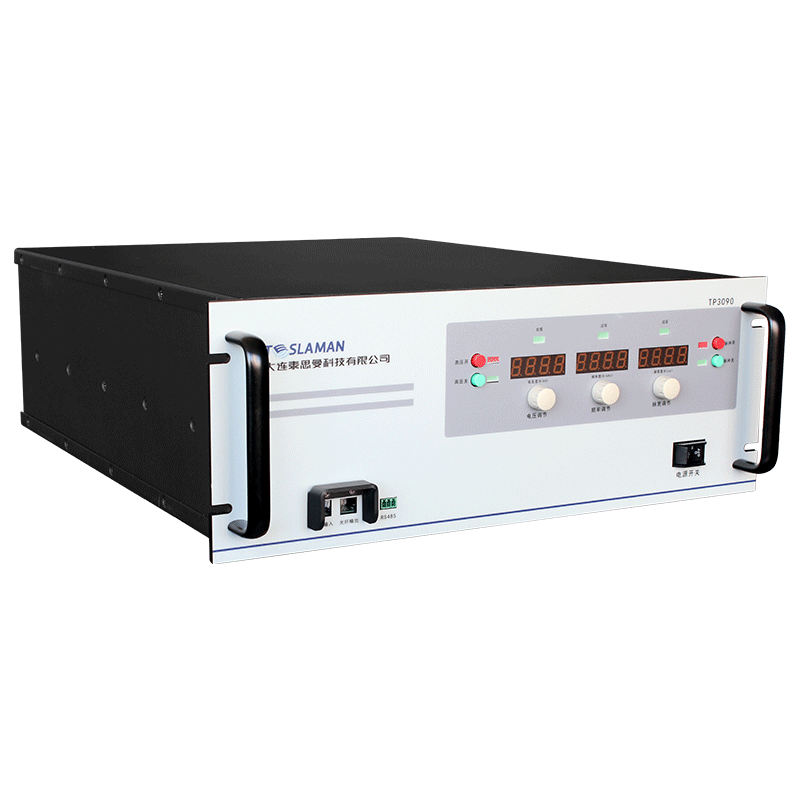
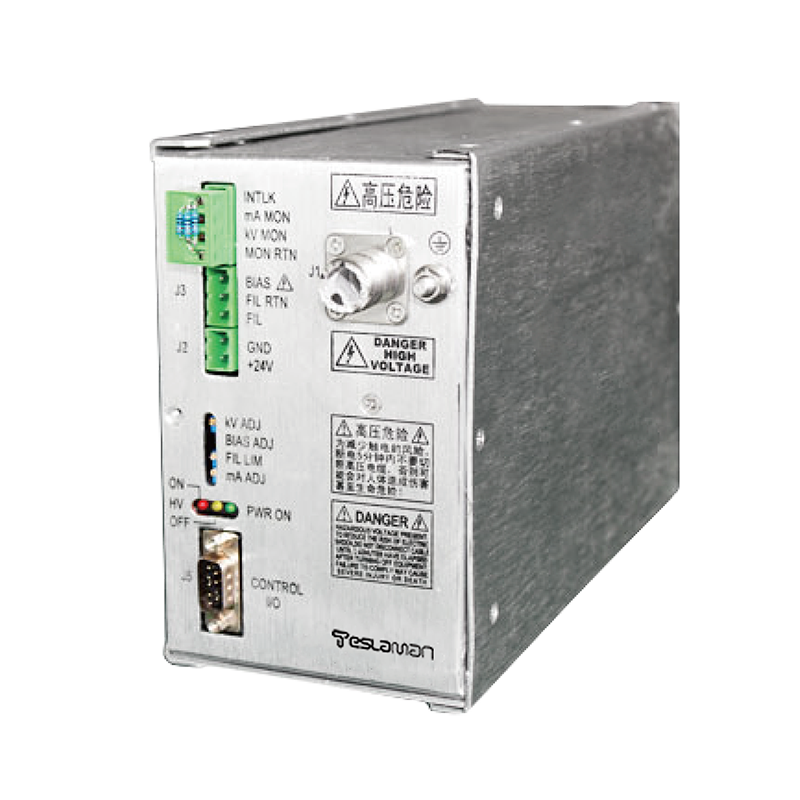
160 kV Sub-ppm Ripple High-Voltage Power Supply for Lithography E-Chucks
Holding 300 mm wafers with sub-micron flatness during EUV and DUV exposure requires electrostatic chuck voltage at 160 kV total differential with ripple below 160 mV p-p (0.1 ppm) and long-term stability better than 0.6 ppm to prevent focus drift and overlay degradation from chuck expansion or helium gap variation.
The supply uses a hybrid architecture: a master 80 kV deck built as a 31-stage parallel-fed Cockcroft-Walton multiplier driven by a 42 kHz resonant inverter regulated to ±2.8 V, followed by two identical ±80 kV floating slave decks mounted directly on the chuck ceramic that add and subtract their outputs to produce the differential 160 kV. Slave decks are powered through 1:1 high-frequency isolation transformers with triple insulation rated for 180 kV DC.
Ripple cancellation occurs in three layers: inherent low ripple from 31-stage multiplication, passive LC filtering using vacuum polypropylene capacitors with <12 ppm/°C drift, and active cancellation whereby a low-voltage linear amplifier injects counter-phase current derived from a capacitive pickup at the chuck electrode. Residual ripple is routinely measured below 92 mV p-p across 0–1.8 mA leakage range.
Stability is anchored by a temperature-controlled buried-zener reference at 7.00000 V followed by a 24-bit DAC and chopper-stabilized amplification chain. Feedback from each deck uses compensated capacitive dividers immersed in circulating fluorinert at 36.000 ± 0.002 °C. A slow digital integrator updates compensation tables every 40 minutes to null dielectric absorption and resistor aging effects.
Transient response during helium leak rate changes is handled by local 22 µF low-inductance storage directly under the chuck, replenished within 110 µs by the slave decks. Voltage settling to ±120 mV occurs in <180 µs after 1.2 mA step loads.
Multi-zone capability supports inner/outer differential control with independent ±80 kV decks sharing the same master reference, achieving zone-to-zone matching better than 0.28 ppm over 72-hour exposures.
These sub-ppm supplies routinely maintain chucking force variation below 0.07 % across full EUV mask and wafer cycles, enabling overlay below 1.1 nm 3-sigma and focus uniformity supporting depth-of-focus margins under 42 nm in high-volume 3 nm logic production.