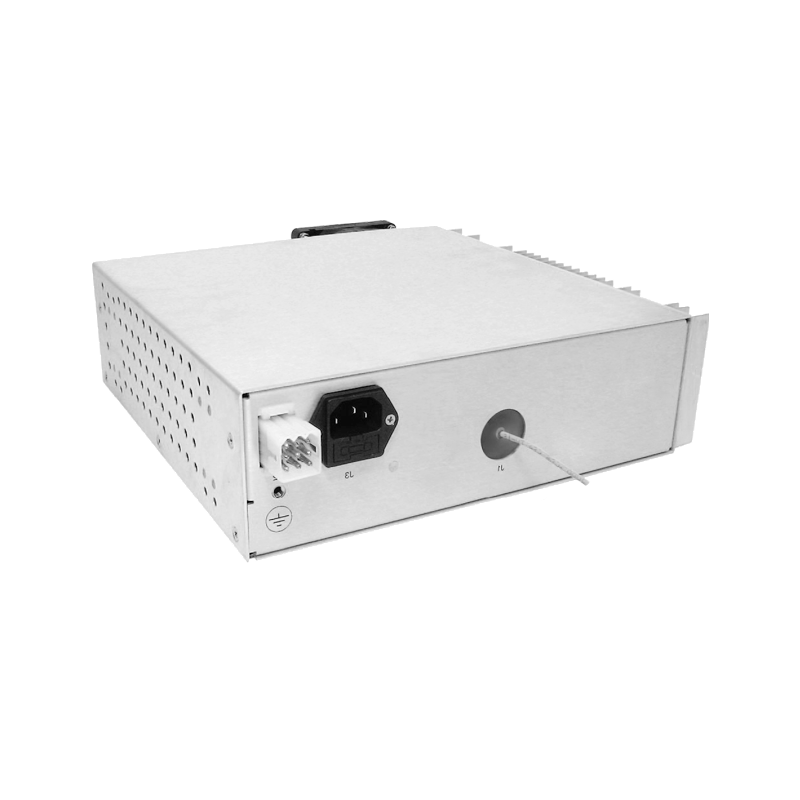
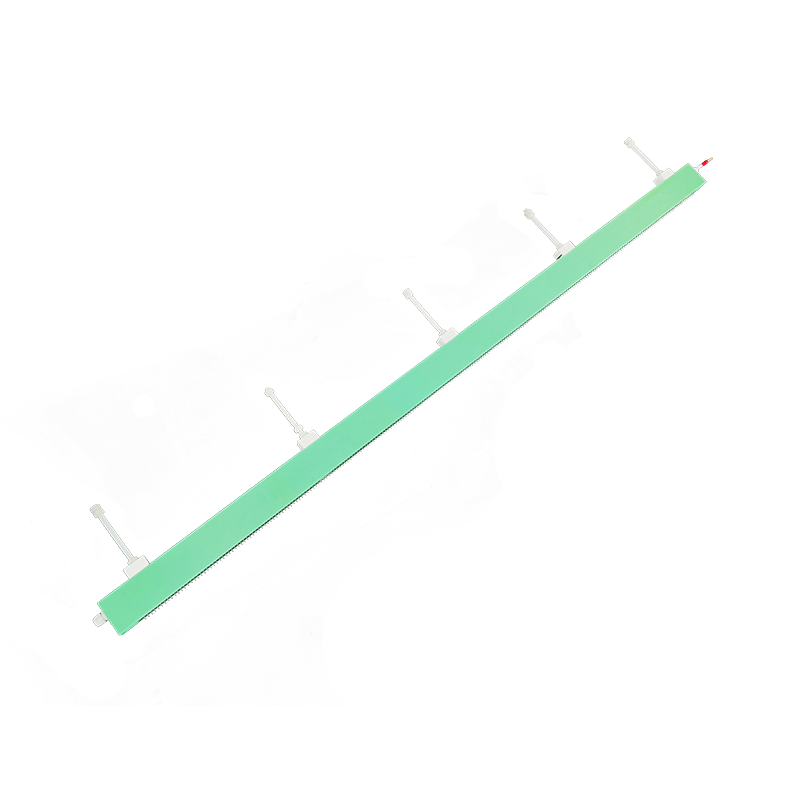
160 kV Parallel-Triggered Flash High-Voltage System for Ampoule Inspection
High-speed pharmaceutical ampoule inspection lines operating at 1200 vials/minute require multiple xenon flash tubes synchronized within 180 ns to deliver 42–68 J optical energy in <8 µs while freezing motion at belt speeds up to 4.8 m/s. Parallel-triggered 160 kV systems therefore combine a single high-power charging supply with distributed trigger and simmer modules to guarantee simultaneous light output across four to eight lamps with jitter below 120 ns.
The charging supply uses a 48 kHz series-resonant converter that maintains a common 1620 V storage capacitor bank within ±1.2 V, supporting 20 Hz flash rate with >42 % energy margin. Energy per flash is metered by a precision current integrator that terminates charging at exactly 68.2 J regardless of line voltage variation or capacitor aging.
Triggering employs eight independent 16 kV solid-state pulse generators built around cascaded avalanche MOSFET stacks fired simultaneously from a single fiber-optic command pulse. Delay matching is achieved by factory trimming of fiber lengths to ±12 mm and on-board 40 ps resolution digital delay lines calibrated weekly using an internal photodiode array. Resulting optical onset jitter remains <98 ns lamp-to-lamp over 500 million flash life.
Simmer current is supplied individually by 280 V DC–DC converters with active current regulation at 180–320 mA, ensuring instant conductivity even after 90-minute idle periods. Simmer power is automatically reduced to 42 mA during continuous operation to minimize electrode erosion while maintaining <1.1 µs trigger-to-light delay.
Multi-angle inspection for particles and cosmetic defects uses staggered flash sequencing: four lamps fire in pairs separated by 420 µs, enabling dark-field and bright-field imaging with a single high-speed camera without motion blur. Energy per lamp is independently adjustable ±8 % via primary-side current limit to balance illumination across viewing angles.
Arc-down protection monitors lamp voltage during the first 1.8 µs of discharge; abnormal collapse triggers immediate energy dump into a parallel MOSFET clamp, limiting total dissipated energy to <7 J and preventing envelope rupture in the sterile zone.
These parallel-triggered systems routinely achieve >99.9998 % simultaneous flash success and illumination uniformity supporting detection of 18 µm particles in 2 mL ampoules at full production speed with zero false rejects over 28-day continuous runs.