Compact Neutron Tube High Voltage Power Supply Integration
Sealed neutron generators, or neutron tubes, are critical components in applications ranging from oil well logging and security screening to neutron activation analysis. These devices operate on the principle of deuterium-deuterium (D-D) or deuterium-tritium (D-T) fusion, where ions are accelerated to high energies and directed onto a target containing the opposite isotope, producing neutrons through nuclear reactions. The core of this process is a multi-stage high-voltage system that must fit within the severe spatial, thermal, and reliability constraints of a sealed, portable tube. The integration of the high-voltage power supply—encompassing the ion source, accelerator, and target bias circuits—into a compact, robust, and efficient package is a defining engineering challenge that directly impacts the tube's output yield, stability, lifespan, and field-deployability.
A neutron tube requires several distinct high-voltage potentials, each with stringent specifications. First, the ion source, typically a Penning or radio-frequency type, requires a stable discharge voltage of several hundred to a few thousand volts to create and maintain a plasma from the deuterium/tritium storage reservoir. This supply must be current-limited and highly reliable, as source instability directly translates into neutron output fluctuation. Second, and most critical, is the accelerator supply. This provides the tens to hundreds of kilovolts necessary to accelerate ions from the source extraction aperture toward the target. The voltage stability here is paramount; a 0.1% drift can alter the fusion reaction cross-section, changing neutron yield. This supply must also be designed to withstand occasional internal arcing within the tube, which is an inherent failure mode as the tube ages and outgasses. Finally, the target itself may be held at a slight positive bias to suppress secondary electron emission, requiring another precisely controlled voltage rail.
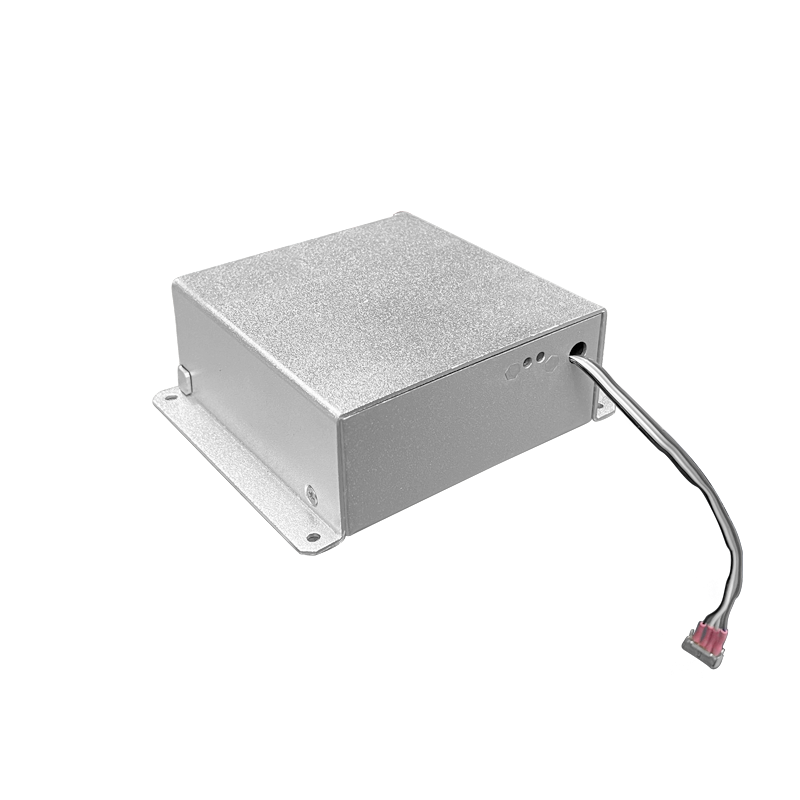
The integration challenge revolves around miniaturization without compromising performance or isolation. Traditional approaches using separate, discrete high-voltage modules connected by external cables are too bulky and prone to corona discharge in compact housings. The modern solution is a fully integrated, potted assembly. All high-voltage generation stages—often based on resonant flyback or push-pull switching topologies using custom high-frequency transformers—are designed on a single multi-layer printed circuit board (PCB) or a set of closely stacked boards. The magnetic components are custom-wound using high-temperature insulation and designed for optimal volumetric efficiency. Every component is selected for its high-voltage rating, low leakage current, and ability to operate in a high-temperature environment, as the entire assembly will be encapsulated in a thermally conductive but electrically insulating epoxy resin.
This potting serves multiple critical functions: it provides structural integrity against vibration and shock (essential for well-logging tools dropped down boreholes), it eliminates air pockets where corona could initiate, and it enhances heat transfer from the power semiconductors to the tube's outer casing. However, it also creates a "one-shot" design with no possibility of repair, making reliability and design-for-manufacturing paramount. Thermal management is the primary limiting factor. The power supply's efficiency, while high, is not perfect. Losses generate heat inside the potted block, which must be conducted through the epoxy and the tube's metal housing to the environment. Careful thermal modeling ensures that no component, especially the high-voltage diodes and switching transistors, exceeds its junction temperature during continuous or pulsed operation. This often dictates the maximum duty cycle or average neutron output of the tube.
Electrical isolation within this dense package is another extreme challenge. Creepage and clearance distances on the PCB are maximized through intricate slotting and the use of guard rings. The potting compound's dielectric strength is a key parameter. The integrated design must also include comprehensive monitoring and protection circuits for each voltage rail, capable of detecting over-current, arc events, and overtemperature, and executing a safe shutdown sequence. For pulsed neutron tubes, the timing and sequencing of the ion source and accelerator supplies must be precisely synchronized on the microsecond scale to generate a sharp neutron pulse, requiring low-jitter control logic embedded within the same potted assembly.
The outcome of successful integration is a neutron generator that is remarkably self-contained. The user interface may require only a low-voltage DC input (e.g., 24V or 48V) and a digital communication line for control. The complexities of generating and regulating multiple kilovolt rails are hidden within a module that is little larger than the neutron tube itself. This enables deployment in handheld chemical, biological, radiological, nuclear, and explosive (CBRNe) detectors, downhole tools with diameter restrictions, and mobile imaging systems. The integrated power supply becomes an inseparable, enabling organ of the neutron tube, dictating its operational envelope and reliability in the field.